Assume a sharp interface, uniformly mixed warm upper air with fixed reduced gravity , cool ambient air entering below, no wind, no wall heat exchange, negligible source volume, and quasi-steady Boussinesq flow through the small vents. Neglect the interior approach velocity. The hydrostatic buoyancy head between the two vents is .
Both openings carry the same volume flux . The discharge coefficient law gives a pressure loss at each opening. Adding the two losses gives , not the single-opening value with an extra factor . Cool replacement air displaces the warm layer, so . With , integrate to obtainThe ideal model sets thereafter. The formula applies only while the parenthesis is nonnegative; squaring a negative value would invent renewed filling. A finite aperture or a diffuse final interface invalidates the idealization near exhaustion.
Write for the height of the warm-layer interface above the heat source. A negligible-volume point heat source supplies a pure plume with conserved buoyancy flux . The given plume buoyancy implies its volume flux at the interface isAt steady displacement ventilation, the plume feeds the warm layer at the same rate it empties through the upper vent: . The upper-layer buoyancy balance gives , soEliminate and to getThe height equation has one solution with . Its height is independent of source strength in this ideal pure-plume model, while its warm-layer density contrast increases as . The sketch shows cool replacement air below, an entraining plume through that region, and the upper mixed layer feeding the ceiling vent.
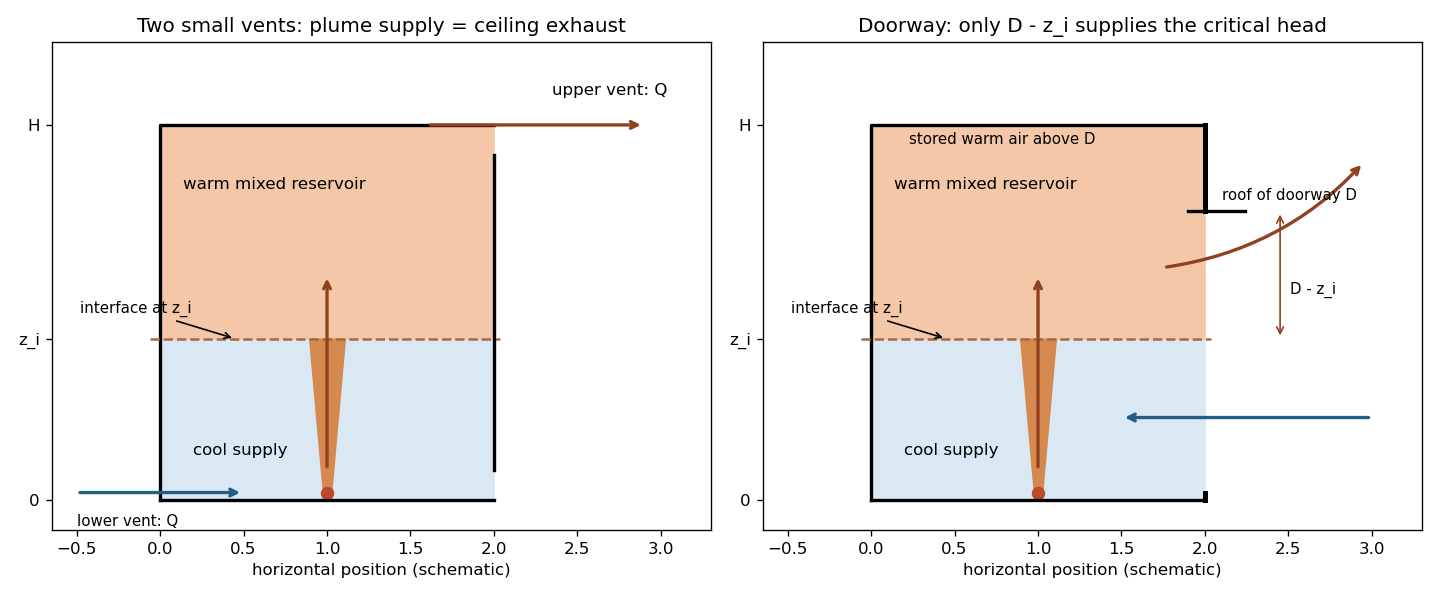
Plume-fed displacement ventilation through two vents and through a hydraulically controlled upper doorway
. Details. For a one-layer shallow water flow the Froude number is . Supercritical flow has , so both characteristic speeds point downstream. Subcritical flow has , allowing information to travel upstream. At hydraulic control the flow passes through at a geometry-induced critical section; that condition fixes discharge in relation to upstream head when the exit is free.
For escaping light air, reflect the usual lower-layer picture vertically: a lowered doorway roof acts as an inverted broad-crested weir. The lower return flow can be ignored dynamically only while it has a sufficiently large available area and small velocity. If the warm interface lies far below the doorway top, the cool inflow occupies a substantial dynamically active fraction of the opening; its inertia and pressure cannot be replaced by a motionless deep ambient. A two-layer exchange model is then required. If the warm layer reaches below the doorway bottom, the assumed separate lower replacement path is lost entirely.
Outside a freely controlled doorway the outgoing current becomes supercritical and then rises rapidly. That upturn violates the small-vertical-acceleration shallow water approximation, but it does not alter the upstream discharge as long as it does not submerge or back-pressure the control. Information cannot return through the supercritical outflow to the critical section. A blocked conservatory or a drowned doorway is different and can move the control upstream.
Assume a steady inviscid light layer of constant reduced gravity under a roof at , with depth , interface , and slowly varying width . The ambient is deep and approximately motionless; neglect entrainment, friction and approach variations across the section. Let be pressure relative to the ambient hydrostatic pressure. Then in the light layer and when the ambient pressure offset is chosen zero. The steady Bernoulli equation along a light-fluid streamline is . With , this becomes the hydraulic flow in an inverted channel energyAt fixed and fixed flux,The energy curve has a minimum at , with . Above that minimum there are a thin supercritical branch and a thick subcritical branch. A lowered roof increases ; it is the inverted counterpart of raising a bed crest.
For a single smooth obstruction in a constant-width channel, energy exceeding its largest permits entirely subcritical passage or entirely supercritical passage, depending on the boundary data. At the limiting head a subcritical upstream current can pass through critical flow at the roof minimum and emerge supercritical; this is the usual freely discharging control. A reverse transcritical branch would need suitable imposed downstream data and is not the usual free discharge. If the supplied head is below the required minimum, no smooth steady flow with that flux exists: upstream adjustment changes the discharge or head. A supercritical current encountering deep downstream warm fluid can undergo a hydraulic jump to the subcritical branch, with an energy loss rather than a second conservative branch switch.
For a rectangular section the jump conserves and . Hence for , and the lost specific energy is . This remains positive after vertical reflection. The energy and profile sketches label the roof and the lower boundary of the light layer explicitly.
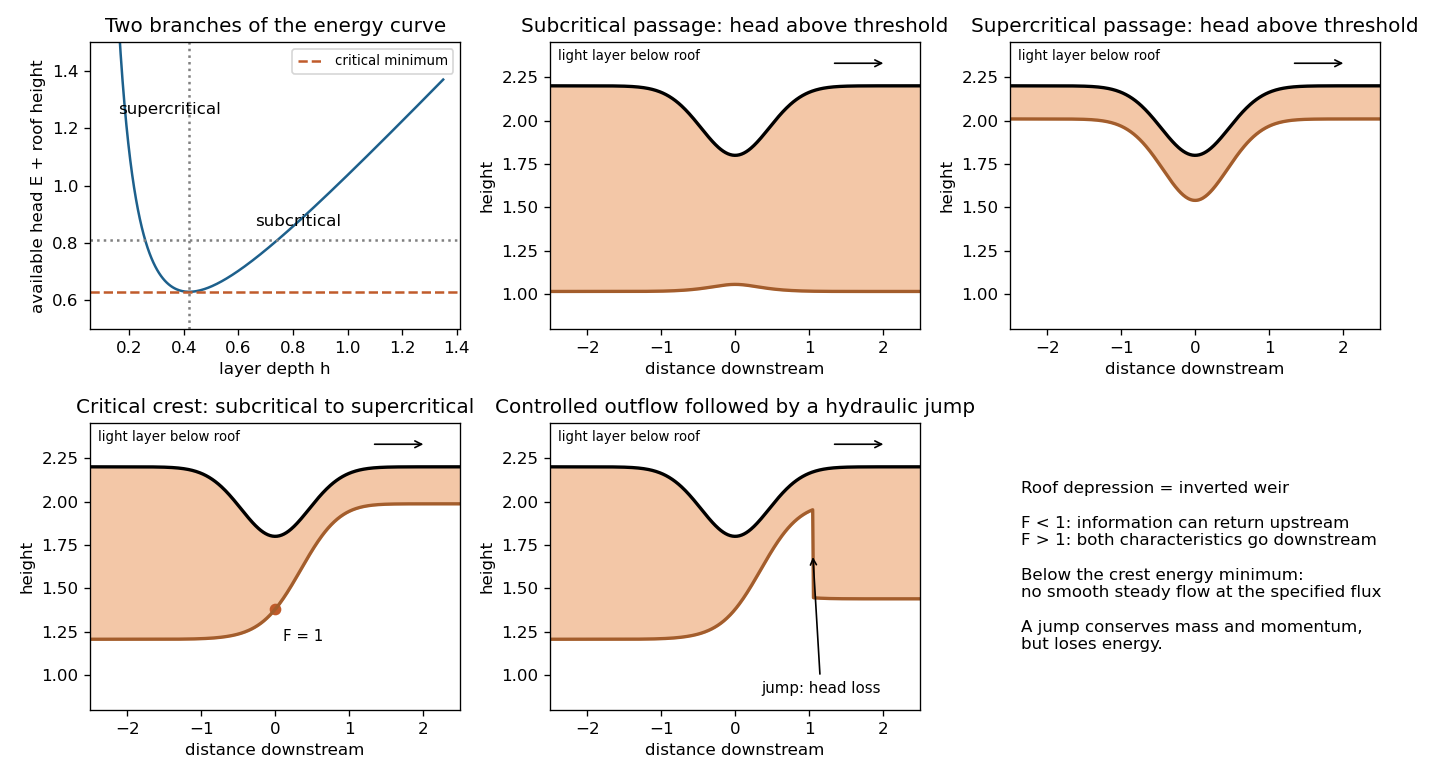
Energy branches and subcritical, supercritical, controlled and hydraulic-jump flows beneath a lowered roof
. Details. The room's nearly motionless upper reservoir has interface . A doorway roof at height has available light-layer head . Evaluate the Bernoulli equation in the room and at a freely controlled doorway: upstream and at its critical section. Therefore andThis is the ideal broad-crested weir law, not a small-orifice law with . A nonideal doorway would require its own measured loss correction.
When the floor heat source is on, volume conservation and buoyancy flux conservation still give and . Combine these with the doorway relation to obtain the plume-fed doorway ventilation equilibrium:There is one interface-height root in the indicated interval. The result is physically appropriate only if its upper outflow is thin enough for the one-layer doorway model to remain valid.
If , air in the volume above the doorway is part of the upper thermal reservoir and can store heat and alter transients. But its extra depth does not add available head at the doorway: only enters the critical condition. In the steady ideal well-mixed model it shares the same density as the outflow. Treating the whole as the doorway head would overestimate discharge.
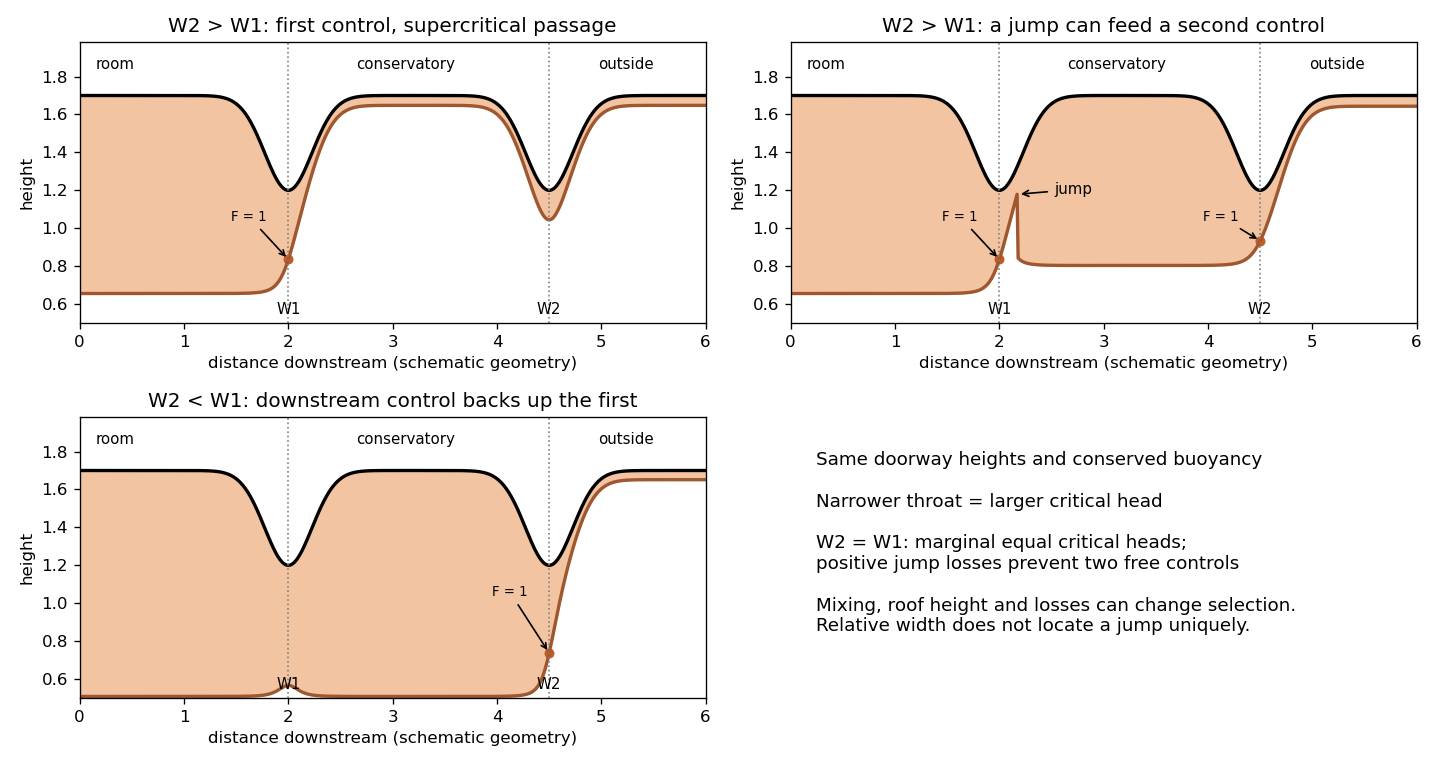
Let be the first doorway width and the conservatory's outer doorway width. For a hydraulic comparison assume the same reduced gravity and conserved volume flux through both, negligible losses except at any hydraulic jump, and roofs at the same doorway height . Their critical depths and limiting energies areThe narrower doorway has the larger minimum required head. This gives the possible two successive hydraulic controls rather than a universal jump location.
If , the first doorway can remain the discharge control. Its supercritical outflow may pass through the wider second doorway without being controlled there. Alternatively, if warm air accumulates in the conservatory, the first jet can undergo an inverted hydraulic jump, feed a subcritical intermediate reservoir, and accelerate to a second critical section at the outer doorway. The wider second throat has a lower critical energy, so the difference can accommodate the positive head loss at the jump. Whether this second configuration occurs, and where its jump stands, depends on conservatory dimensions and downstream head.
If , an outflow set solely by critical flow at the first doorway lacks the energy to pass the narrower second doorway: , and a jump cannot increase energy. Warm air backs up in the conservatory. The downstream doorway becomes the dominant control, and the first doorway is subcritical or submerged by the intermediate layer. During adjustment an upstream-moving bore or jump can propagate towards or through the first doorway. A permanently freely controlled first doorway followed by a narrower same-height control is impossible under the conserved-buoyancy assumptions.
If , the equal-energy idealization is marginal. Both throats can reach critical conditions in a lossless configuration, but any positive interposed jump loss prevents two independent critical sections at the same flux and buoyancy. Small losses or differences in effective discharge geometry select the downstream restriction and can drown the first. A constriction should not be assumed controlled simply because it exists.
The sketches show these admissible regimes. Mixing with cool conservatory air, heat loss, finite return-flow inertia, different roof elevations or aperture losses change the comparison and need additional data. In particular relative widths alone do not determine the actual conservative-room temperature or the position of a jump.


Articles by others on the same topic
There are currently no matching articles.