An integrating factor for a differential one-form is a nonzero function for which is an exact differential, say . Then solutions lie on level sets . Locally, the compatibility condition is .
Here multiplication by , which is nonzero for , producesThe initial condition makes this first integral equal to . Taking the positive branch yields the solutionon the connected interval containing zero where the radicand is positive. This domain restriction matters because the original differential equation is singular at .
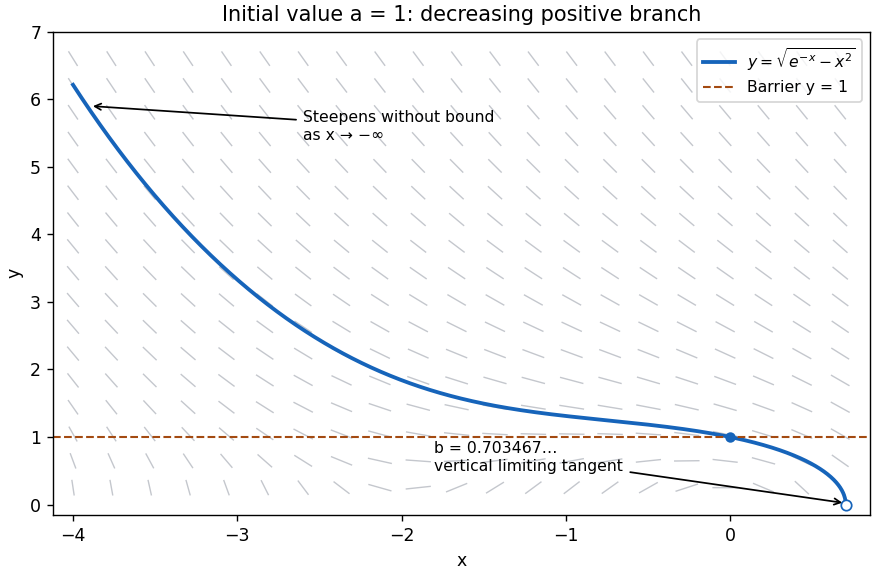
Completing the square gives . As , the differential equation consequently impliesAt , . Thus, moving a little to the left from , the curve rises above . Throughout every segment of the direction field points downwards as increases, by the inequality above. Tracing backwards therefore makes rise further, so it cannot return to . This graphical barrier argument proves and for every on the solution. The explicit first integral also shows this branch extends throughout : writing , the minimum of is , so for . Including the initial point, for all .
For the curve is on , where the strictly increasing function has the unique positive root at . The curve decreases through with slope and reaches only as a limiting endpoint. Its derivative isAs , and . As , the numerator tends to and the denominator to zero from above, so again . More precisely, at the endpoint. Both ends have the requested unbounded negative slope.

Articles by others on the same topic
There are currently no matching articles.