A normalizable bound state has : the potential is nonnegative, while exponential decay is needed on the infinite right-hand region. Set and . The hard-wall condition and decay selectContinuity at has already been used. Since the finite step contains no delta interaction, integrating the Schrödinger equation across it also requires derivative continuity. Thus , givingThe ground-state solution uses the first branch and has no internal node. It starts at zero, rises to one maximum inside the well, decreases to a positive value at , and joins smoothly onto a decaying exponential tail.
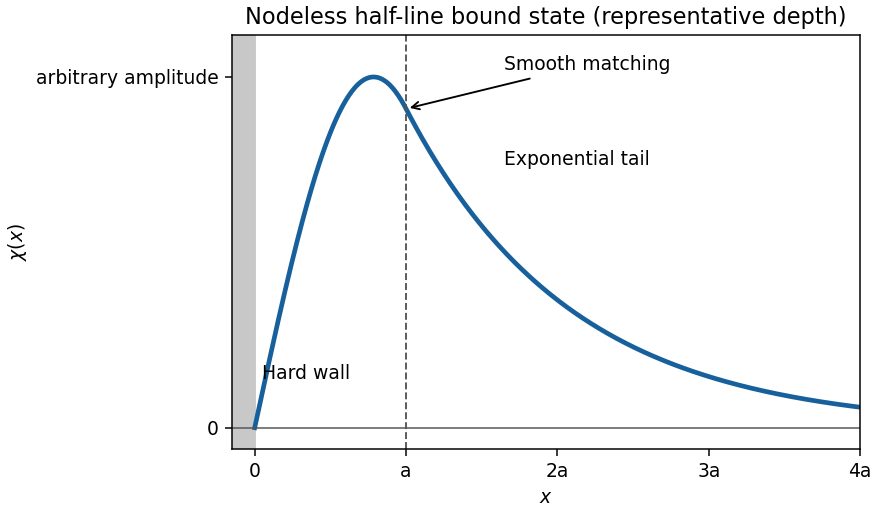

To see the precise existence condition, set and . The first-branch matching equation gives on . This increases strictly from to infinity, since its derivative is . Thus the bound ground state exists exactly when , or , as in the bound-state thresholds for a square well with one hard wall. At equality and the exterior solution is not square-integrable. Below it there is no normalizable energy eigenfunction of the requested ground-state type. The sketch assumes the binding condition and uses one representative solution, not a specified numerical well depth.
Articles by others on the same topic
There are currently no matching articles.