The Lorentz factor is . Length contraction makes the moving javelin's length in the shed frameThis measures its two endpoints at the same shed-frame time.
The shed moves relative to the javelin frame at the same speed, so its simultaneous length there isThe javelin retains its proper length . The two statements use different simultaneity slices, as prescribed by relativity of simultaneity.
Choose event , when the trailing end reaches the entrance, as and as the primed origin. Write , . Before impact, the shed-frame worldlines are entrance , back , trailing end , and leading end . The Lorentz transformation isThus in the javelin frame the ends have and , while the entrance and back have and . These four lines in each frame produce the requested spacetime diagrams. The diagrams show initial motion; dashed portions extrapolate that motion beyond first impact and are not a model of collision dynamics.
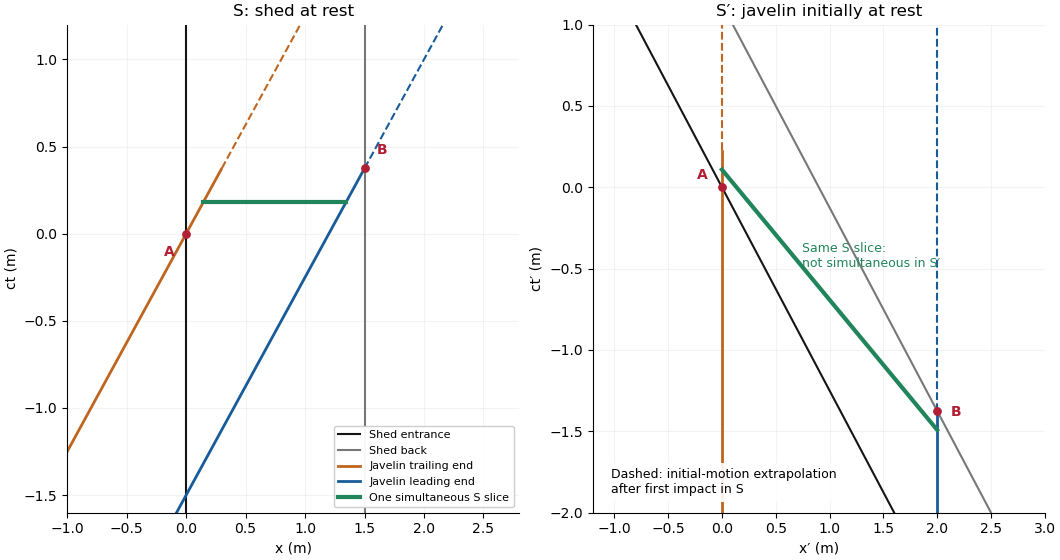
Javelin and shed worldlines in both inertial frames, with entrance event A, first impact B and a simultaneous shed-frame containment slice
. Details. 
In the shed frame, the leading end reaches the back when , giving . Transforming both events yieldswith every coordinate in metres. The invariant interval isThus the events are spacelike separated. Event occurs first in the shed frame, but occurs first in the javelin frame; this is allowed for spacelike separation.
In the shed frame there is a pre-impact interval during which both ends lie inside the shed, since its simultaneous moving length is only . Those simultaneous endpoint events do not remain simultaneous after a boost. In the javelin frame the front hits the back before the rear enters, and there is no simultaneous pre-impact containment of the full rod in a shed. This is rod containment and simultaneity, not inconsistent length measurements.
After impact, the front's motion changes while the rear cannot respond instantaneously: stress signals propagate no faster than light. A claim that the entire javelin stops rigidly at event is inadmissible. Actual post-impact compression or fracture needs material data and is not represented by the straight-line extrapolations in the diagrams.
Articles by others on the same topic
There are currently no matching articles.