For a closed piecewise smooth contour in a domain, null-homologous there and avoiding the poles of a meromorphic function , the residue theorem iswhere is the winding number and the sum runs over enclosed poles with their indices. Suppose now is meromorphic and has neither zeros nor poles on . At a zero or pole , write with holomorphic and nonzero, where for a zero and for a pole. Thenso its residue is . Substituting into the residue theorem and changing variables along the image contour gives the argument principle:For a positively oriented simple boundary, this is the number of zeros minus poles inside, counted with multiplicity. The winding-number form also applies to self-intersecting image paths.
Write . The trigonometric sum formulas giveThus the imaginary part is zero either when , , or when , . These two lists are disjoint. At the latter four points . At the former six points the real values, in increasing angular order, areEquivalently, maps to , to , to , to , and the four roots of map to zero. These are all the unit-circle points with real image.
The image contour has polar representation . It is invariant under complex conjugation and under reflection through the origin. As runs from zero to , the successive real-axis visits areat angles . To specify the crossing direction, differentiate:Its imaginary component is at the point , at , at either visit to , and at either visit to . At a visit to zero it is , nonzero for each of the four angles. Therefore all these visits are transverse crossings of the real axis, even though different arcs share the same image point.
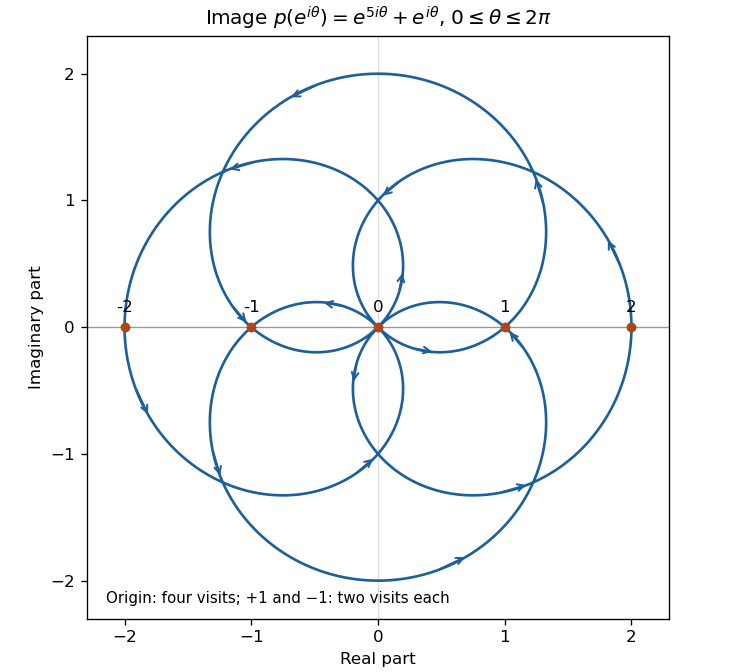
Oriented image of the unit circle under z to the fifth power plus z, showing its real-axis crossings
. Details. 
Let count roots in the open unit disk. A boundary crossing can occur only at the real values found above, so the count is constant between them. Also , because the polynomial is odd. At , has one root inside and four on the circle, giving .
For small positive , the root near zero stays inside. At each boundary root , , so implicit differentiation gives . The radial crossing test for polynomial root counts isThe two roots with positive real part enter and the other two leave. Hence for .
At , the boundary roots are . Since , their radial derivative is . Both leave as increases, so the count becomes one; at itself they are excluded, also leaving one interior root. At , the remaining boundary root has radial derivative and leaves. For no interior root is possible, since in the open disk. Combining these facts and odd symmetry givesThis also gives the corresponding winding numbers of the image contour away from its crossings. Boundary roots are excluded at the crossing values; using a nearby winding number at would incorrectly count two extra roots.
Articles by others on the same topic
There are currently no matching articles.