Use , and in the sl2 Lie algebra, so , , and . On the symmetric power, a monomial has weight . The tensor product of Lie algebra representations adds weights, because acts as .
Put and for . These eight vectors are a basis of ; their weights are and . Thus the weight-space decomposition and a weight basis for each summand areIn particular , with dimensions summing to eight. Here the subscripts are the eigenvalues of the chosen Cartan element .
Write for the irreducible representation of with highest weight , dimension and weights . The weight diagram below records multiplicities at weights .
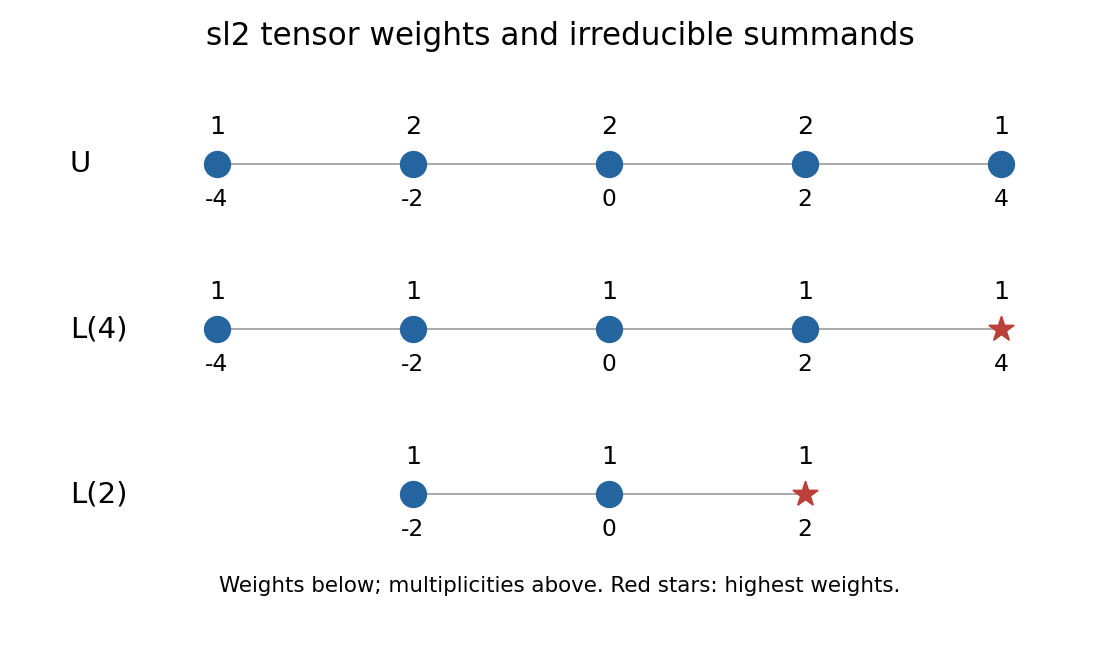
The unique top weight four forces one copy of , by complete reducibility of semisimple Lie algebra representations. Removing its five weights, each with multiplicity one, leaves weights with multiplicity one, exactly the character of . HenceThe two lower rows draw their separate weight diagrams. The explicit invariant copies constructed next establish the Clebsch-Gordan splitting of a defining module and its cubic symmetric power within itself.
In the notation of part (i), the tensor raising operator and lowering operator act bywith terms beyond the stated index range omitted. Both and are killed by , and have respective weights four and two. They are the desired highest-weight vectors.
For , successive lowering givesThus a basis of the five-dimensional summand, in descending weight order, isFor , the successive vectors are , and . HenceThese spans are invariant under . The sl2 highest-weight lowering formula gives , so all interior raising coefficients in either chain are nonzero. Any nonzero submodule therefore contains the highest vector and then the whole chain; each span is irreducible.
At the shared weights , the two displayed summand vectors are independent: their coefficient determinants in the original weight bases are . At weights only the five-dimensional summand occurs. Consequently the eight displayed vectors form a basis of , proving that these are complementary submodules, not only modules with the right dimensions.
Let , and let be the weight of a representation defined by . Since the trace is zero, . The dual representation gives weight to . PutTaking gives an eighteen-vector tensor product basis. Its weight is .
For explicit coordinates use the usual simple coroots and , and write each weight as . Then , and . Collecting equal weights gives every weight space:The first six weights are with ; the next three are ; the last three are the defining weights . Thus there are nine multiplicity-one weights and three multiplicity-three weights, giving total dimension .
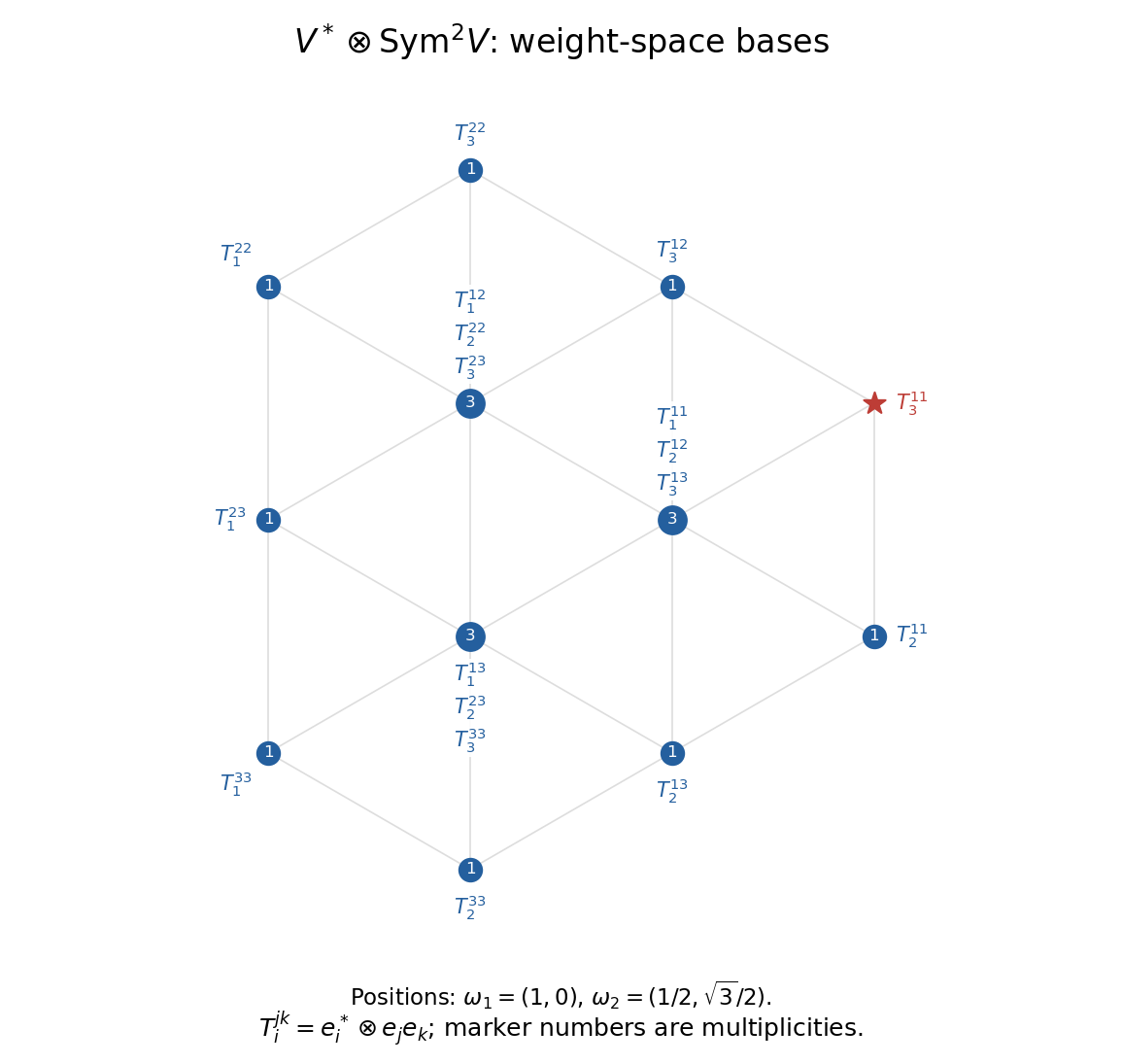
The planar coordinates are with and , so the weight diagram uses an equilateral root geometry rather than orthogonal Dynkin-coordinate axes. Every point is labelled with its complete weight-space basis.
Define an equivariant contraction byThis uses the natural dual pairing, so it commutes with the Lie algebra representation. Also define . The identity tensor is invariant, making equivariant. Direct contraction gives . Thus is injective and is surjective, andis a direct decomposition into and . In particular and is a defining irreducible module of highest weight .
For the usual upper-triangular choice of positive roots, lies in the kernel and is killed by both simple raising operators . Its highest weight is , with Dynkin labels . The highest-weight classification and complete reducibility give an irreducible copy generated by this vector. The Weyl dimension formula for isso . It fills the entire kernel. Therefore the sl3 decomposition of the symmetric-square dual tensor product, with its tensor factors exchanged, isThe weight diagrams below record both summands. Their labels use for and ; these are the weight bases detailed in part (iii).
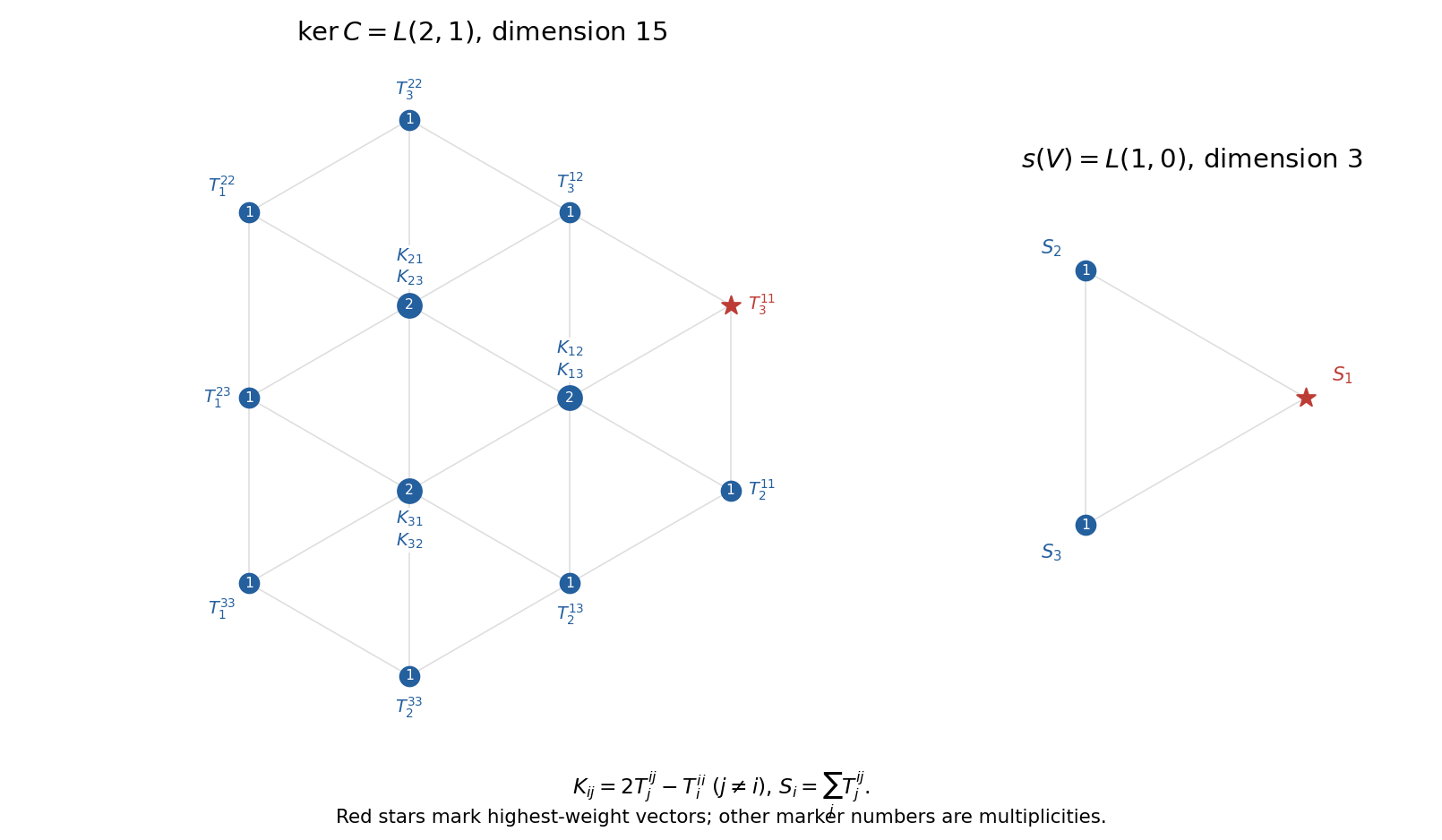


The nine one-dimensional weight spaces from part (i) all lie in , because the dual index differs from every polynomial index. Their bases remain at weight for , and at weight for three distinct indices .
At weight , the full space has basis , where are the two other indices. Their contractions are . Thus the contraction kernel has the independent basis and . Explicitly the weight basis of the trace-free symmetric-square dual tensor module is completed byTogether with the nine single vectors, these give fifteen independent vectors. They are precisely the and labels on the fifteen-dimensional weight diagram.
The defining summand has only the following three weight spaces:Each is nonzero, has its indicated weight and satisfies . These are the labels on the three-dimensional diagram. The highest-weight vectors in the two summands areAt each repeated weight, the two kernel vectors together with span the original three-dimensional weight space, since the kernel has dimension two and . Thus the displayed diagrams specify all submodule weight-space bases.
Articles by others on the same topic
There are currently no matching articles.