Let , and let be the weight of a representation defined by . Since the trace is zero, . The dual representation gives weight to . PutTaking gives an eighteen-vector tensor product basis. Its weight is .
For explicit coordinates use the usual simple coroots and , and write each weight as . Then , and . Collecting equal weights gives every weight space:The first six weights are with ; the next three are ; the last three are the defining weights . Thus there are nine multiplicity-one weights and three multiplicity-three weights, giving total dimension .
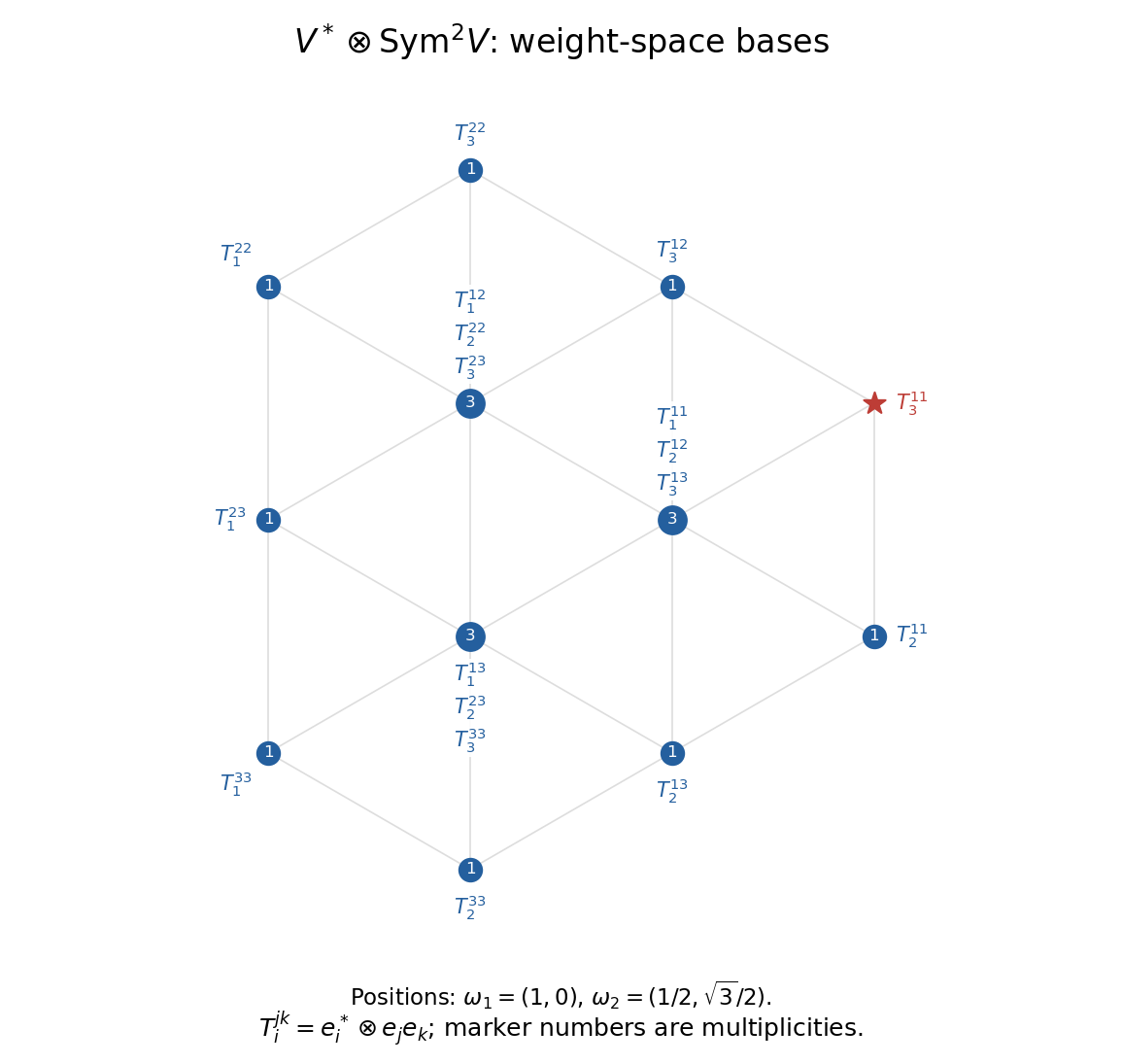
The planar coordinates are with and , so the weight diagram uses an equilateral root geometry rather than orthogonal Dynkin-coordinate axes. Every point is labelled with its complete weight-space basis.
Define an equivariant contraction byThis uses the natural dual pairing, so it commutes with the Lie algebra representation. Also define . The identity tensor is invariant, making equivariant. Direct contraction gives . Thus is injective and is surjective, andis a direct decomposition into and . In particular and is a defining irreducible module of highest weight .
For the usual upper-triangular choice of positive roots, lies in the kernel and is killed by both simple raising operators . Its highest weight is , with Dynkin labels . The highest-weight classification and complete reducibility give an irreducible copy generated by this vector. The Weyl dimension formula for isso . It fills the entire kernel. Therefore the sl3 decomposition of the symmetric-square dual tensor product, with its tensor factors exchanged, isThe weight diagrams below record both summands. Their labels use for and ; these are the weight bases detailed in part (iii).
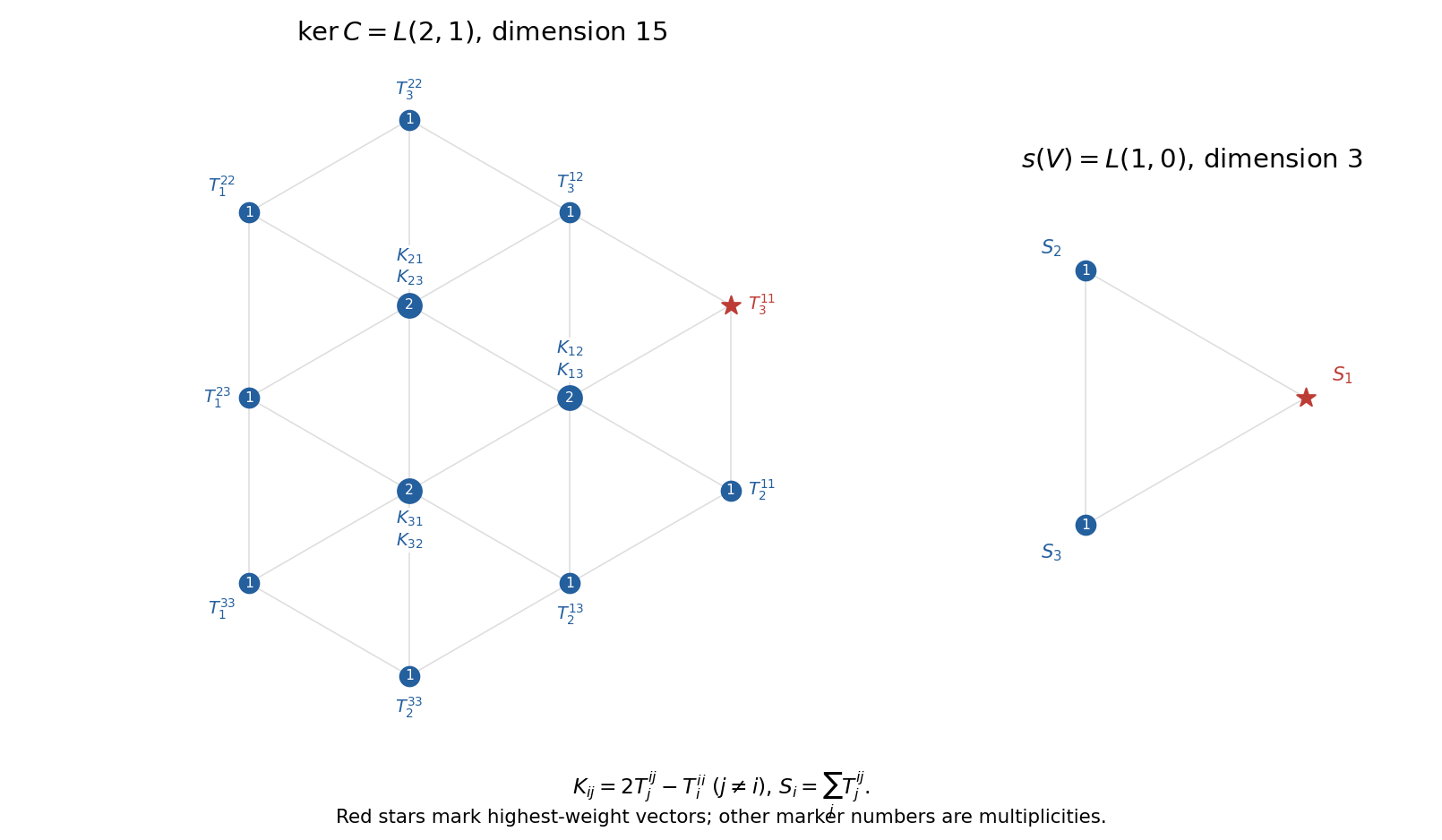


The nine one-dimensional weight spaces from part (i) all lie in , because the dual index differs from every polynomial index. Their bases remain at weight for , and at weight for three distinct indices .
At weight , the full space has basis , where are the two other indices. Their contractions are . Thus the contraction kernel has the independent basis and . Explicitly the weight basis of the trace-free symmetric-square dual tensor module is completed byTogether with the nine single vectors, these give fifteen independent vectors. They are precisely the and labels on the fifteen-dimensional weight diagram.
The defining summand has only the following three weight spaces:Each is nonzero, has its indicated weight and satisfies . These are the labels on the three-dimensional diagram. The highest-weight vectors in the two summands areAt each repeated weight, the two kernel vectors together with span the original three-dimensional weight space, since the kernel has dimension two and . Thus the displayed diagrams specify all submodule weight-space bases.
Articles by others on the same topic
There are currently no matching articles.