Take a finite set of source-sink pairs , with fixed demands , and finitely many permitted routes for each pair. Every positive demand must have at least one available route. Let be route flow and link throughput. The source-sink route incidence matrix and link-route incidence matrix arefor simple routes; if a route traverses a link repeatedly, its entry counts those traversals. Thus conserves each demand and aggregates link traffic.
At a Wardrop equilibrium, every route carrying positive flow has minimum delay among routes for the same source-sink pair. Ifthere are numbers such that for , with equality whenever . This is a nonatomic routing game: one infinitesimal user's route change does not alter the link costs it sees.
For continuous nondecreasing link delays, define the Beckmann potentialEach term is convex because its derivative is nondecreasing. The feasible route-flow set is nonempty and compact: on each pair's routes. Hence the continuous function attains a minimum. Its gradient with respect to route flow isIf carries positive flow and serves the same pair, moving a small amount of flow from to is feasible. At a minimizer its directional derivative is nonnegative. Thus every used route minimizes delay, proving existence of a Wardrop equilibrium.
Conversely, at such an equilibrium, any feasible competitor satisfiesIndeed, the competitor's cost sum for pair is at least , while the current flow's cost sum equals . This first-order variational inequality is sufficient for optimality of a differentiable convex function. ThereforeThe argument proves both directions of the claimed optimization equivalence, including unused routes with costs tied at the minimum.
If each is strictly increasing, each integral is strictly convex, hence so is as a function of link throughputs. The feasible link-throughput set is convex. Two distinct minimizing vectors would have a feasible midpoint with strictly smaller potential, so the equilibrium link-throughput vector is unique. Strictly convex function in need not give strictly convex function in , because can have a nontrivial kernel.
For an explicit route-flow ambiguity, put two parallel links in each of two consecutive stages, with one unit of demand traversing both stages. Order the four routes by the first and second link choices: . Set all four link delays to . Theninduces throughput on each link, and every route has delay one. Every member of this family is an equilibrium, though its route-flow vector changes. This is route-flow nonuniqueness at a Wardrop equilibrium with strictly increasing delays.
For Braess paradox, use vertices and one unit of -to- demand. The delays are , , , and . Initially the only routes are and . If the upper route carries , their costs are and , so equilibrium has and common delay .
Add the directed link with delay zero. Let the upper, lower and new middle routes carry , where . Their costs becomeIf , the middle route is strictly cheaper than the upper route, contradicting equilibrium; likewise is impossible. Thus all flow uses the middle route, with , and all three route costs are two. Therefore
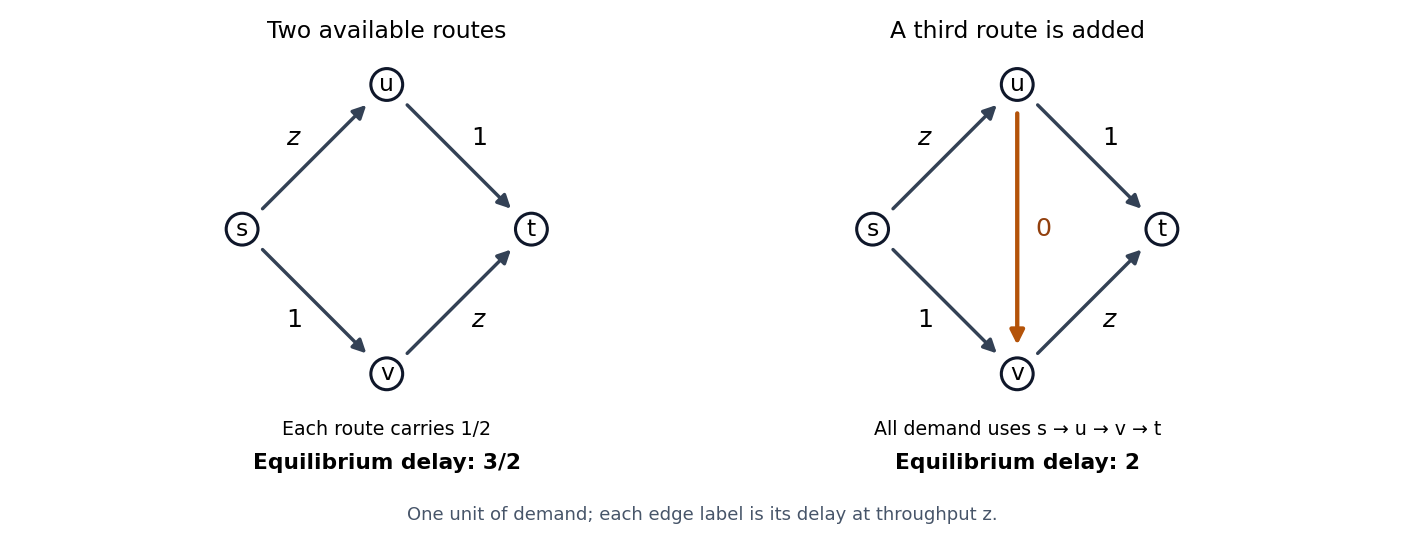

The potential for the expanded network isThe old flow remains feasible and has potential ; the new equilibrium has potential . The enlarged feasible set has indeed lowered the minimized potential. But total travel delay is , not this integral potential: it rises from to . This explains the paradox within the optimization framework. The optimal total-delay value cannot worsen when the old flow is still allowed; selfish equilibrium minimizes a different function.
The phenomenon also survives strictly increasing delays on every link. Replace each constant-one delay by and the new-link delay by . Symmetry gives upper and lower flows after expansion, with middle flow . The common new delay is , while the old delay was . For , these are . Thus the example does not depend on interpreting increasing delays as merely nondecreasing.
Articles by others on the same topic
There are currently no matching articles.