Let the equilibrium be and write . The linearization of the cubic term gives . Therefore the real stability matrix isIts eigenvalues obeyThe square root may be imaginary; stability uses real parts. The determinant is exactly , so a zero eigenvalue occurs only at the turning points derived above. Away from the cusp those are ordinary saddle-node bifurcations; the parameterization joining point has .
At a candidate Hopf bifurcation, the trace vanishes: . Substitution into the steady cubic gives , which has one positive root. The pair is genuinely imaginary only ifThus and, equivalently,This direct calculation proves the threshold without needing the additional monotonicity assumption. The equality gives a double-zero eigenvalue, not an ordinary Hopf bifurcation. Along a fixed- branch, implicit differentiation gives ; at this crossing . A nonzero nonlinear Hopf coefficient then gives the usual Hopf bifurcation.
The fold and Hopf thresholds of a directly forced cubic amplitude divide the diagrams into three regimes. At noncritical points the two eigenvalues, counted with multiplicity by the signs of their real parts, are classified as follows:
- For , there is one equilibrium for every . It has two stable eigenvalues for and two unstable eigenvalues for .
- For , the largest-amplitude branch has two stable eigenvalues; the intermediate-amplitude branch has one stable and one unstable eigenvalue. The smallest-amplitude branch emerging from the lower fold has two stable eigenvalues up to its Hopf crossing, and two unstable eigenvalues beyond it. The relative location of the Hopf point and the other fold in is not fixed throughout this interval.
- For , the largest-amplitude branch again has two stable eigenvalues, the intermediate branch has one of each, and the smallest-amplitude branch has two unstable eigenvalues. The trace-zero point lies on the saddle segment and is not a Hopf bifurcation because its determinant is negative.
At a fold one eigenvalue is zero; at a Hopf point the pair has zero real part. These nonhyperbolic points are marked separately in the sketches.
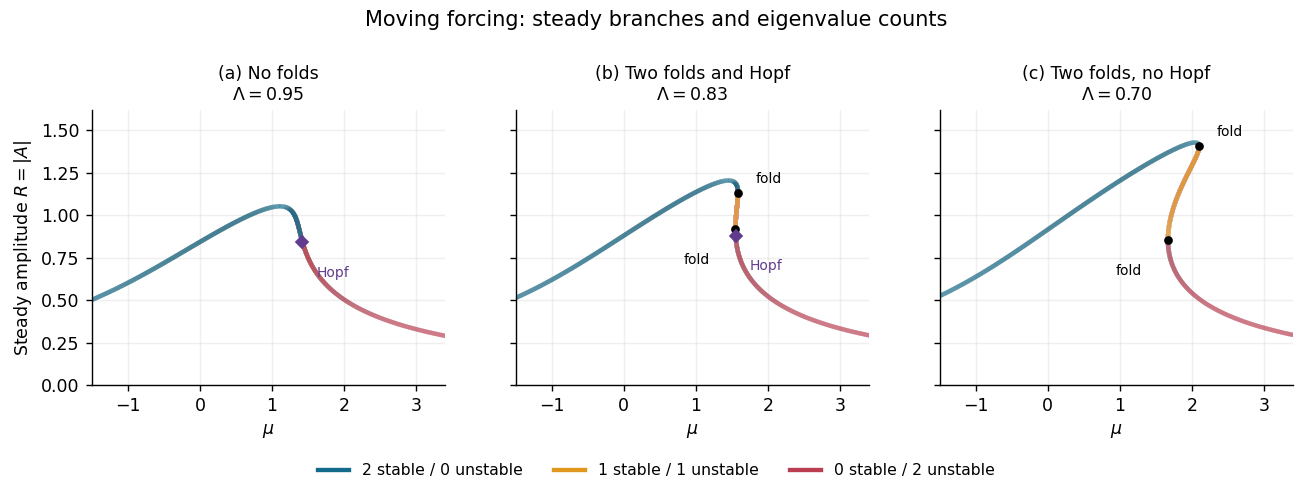
Steady amplitudes of the moving forced pattern, with folds, Hopf points and stable/unstable eigenvalue counts in all three regimes
. Details. 
Articles by others on the same topic
There are currently no matching articles.