Take and normalize the Big Bang to . The cosmological perfect-fluid continuity equation for pressureless matter makes a positive constant. The flat Friedmann equation consequently readsPutting gives , which is directly integrable. The expanding flat dust universe with a cosmological constant hasFor negative cosmological constant, the last expression describes expansion and contraction on . Its maximum is at ; it reaches zero again at . Positive or zero cosmological constant gives unbounded expansion and no finite maximum. All three have infimum zero at their initial singularity; negative cosmological constant also gives zero at the final singularity, with no positive minimum.
For positive cosmological constant, expanding the hyperbolic sine shows at early times: pressureless matter dominates. At late times,Thus the expansion changes from matter-dominated deceleration to exponential acceleration. Indeed changes sign at .
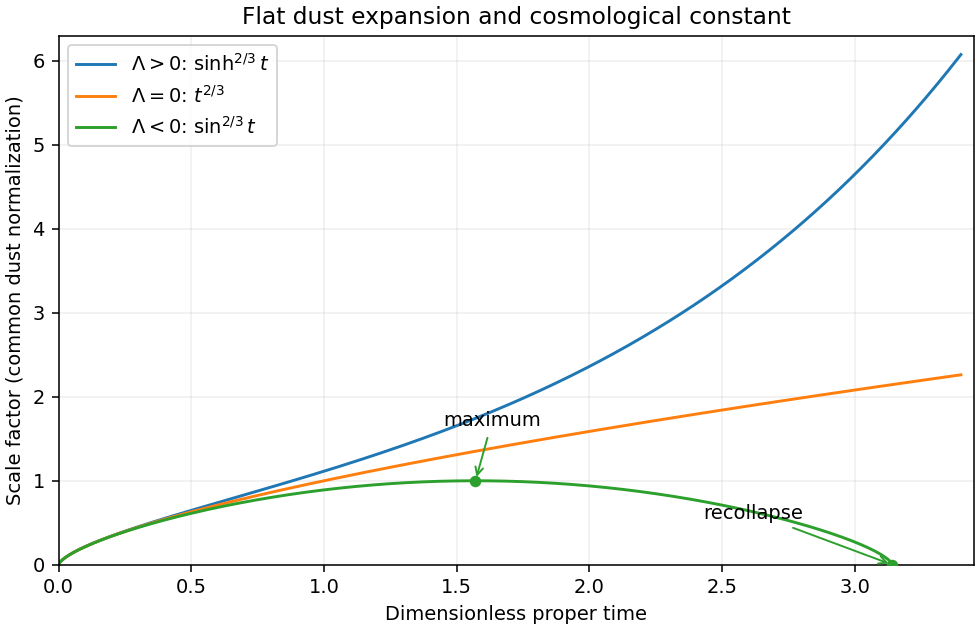
Flat dust expansion for positive, zero and negative cosmological constant, with a common early-time normalization
. Details. Normalize today's scale factor to and use . A source of bolometric luminosity emits photons whose energies arrive smaller by , and whose arrival intervals are longer by . Their wavefront has physical area . The received radiative flux is thereforeBy the definition of luminosity distance, , so . The final equality assumes the stated normalization of the scale factor; it is not a formula invariant under an arbitrary rescaling of .
A radial null geodesic of the FRW metric obeys . Using and gives the radial comoving distanceFor this last integral is , continued along the radial coordinate when necessary; for it is . Inverting, with , provesHere is sine for positive spatial curvature of an FLRW universe, hyperbolic sine for negative spatial curvature of an FLRW universe, and its argument for zero spatial curvature of an FLRW universe. The flat case is the continuous limit , not a literal division by zero. The original PDF has in the denominator and ; the converted TeX loses these details.
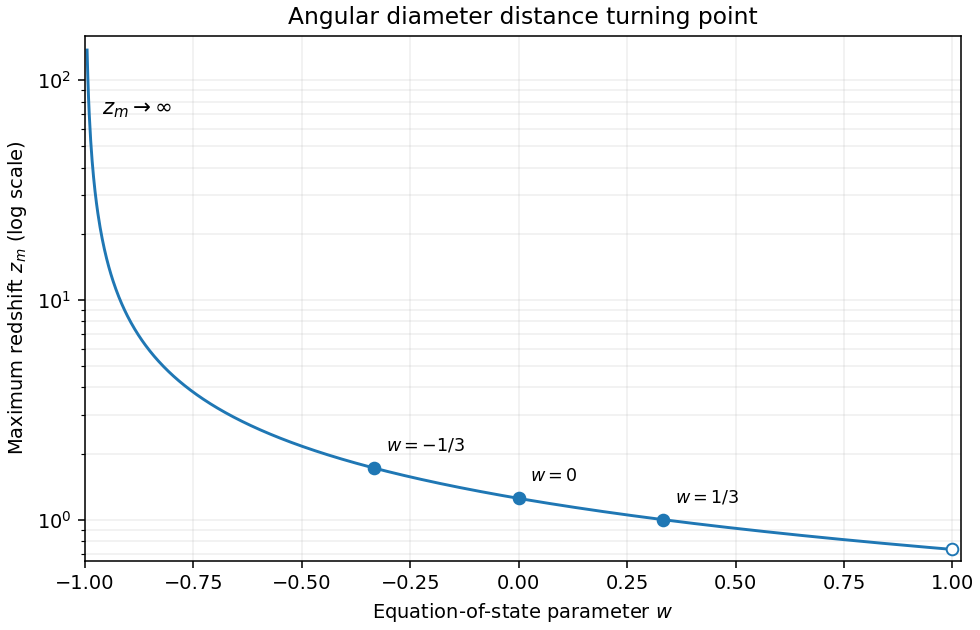
The cosmological perfect-fluid continuity equation gives . In a flat universe the Friedmann equation then gives , where . Writing , the angular diameter distance obtained from the luminosity distance isIt is positive for , starts at zero and tends to zero as for every , including where the radial comoving distance itself is unbounded. Differentiation gives the constant-equation-of-state angular diameter distance maximum:For the stationary equation is , which has exactly one solution greater than one. For the derivative has the sign of . Hence this stationary point is always the unique maximum.
To determine the sketch's shape, differentiate :with limiting value at . The inequality follows because has its unique minimum zero at one. Thus decreases from infinity as to as . Useful points are at , at , and at . The endpoint is excluded: there increases to an asymptote and has no finite turning point.


Articles by others on the same topic
There are currently no matching articles.