In cylindrical coordinates the particle's radial and vertical equations are and . Axisymmetry gives conservation of angular momentum, with specific angular momentum . Eliminating the cyclic azimuthal motion therefore givesThus governs the meridional motion. Its conserved energy is . The additional term is the centrifugal barrier appropriate to fixed angular momentum.
For a point mass, . If , the vertical derivative vanishes only at , and the radial stationary condition there gives . This is the sole stationary point with , at energy . Its Hessian matrix isConsequently the local contours are closed, approximately circular curves about a strict minimum. Finite negative-energy contours above the minimum remain closed; the centrifugal barrier prevents approach to the axis and the negative energy prevents escape to infinity. The zero contour satisfies , while positive-energy contours can be unbounded. The left panel illustrates these features; portions of the outer contours extend outside the plotting window.
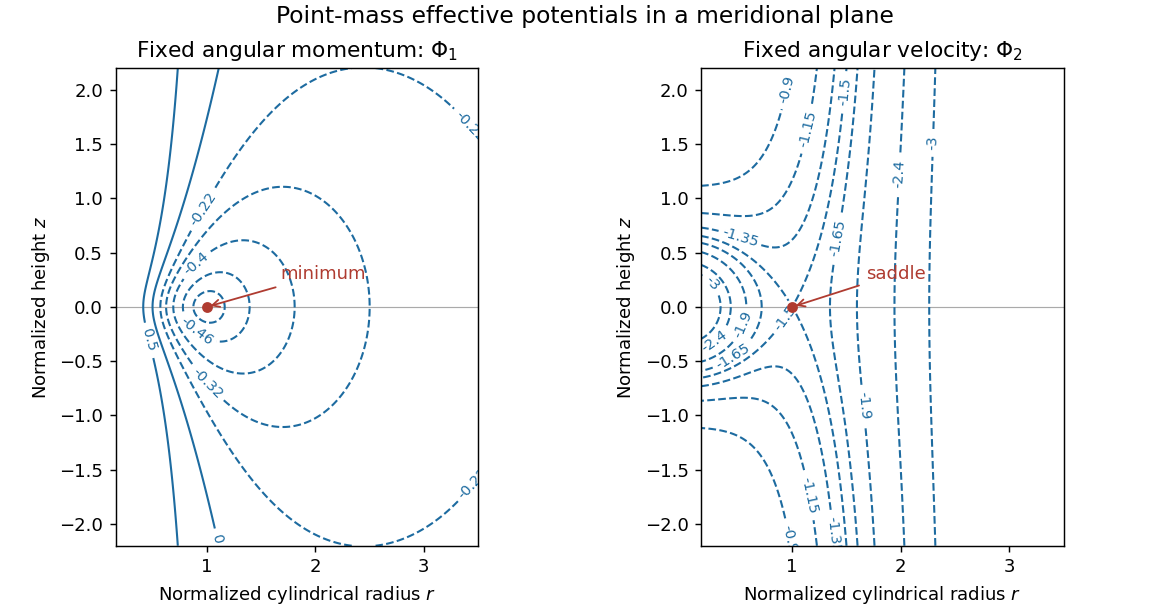

Each panel uses its own circular radius as length unit and as potential unit. Linearizing near the minimum givesThe radial and vertical epicyclic frequencies both equal the circular orbital frequency. Circular Kepler orbits are stable to small meridional perturbations of a freely moving particle. With no dissipation the oscillations persist rather than decay. A change in h shifts the circular radius to a nearby orbit; azimuthal phase itself is neutral by rotational symmetry. If , there is no stationary point or centrifugal barrier and this circular-orbit stability discussion does not apply.
The imposed constraint now fixes , while a torque allows to vary as the particle moves radially. The meridional equations become and . Hence is the appropriate effective potential. One must not substitute a variable h into the fixed-angular-momentum potential and then differentiate as though h were constant.
For a point mass and nonzero , the stationary point is with . Its meridional Hessian matrix isIt is a saddle, at . Near it the contours are hyperbolas, with the saddle contour locally tangent to , as shown in the right panel. On the equatorial plane the potential tends downward both toward the point mass and at large cylindrical radius; at fixed r it increases as increases. The radial perturbation obeys , while the vertical perturbation obeys . Thus the radial motion has growing and decaying exponential solutions and the vertical motion is oscillatory. For no such stationary point exists.
This saddle is the basis of magnetocentrifugal acceleration. A sufficiently strong, open poloidal magnetic field can enforce approximate corotation with its disc footpoint while allowing motion along the field. If its outward tangent makes angle with the vertical, a small distance l along it has , . Its leading potential change at a Keplerian rotation footpoint isThe thirty-degree magnetocentrifugal launching criterion follows: cold local launching has a downhill quadratic direction when from the vertical. Equality is marginal at quadratic order and depends on higher terms and field-line geometry. The field transmits the torque needed to increase the material's angular momentum; a freely moving particle has no such constraint and instead sees the stable minimum in part (a). The local criterion does not by itself prove global escape or determine the mass loading of a complete magnetohydrodynamic wind.
The centripetal acceleration of the purely rotating barotropic fluid is . For , the pressure force satisfies , so its barotropic enthalpy function is . The equilibrium equation is thereforeTaking its curl gives . Thus is independent of z; for a continuous, consistently signed rotation law, so is . This proves the barotropic cylindrical rotation theorem. Integrating the remaining radial force yieldsThe constant C is common to a connected fluid region.
Interpret the semi-thickness as a free surface with , taking the exterior pressure to be negligible. At , the gravitational potential on this surface is . The first integral evaluated at the surface says . Differentiating along it givesand therefore . Radial pressure support makes this slightly slower than Keplerian rotation for nonzero thickness.
Subtracting the free-surface first integral from its value inside the disc gives the complete density profileIt is nonnegative for . Integrating over height, with , givesThus the surface density is independent of r in this quadratic-polytrope disk with constant aspect ratio. The factor in density is canceled by the scale r in the vertical extent. The free-surface assumption is essential to this determination; a prescribed nonzero boundary pressure would require its own boundary data. No radial edges are specified, so the formula describes the local equilibrium rather than a finite-mass disc extended to all radii.
Articles by others on the same topic
There are currently no matching articles.