In cylindrical coordinates the particle's radial and vertical equations are and . Axisymmetry gives conservation of angular momentum, with specific angular momentum . Eliminating the cyclic azimuthal motion therefore givesThus governs the meridional motion. Its conserved energy is . The additional term is the centrifugal barrier appropriate to fixed angular momentum.
For a point mass, . If , the vertical derivative vanishes only at , and the radial stationary condition there gives . This is the sole stationary point with , at energy . Its Hessian matrix isConsequently the local contours are closed, approximately circular curves about a strict minimum. Finite negative-energy contours above the minimum remain closed; the centrifugal barrier prevents approach to the axis and the negative energy prevents escape to infinity. The zero contour satisfies , while positive-energy contours can be unbounded. The left panel illustrates these features; portions of the outer contours extend outside the plotting window.
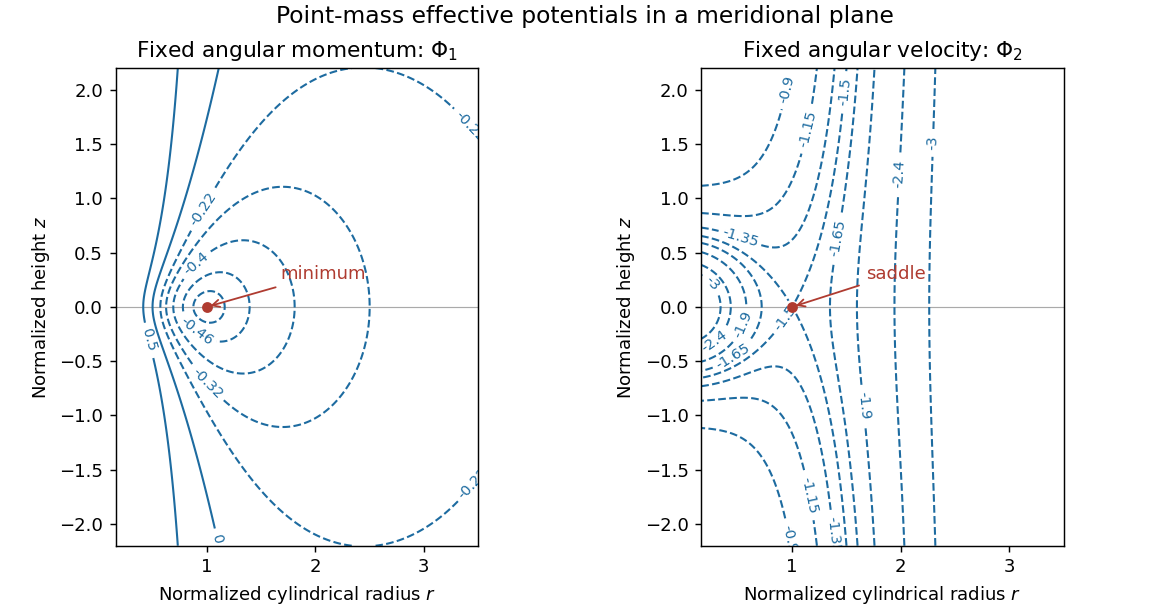

Each panel uses its own circular radius as length unit and as potential unit. Linearizing near the minimum givesThe radial and vertical epicyclic frequencies both equal the circular orbital frequency. Circular Kepler orbits are stable to small meridional perturbations of a freely moving particle. With no dissipation the oscillations persist rather than decay. A change in h shifts the circular radius to a nearby orbit; azimuthal phase itself is neutral by rotational symmetry. If , there is no stationary point or centrifugal barrier and this circular-orbit stability discussion does not apply.
The imposed constraint now fixes , while a torque allows to vary as the particle moves radially. The meridional equations become and . Hence is the appropriate effective potential. One must not substitute a variable h into the fixed-angular-momentum potential and then differentiate as though h were constant.
For a point mass and nonzero , the stationary point is with . Its meridional Hessian matrix isIt is a saddle, at . Near it the contours are hyperbolas, with the saddle contour locally tangent to , as shown in the right panel. On the equatorial plane the potential tends downward both toward the point mass and at large cylindrical radius; at fixed r it increases as increases. The radial perturbation obeys , while the vertical perturbation obeys . Thus the radial motion has growing and decaying exponential solutions and the vertical motion is oscillatory. For no such stationary point exists.
This saddle is the basis of magnetocentrifugal acceleration. A sufficiently strong, open poloidal magnetic field can enforce approximate corotation with its disc footpoint while allowing motion along the field. If its outward tangent makes angle with the vertical, a small distance l along it has , . Its leading potential change at a Keplerian rotation footpoint isThe thirty-degree magnetocentrifugal launching criterion follows: cold local launching has a downhill quadratic direction when from the vertical. Equality is marginal at quadratic order and depends on higher terms and field-line geometry. The field transmits the torque needed to increase the material's angular momentum; a freely moving particle has no such constraint and instead sees the stable minimum in part (a). The local criterion does not by itself prove global escape or determine the mass loading of a complete magnetohydrodynamic wind.
The centripetal acceleration of the purely rotating barotropic fluid is . For , the pressure force satisfies , so its barotropic enthalpy function is . The equilibrium equation is thereforeTaking its curl gives . Thus is independent of z; for a continuous, consistently signed rotation law, so is . This proves the barotropic cylindrical rotation theorem. Integrating the remaining radial force yieldsThe constant C is common to a connected fluid region.
Interpret the semi-thickness as a free surface with , taking the exterior pressure to be negligible. At , the gravitational potential on this surface is . The first integral evaluated at the surface says . Differentiating along it givesand therefore . Radial pressure support makes this slightly slower than Keplerian rotation for nonzero thickness.
Subtracting the free-surface first integral from its value inside the disc gives the complete density profileIt is nonnegative for . Integrating over height, with , givesThus the surface density is independent of r in this quadratic-polytrope disk with constant aspect ratio. The factor in density is canceled by the scale r in the vertical extent. The free-surface assumption is essential to this determination; a prescribed nonzero boundary pressure would require its own boundary data. No radial edges are specified, so the formula describes the local equilibrium rather than a finite-mass disc extended to all radii.
Use outward radial mass flux and outward stress-carried angular-momentum flux . The PDF includes a second conservation equation omitted from the converted TeX:Together with mass conservation, , it fixes the signs of the wind terms. Subtract h times the mass equation, noting that the prescribed is independent of time. One obtainsThe viscous torque in an accretion disk in this outward-flux convention is . Thus, where ,Putting this result back into mass conservation givesThe derivation requires a fixed rotation law; it would acquire additional terms if h evolved independently in time.
For Keplerian rotation, , , and . With , the radial flux becomesConsequently the wind-loaded Keplerian disk evolution equation isThe final term removes mass locally. The extra flux term describes the disc's radial response when the outflow removes more or less than the local specific angular momentum. In particular, cancels this additional transport term without canceling the local mass sink.
Set and choose , with constant. Define and . Then , and . Directly transforming the Keplerian viscous diffusion equation givesThe heat-equation transform for linear-radius disk viscosity is completed by :Equivalently one can use , which differs only by a constant. This is the viscosity law making the transformed diffusivity constant under this square-root-radius reduction. Initial and boundary conditions transform too; the change of variables does not supply unspecified disc-edge data.
The physical diffusion arises from angular momentum transport. Differential rotation creates a viscous shear stress, which transfers angular momentum between neighboring annuli. Gas that loses angular momentum moves inward, while gas that gains it can move outward. Combining conservation of angular momentum with mass conservation turns the stress gradient into a radial mass flux and its divergence into a second radial derivative. Positive kinematic viscosity smooths the appropriately weighted profile; matter need not all move in one direction, and an accreting disc can simultaneously spread outward. Viscosity dissipates orbital energy but redistributes angular momentum internally except for boundary losses.
Put . With zero viscosity and , the wind-loaded Keplerian disk evolution equation becomesOn an interval with , introduce the inward travel-time coordinate and weighted densityPrimes on and denote the new variables, not differentiation. To verify the transformation, let and . Its logarithmic derivative satisfiesSince , multiplication of the density equation by W gives exactlyThis establishes inward transport by an angular-momentum-enhanced disk wind, including the amplitude weighting rather than only a characteristic speed.
The general local advection equation solution is ; an initial profile fixes F on the interval swept out by its characteristics. A constant wave phase therefore obeys , orThus the transformed wave propagates inward. The physical surface density is not a rigid profile in r: its weighting accounts for radial compression and loss of mass into the outflow. The same velocity follows independently from the mass flux in part (a), . If f vanishes, the coordinate change applies only on the neighboring positive-loss intervals; at a loss-free point this wind-driven velocity vanishes.
A magnetocentrifugal acceleration mechanism can produce . A poloidal field anchored to the disc transmits a torque to the outflow and enforces approximate corotation below its Alfvén surface. The wind's total specific angular momentum is , where is its cylindrical Alfvén radius, compared with the footpoint value . Hence for a lever arm beyond the footpoint. Magnetic stresses remove the surplus angular momentum and drive accretion without an effective internal viscosity.
The additional conditions are : incompressible flow and the solenoidal magnetic field constraint. The scalar combines pressure per unit density with magnetic pressure per unit density and any conservative gravitational and centrifugal potentials. In particular, the Lorentz force identity separates magnetic tension from . Adding this latter term to the rotating-flow pressure potential gives the pressure appearing in the stated equation; the Coriolis force remains explicit.
Work in magnetic velocity units , and write for the background shearing sheet flow. Its advective acceleration is zero, and , so the stated quadratic background pressure potential gives an exact balance. A spatially uniform mean magnetic field must evolve asThis is stretching of radial field into azimuthal field by differential rotation.
For the shearing wave phase , advection by the background givesIt vanishes identically ifThe changing wavevector describes the shear of initially planar wavefronts. The mean-field stretching and wavevector evolution cancel in the Alfvén frequency:Hence .
These solutions are exact finite-amplitude disturbances, not merely a linearization. To see this, let and in magnetic velocity units. The divergence constraints give . Thus both real disturbances are pointwise perpendicular to k, whereas all their spatial derivatives are along k. Every quadratic term , , and vanishes, including terms involving conjugate amplitudes. This extends the exact incompressible shearing wave to an exact magnetic shearing wave. The gas pressure can compensate quadratic magnetic-pressure terms even though the combined contains only its stated background and wave harmonic.
The remaining wave terms are therefore preciselyThe shear terms arise from perturbations acting on , the magnetic terms from the uniform field acting on the wave, and the last terms from diffusion. Pressure enforces the moving-wavevector velocity constraint: differentiating it givesUsing this pressure leaves invariant. Differentiating in the induction equation similarly leaves it zero. Thus the evolution is consistent with both constraints for initially transverse amplitudes.
Now take positive , so the stipulated condition implies , and take magnetic Prandtl number , with . For a vertical wavevector , use the equal-diffusivity magnetorotational channel formThe two horizontal momentum equations, after adding them, give . Either component then gives . The first induction equation gives . These equations are simultaneously solved byThe second induction component gives the same relation, since . Exponential growth occurs when . The quarter-cycle phase between magnetic and velocity perturbations is required by the factor i in the Fourier equations.
For Keplerian rotation, expanding the local shear gives , hence . Therefore . With and , the growth condition for this prescribed polarization becomesA weaker field would require a shorter wavelength to retain this mode's selected Alfvén frequency, making diffusive damping too strong. The required wavelength must also fit any actual vertical domain; no vertical boundary conditions are specified here.
The field bound is for the requested equal-component mode, rather than a universal necessary condition for all magnetorotational instability. This distinction matters if all vertical wavelengths are admitted. Indeed, let for a general horizontal polarization. Eliminating its two magnetic amplitudes gives and . Their determinant givesFor a Keplerian disk, . As a concrete counterexample to a universal reading of the bound, in consistent dimensionless units take , , , , and . The positive root gives and , even though . This mode has a different polarization and a much longer wavelength. Real finite-height discs restrict such wavelengths; the PDF supplies no such restriction.
Finally, the horizontally averaged radial flux of azimuthal momentum is the sum of Reynolds stress and magnetic tension stress:Multiplication by the local radius gives an outward angular-momentum flux. Equal radial and azimuthal velocities give the largest positive product at fixed horizontal kinetic energy, while opposite magnetic components give the largest positive at fixed horizontal magnetic energy. Both follow from . This stress-maximizing magnetorotational channel polarization therefore makes both contributions reinforce outward angular momentum transport. It extracts shear energy at rate , explaining why these correlations are especially effective in driving accretion.
Articles by others on the same topic
There are currently no matching articles.