In cylindrical coordinates the particle's radial and vertical equations are and . Axisymmetry gives conservation of angular momentum, with specific angular momentum . Eliminating the cyclic azimuthal motion therefore givesThus governs the meridional motion. Its conserved energy is . The additional term is the centrifugal barrier appropriate to fixed angular momentum.
For a point mass, . If , the vertical derivative vanishes only at , and the radial stationary condition there gives . This is the sole stationary point with , at energy . Its Hessian matrix isConsequently the local contours are closed, approximately circular curves about a strict minimum. Finite negative-energy contours above the minimum remain closed; the centrifugal barrier prevents approach to the axis and the negative energy prevents escape to infinity. The zero contour satisfies , while positive-energy contours can be unbounded. The left panel illustrates these features; portions of the outer contours extend outside the plotting window.
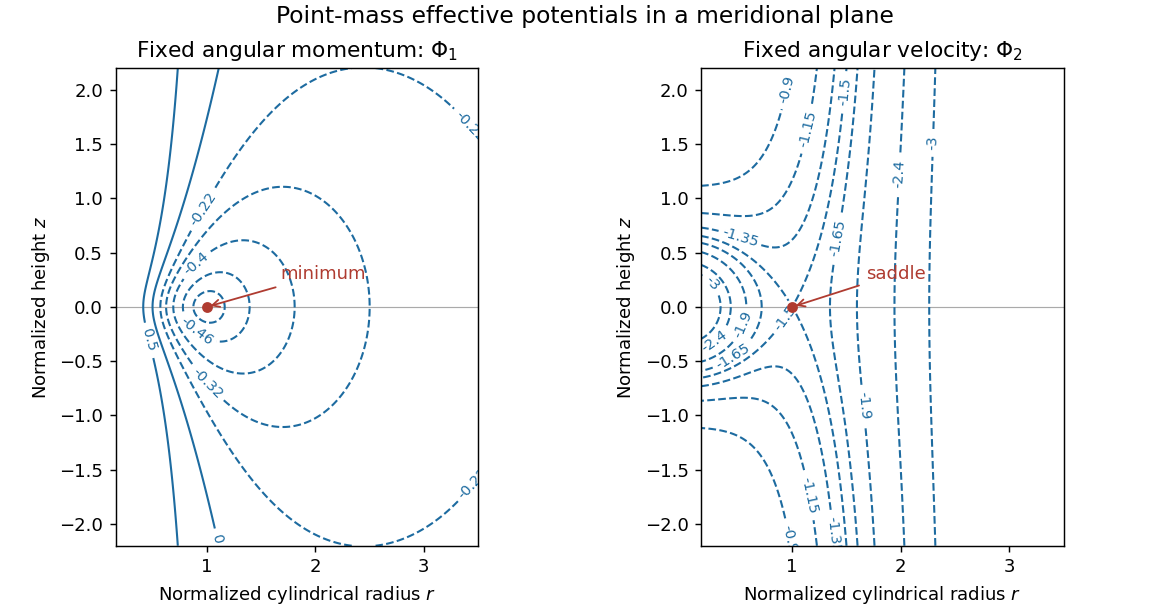

Each panel uses its own circular radius as length unit and as potential unit. Linearizing near the minimum givesThe radial and vertical epicyclic frequencies both equal the circular orbital frequency. Circular Kepler orbits are stable to small meridional perturbations of a freely moving particle. With no dissipation the oscillations persist rather than decay. A change in h shifts the circular radius to a nearby orbit; azimuthal phase itself is neutral by rotational symmetry. If , there is no stationary point or centrifugal barrier and this circular-orbit stability discussion does not apply.
Articles by others on the same topic
There are currently no matching articles.