The complex exponential function factorizes as . HenceThe real exponential multiplies both components; it does not change the argument.
Using and collecting real and imaginary terms gives the complex cosine identity . ThusThe sign follows from the factors and in the two complex exponentials.
For , write with . The complex logarithm has values , . ThereforeFor a specified single-valued branch, choose the corresponding continuous determination of the argument. In particular, the principal value uses ; it is not represented correctly by in every quadrant. The complex logarithm is undefined at zero.
For , rationalizing the denominators gives and . Their imaginary parts cancel, soThis also follows because the summands are complex conjugates.
The cubic terms are the expansion of . Subtracting therefore givesHere the expression is a polynomial in and its complex conjugate, rather than a holomorphic polynomial in alone.
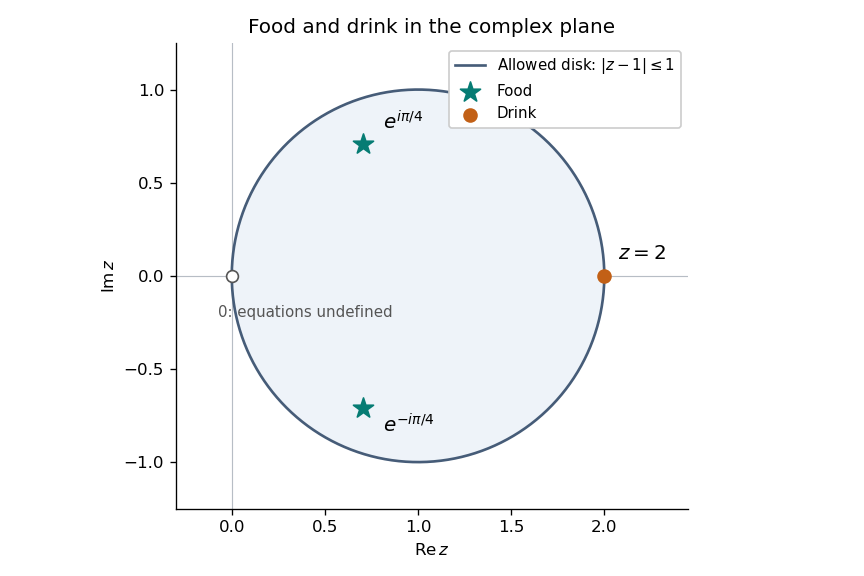
For the unheaded continuation, set in the food equation. The two square roots are , so exponentiating givesBoth values have and hence lie strictly inside the disk. Both also have the indicated principal logarithms. Allowing the multivalued complex logarithm produces no additional points: the only permitted values of are still the two square roots already used.
For drink, the PDF squares only the denominator. Put . Its numerator is and its unsquared denominator is , which is nonzero unless . Multiplying the equation by this denominator squared and equating the real part and imaginary part yieldsthat is and . If , the real equation gives or , and zero is excluded. If , then , but the real equation would require , impossible for real . ThusIt lies on the allowed disk boundary, and direct substitution gives . The denominator-only square matters: squaring the entire quotient would define a different locus.

Articles by others on the same topic
There are currently no matching articles.