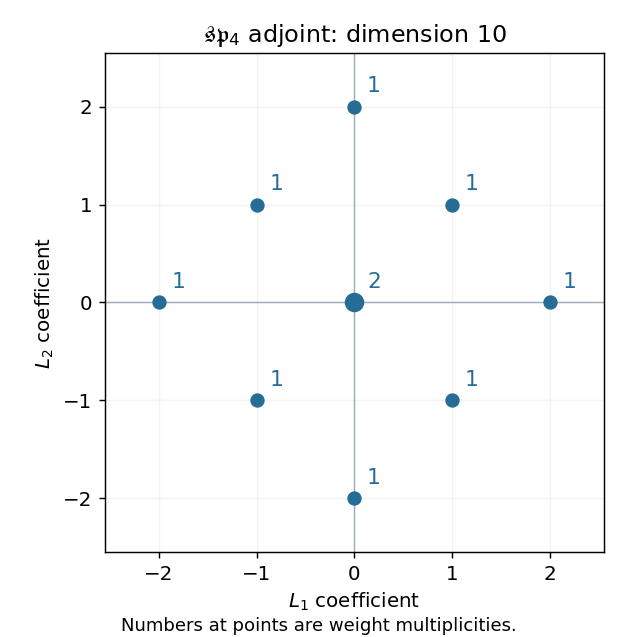
For , put , . Then , . The matrix unit identityreads off the root spaces directly. The complete list isThus the C2 root system isAll eight root spaces have dimension one. The zero-weight space is the two-dimensional Cartan subalgebra ; zero itself is not a root.
For the Adjoint representation, the root-space decomposition gives the eight nonzero weightseach of multiplicity one, and weight zero of multiplicity two from the Cartan subalgebra. Thus its weight diagram is the root diagram with a double zero weight, and its total dimension is .
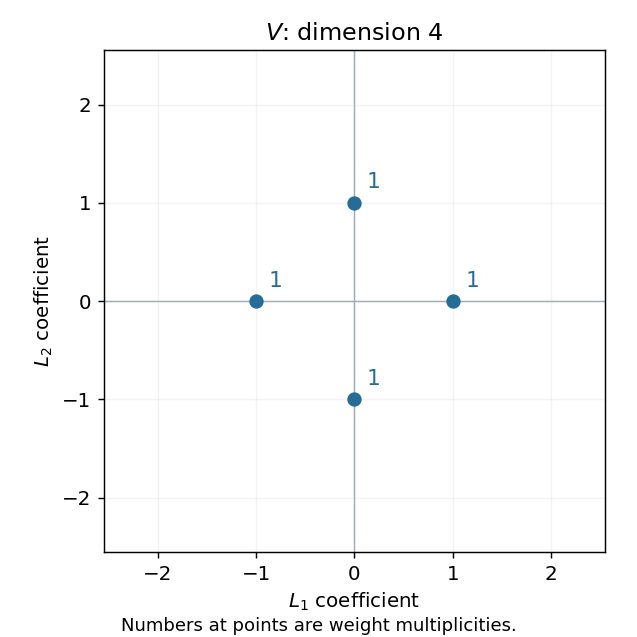
In the defining representation, the diagonal element of the Cartan subalgebra acts on the four standard basis vectors with eigenvalues . ThereforeTheir weight diagram is the four-point cross below.
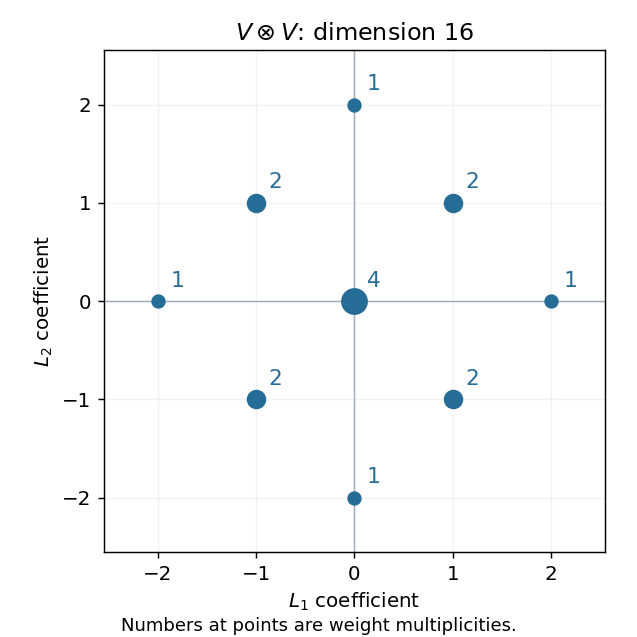
The tensor-product weight diagram is obtained by adding every ordered pair of defining weights. Each occurs once, while each of the four weights occurs twice, from the two orders of the summands. Zero occurs four times, from the ordered pairs and for . HenceThe dimensions sum to , as required for .


The printed phrase “not reducible” is a misprint: the requested nonzero complementary submodules establish that this tensor square is reducible. The natural reason is that the flip commutes with the Lie algebra representation. Its two eigenspaces are the symmetric square and the exterior square, givingIn the symmetric square, the four weights and four weights each occur once, while zero occurs twice. In the exterior square, the four weights each occur once and zero occurs twice; the are absent because repeated wedge factors vanish. These are the two requested complementary weight diagrams.
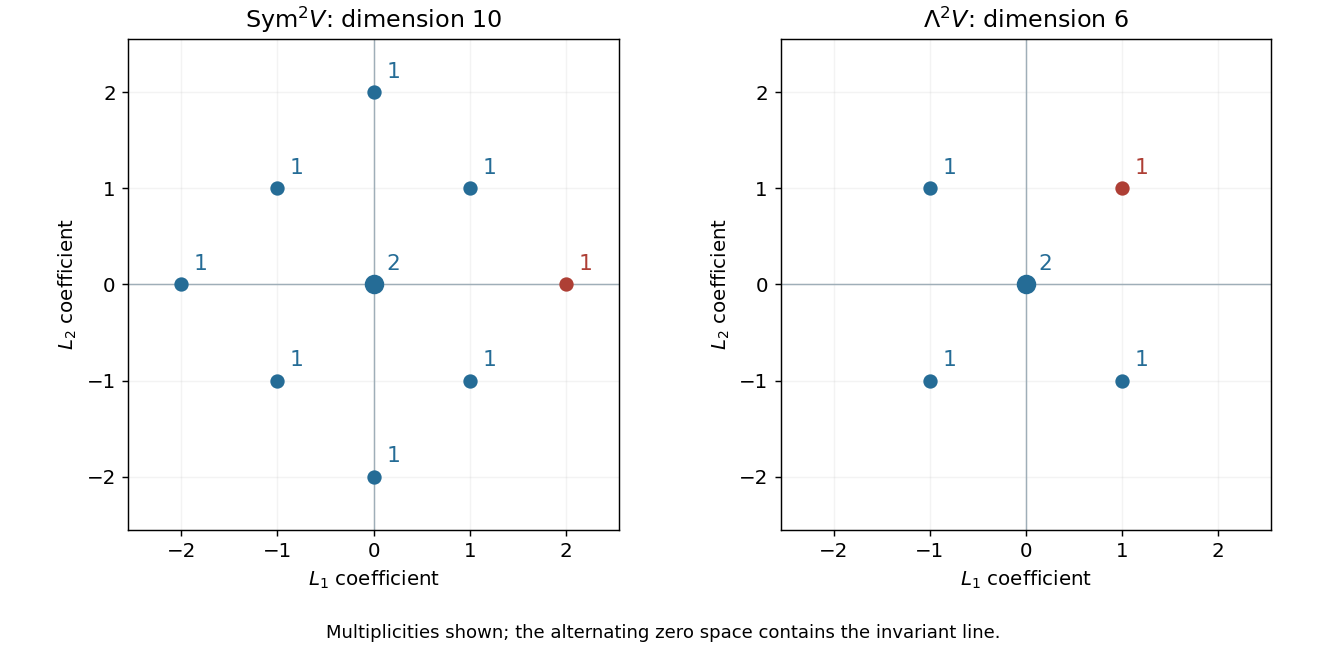
The complementary symmetric and alternating tensor submodules of the defining sp4 representation
. Details. 
More precisely, the tensor-square decomposition of the defining symplectic representation identifies with the irreducible adjoint module . The identification is an intertwiner sending a symmetric tensor to the element of the symplectic Lie algebra . For the exterior square, symplectic contraction of an exterior square has a five-dimensional kernel, the primitive exterior square, and the invariant tensor supplies a complementary line. Thus the full irreducible decomposition isHere and . The two zero weights in the exterior square split into one primitive zero weight and the invariant line.
Articles by others on the same topic
There are currently no matching articles.