Realize the defining sl2 Lie algebra Lie algebra representation as , with , , . A basis of the symmetric power is for , with . Hence the exterior square basis , , has weight .
Collecting equal weights gives the complete weight-space decomposition:Every one of the ten exterior basis vectors appears exactly once. Thus , with the displayed bases and dimensions.
The weight diagram has weights with multiplicities . An Irreducible Lie algebra representation of the sl2 Lie algebra with highest weight has weights , all of multiplicity one. The top weight therefore forces one summand. Subtracting its formal character leaves weights , each once, which is . By Weyl complete reducibility theorem,Their dimensions account for the entire module.
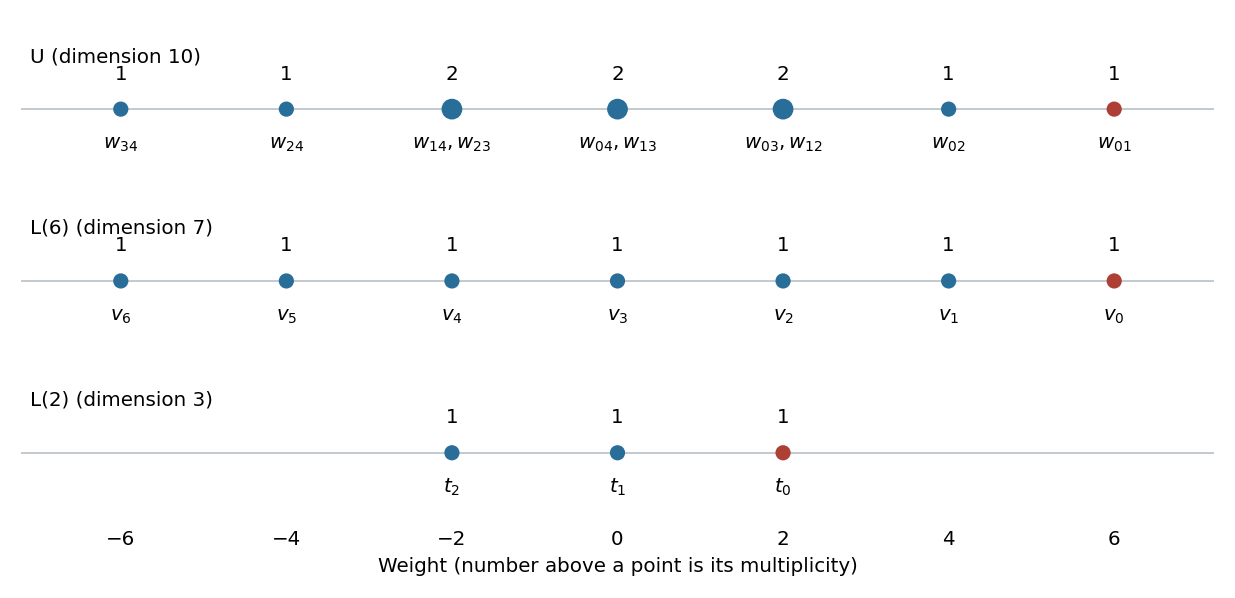
The exterior-square weight diagram and its two irreducible summands; basis labels are defined in part iii
. Details. Use the exterior-power Lie algebra representation:Reorder wedge factors when necessary and interpret repeated factors as zero. The explicit weight basis of the exterior square of Sym4 for sl2 isfor , andfor . Their weights are and , respectively.
Direct application of the displayed operators gives and the lowering chainsThe raising coefficients along the first chain are ; along the second, and . Thus each span is stable and is the required irreducible module. At the common weights , the and vectors are independent; the other weight spaces occur only in the first span. This proves that the ten vectors are a basis of and that the two spans are complementary. The highest-weight vectors are
Let be the basis of the defining representation and its dual. On a diagonal element of the Cartan subalgebra their weights are and , with . Use the tensor product and symmetric square basisIts weight is . For the three repeated weights putIf , the complete weight-space decomposition isThere are six spaces of the first type, three of the second, and three of the third. Their dimensions sum to . The weight diagram below labels every space with all of its basis vectors.
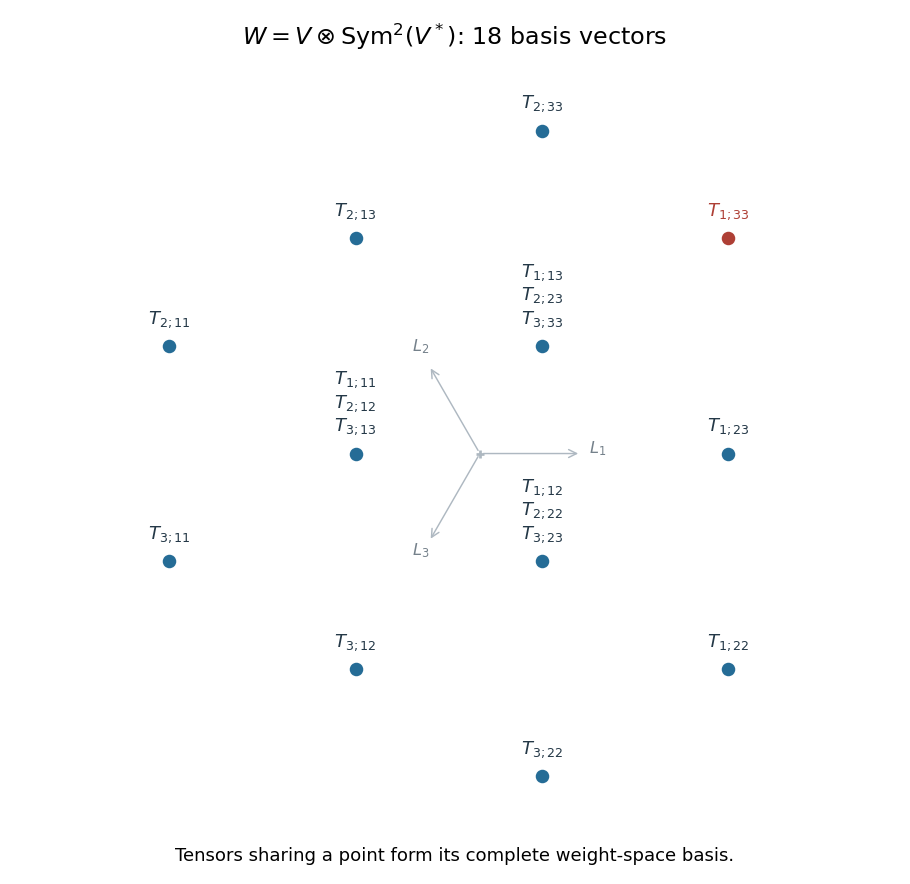
Use the contraction splitting of a defining module tensor a dual symmetric square. For a quadratic polynomial in the dual variables, defineBoth maps are intertwiners. The first is the natural tensor contraction; the second uses the invariant tensor . Directly, , so andThe vector lies in and is killed by both positive simple-root operators . It is a highest-weight vector of weight . By Weyl complete reducibility theorem, it generates the corresponding irreducible summand. The Weyl dimension formula for gives , hence , exhausting the kernel. ThereforeThe kernel has the nine outer weights of multiplicity one and each inner weight of multiplicity two; the dual summand has just the three weights , each once.
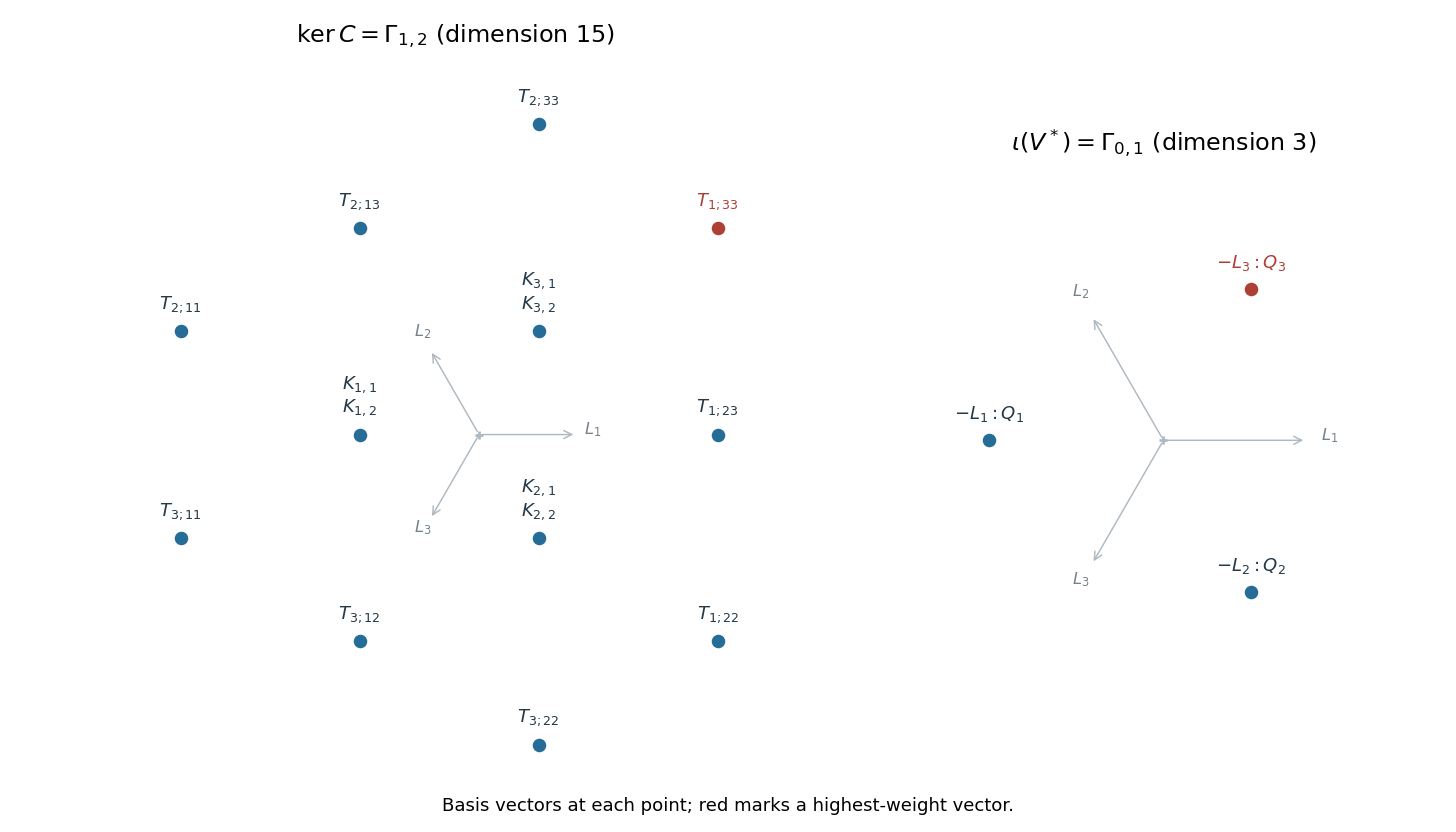
Weight diagrams and basis labels of the fifteen-dimensional kernel and the dual summand
. Details. Use the basis labels in the preceding diagrams. For each , write with , and defineThe contraction satisfies and , so both vectors lie in . They are independent and form a basis of its weight space at .
Thus the bases marked on the weight diagram of areand the diagram of uses the basis at . Each is complementary to the two kernel vectors because its contraction is . All vectors shown are therefore genuine bases, not merely weight counts. The highest-weight vectors areThe latter is highest because intertwines the dual Lie algebra representation and is its highest-weight vector.
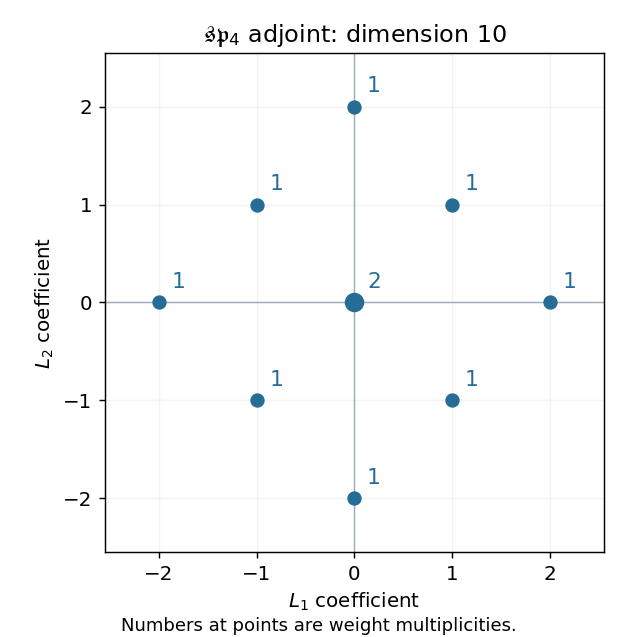
For , put , . Then , . The matrix unit identityreads off the root spaces directly. The complete list isThus the C2 root system isAll eight root spaces have dimension one. The zero-weight space is the two-dimensional Cartan subalgebra ; zero itself is not a root.
For the Adjoint representation, the root-space decomposition gives the eight nonzero weightseach of multiplicity one, and weight zero of multiplicity two from the Cartan subalgebra. Thus its weight diagram is the root diagram with a double zero weight, and its total dimension is .
In the defining representation, the diagonal element of the Cartan subalgebra acts on the four standard basis vectors with eigenvalues . ThereforeTheir weight diagram is the four-point cross below.
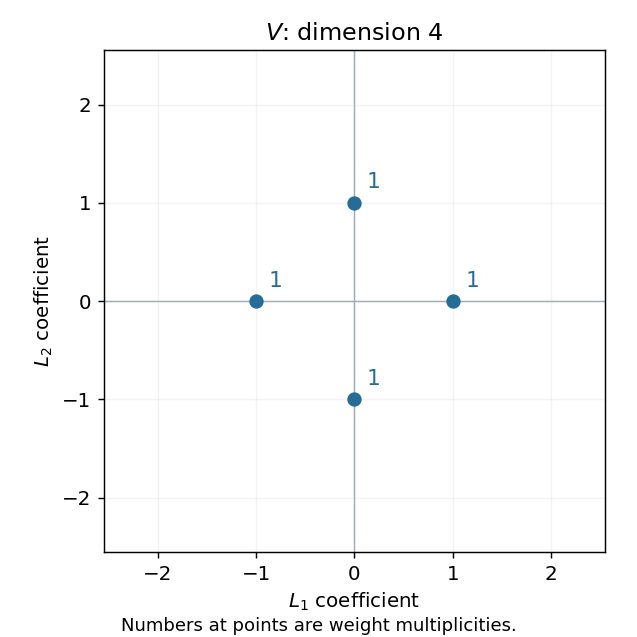
The tensor-product weight diagram is obtained by adding every ordered pair of defining weights. Each occurs once, while each of the four weights occurs twice, from the two orders of the summands. Zero occurs four times, from the ordered pairs and for . HenceThe dimensions sum to , as required for .
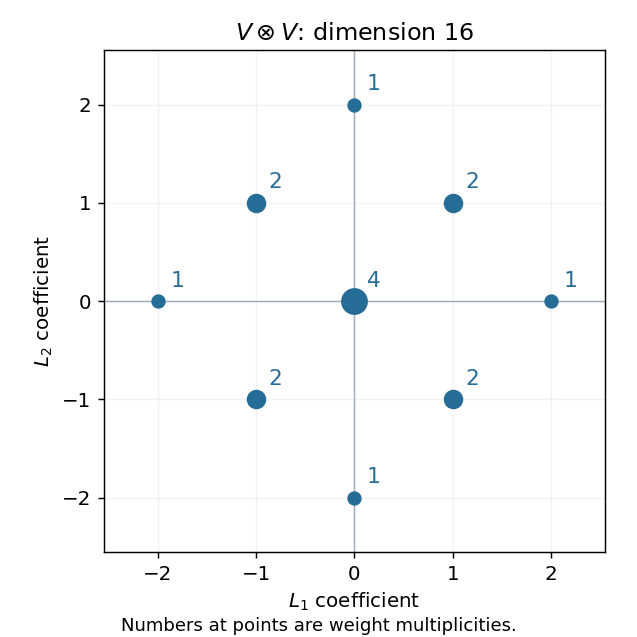


The printed phrase “not reducible” is a misprint: the requested nonzero complementary submodules establish that this tensor square is reducible. The natural reason is that the flip commutes with the Lie algebra representation. Its two eigenspaces are the symmetric square and the exterior square, givingIn the symmetric square, the four weights and four weights each occur once, while zero occurs twice. In the exterior square, the four weights each occur once and zero occurs twice; the are absent because repeated wedge factors vanish. These are the two requested complementary weight diagrams.
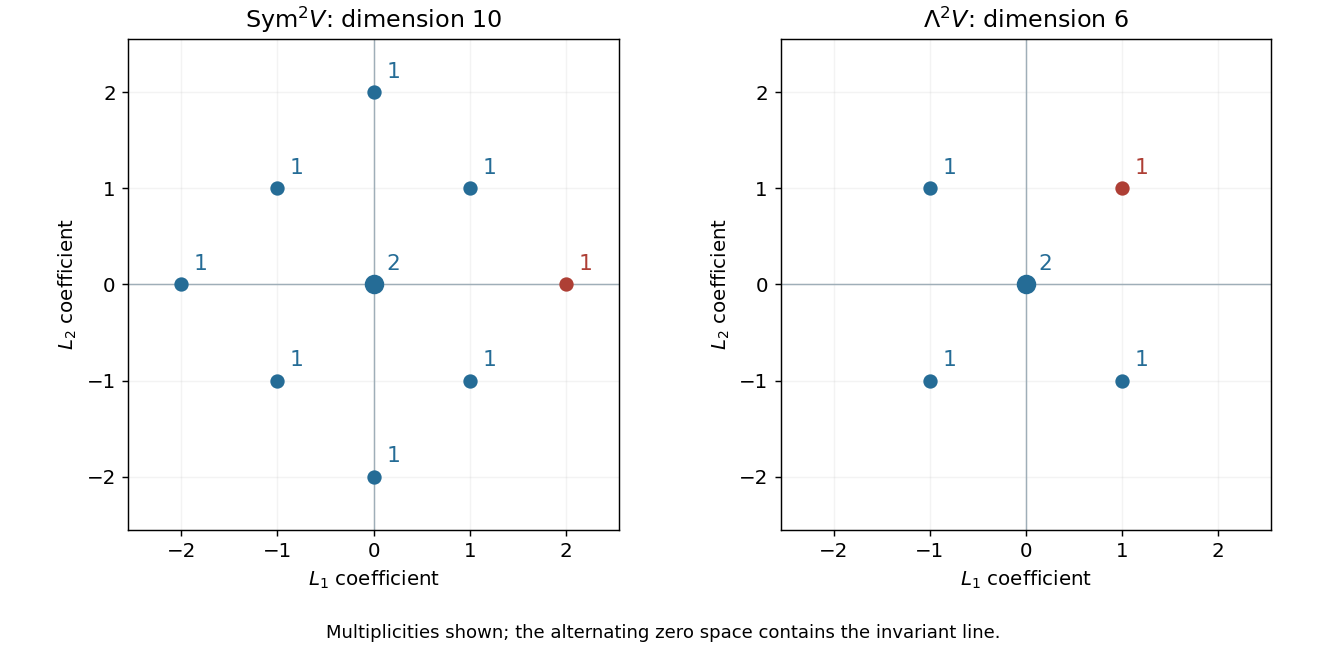
The complementary symmetric and alternating tensor submodules of the defining sp4 representation
. Details. 
More precisely, the tensor-square decomposition of the defining symplectic representation identifies with the irreducible adjoint module . The identification is an intertwiner sending a symmetric tensor to the element of the symplectic Lie algebra . For the exterior square, symplectic contraction of an exterior square has a five-dimensional kernel, the primitive exterior square, and the invariant tensor supplies a complementary line. Thus the full irreducible decomposition isHere and . The two zero weights in the exterior square split into one primitive zero weight and the invariant line.
The ambient group ring of a weight lattice isAddition is coefficientwise, and multiplication uses addition in the weight lattice. For a finite-dimensional Lie algebra representation , its formal character isThe formal character records the dimensions of all weight spaces. The ambient lattice ring should be distinguished from the representation ring of a semisimple Lie algebra, which identifies with its Weyl-invariant subring.
For the module , and the highest weight is . The decomposition givesCollecting equal weights yieldsThe six first weights and three second weights have multiplicity one; each of the three weights has multiplicity two. Their total is , as required.
For and , the tensor product of Lie algebra representations acts byThus its weight space of weight isSubstituting this into the formal character and using provesEvery sum is finite for the Lie algebra representations under consideration.
The Weyl group acts on the weight lattice by its root reflections and extends to ring automorphisms of the group ring of a weight lattice:Weights and their multiplicities in a finite-dimensional Lie algebra representation of a semisimple Lie algebra are permuted by this action, so its formal character is Weyl-invariant.
Choose a set of positive roots and putHere are the fundamental weights, and , where the Coxeter length counts positive roots carried to negative ones. For a dominant integral weight , let denote the finite-dimensional Irreducible Lie algebra representation of highest weight . The Weyl character formula isThe second denominator expression is the Weyl denominator formula. Both alternants change sign under each root reflection; their quotient is invariant. Although written as a fraction, the theorem asserts that it is a finite element of with the nonnegative coefficients given by weight multiplicities. The highest-weight classification specifies which label the irreducibles, while the root system and choice of positive roots determine every other term.
Write with finite support. The root reflection is an involution, and implies . Any fixed weight has coefficient zero. For each nonfixed orbit choose its representative withIntegrality of follows because belongs to the weight lattice; positivity is ensured by our choice of orbit representative. Pairing the orbit coefficients givesFor each pair, elementary finite telescoping showsThere are finitely many chosen orbits, and each inner sum is finite. This proves the root-binomial divisibility of reflection anti-invariants:
For precision, the geometric-series expression is interpreted coefficientwise. Its coefficient at a weight is , which is a finite sum because has finite support. On each coset of , reflection pairs the coefficients with opposite signs, so their total is zero. These cumulative sums vanish both before the smallest occupied weight and after the largest occupied weight. Only finitely many cosets are occupied, hence the product of the formal series with has finite support and equals the boxed quotient.
The individual terms need not vanish for large . For example, is anti-invariant, and its quotient is . Thus “finite sum” means a finite result after coefficientwise cancellation, not an actually truncated geometric series. No analytic convergence assumption is involved.
Work over with finite-dimensional Lie algebras and Lie algebra representation spaces. The adjoint form of Engel theorem isHere a nilpotent Lie algebra has terminating lower central series, , . We prove the stronger linear statement: if , and every member of is a nilpotent endomorphism, then there is a nonzero killed by all of , and can be simultaneously represented by strictly upper triangular matrices.
For the proof of Engel theorem by induction and normalizers, first establish a useful nilpotence fact. If , left and right multiplication by on commute. Expanding their difference givesFor , every summand contains a power of at least , so . Restrictions and induced quotient maps remain nilpotent.
Now prove the common-kernel statement, the Engel lemma, by induction on . The zero algebra is immediate. Choose a maximal proper Lie subalgebra . Its action on by commutators consists of nilpotent maps by the preceding fact. Applying the lower-dimensional induction hypothesis to its image gives a nonzero coset with . HenceThe normalizer of a Lie subalgebra is a Lie subalgebra by the Jacobi identity. Maximality implies , so is an ideal of a Lie algebra. Moreover has no proper nonzero Lie subalgebra, and every one-dimensional subspace is a Lie subalgebra. Thus .
Induction also provides a nonzero common annihilatorIt is stable under : for , , ,because . Choose representing a basis of . The restriction of the nilpotent endomorphism to the nonzero space has nonzero kernel. A vector in this kernel is killed by both and , hence by all of . This finishes the induction. When an action is not faithful, induction is applied to its image, whose dimension is no larger than ; no faithfulness assumption is hidden.
Starting with the common-kernel line, apply the same statement to each successive quotient Lie algebra representation space. It constructs a complete flag of invariant subspacesAn adapted basis represents every member of by a strictly upper triangular matrix. Every product of such matrices is zero, so every iterated commutator with entries is zero as well.
Finally, if every on is nilpotent, apply the linear statement to the Adjoint representation. With , every product of adjoint operators vanishes, so . Conversely, if , then for all , proving the other implication. This proves Engel's theorem and its simultaneous-triangularization form. The hypothesis concerns every element of the algebra, not merely a chosen set of generators.
The Killing form is the symmetric bilinear formThe facts needed here are its invariance, , and the root space identity . Invariance follows from and cyclicity of the trace:Taking , , provesNo normalization of is needed for this identity. Semisimplicity gives nondegeneracy of the Killing form, but that fact is not needed for this particular equality.
Use the standard coroot normalization . The symbols are vectors in the Cartan subalgebra, not the root-space vectors . The root-string theorem gives , so every root takes real values onThe simple coroots form a basis of this real space.
In the root-space decomposition, is zero on and scalar multiplication by on the one-dimensional space . Therefore, for ,For every term is real, so the restricted form is real. Moreover,If it is zero, all vanish. Then commutes with every root space and with , hence is central in . The center of a Lie algebra vanishes for a semisimple Lie algebra, so . Thus the Euclidean subspace of a Cartan subalgebra hasEquivalently, positivity follows because the roots span .
Put . The six roots of take values on , so the root-space decomposition givesUsing the preceding invariant-form identity with ,HenceThis agrees with the Killing form of the special linear Lie algebra, , at .
The weight lattice iswhere the fundamental weights satisfy . The coroots use the normalization fixed above.
The Killing form defines the complex-linear mapBy nondegeneracy of the Killing form on a Cartan subalgebra, this is an isomorphism. For , expand its image in the dual fundamental-weight basis:The coefficients are real by the preceding positivity calculation, and the are in . ConsequentlyIn fact both spaces have real dimension , so this inclusion is equality.
Evaluate the Killing form on the root-space decomposition. For arbitrary ,Thus the Killing dual of a coroot is the root expansionThe factor two in the positive-root expression occurs because the contributions of and are equal.
For , let , ; the positive roots are . On their values are . ThereforeThis uses the unscaled Killing form . Changing that normalization would change the scalar six.
Work with a finite-dimensional complex semisimple Lie algebra. The Dynkin diagram is obtained from its intrinsic root system, with several structure theorems entering the construction.
First choose a Cartan subalgebra . The semisimple structure theory gives the root-space decompositionThe nonzero roots span , root spaces have dimension one, and every root has its negative. The rank is .
Next use the Killing form. Its nondegeneracy on and its positive-definite restriction to the real coroot span identify the real root span with a Euclidean space. Explicitly, if , put . The sl2 subalgebra associated with a root supplies its normalized coroot and the integral pairingThe root-string theorem makes the reflection permute . Together with the absence of multiples other than , this shows that is a finite reduced root system and a crystallographic root system. These properties come from semisimple Lie algebra theory, not from the diagram's definition.
Choose a vector in that is not perpendicular to any root. Define the positive roots by positive inner product with this vector. The simple roots are those positive roots that cannot be expressed as sums of two positive roots. Root-system theory shows that they form a basis , and each root is an integer combination of them with coefficients all of one sign. Distinct simple roots have nonpositive inner product.
Use the standard Cartan matrix conventionThere is one diagram vertex for each simple root. For , the integral off-diagonal entries are nonpositive andConnect the two vertices with respectively zero, one, two or three edges. The corresponding angles are . A multiple edge carries an arrow toward the shorter root. For joined vertices, the length ratio is determined by ; hence the diagram records both angle and relative length.
For example, has simple roots and , giving two equal-length vertices joined by one edge: type . For , take and . Thenso the two vertices have a double edge directed toward , the shorter root: type .
Finally, orthogonal irreducible components of the root system correspond to the simple ideals of a Lie algebra in the semisimple Lie algebra, so its diagram is the disjoint union of their connected diagrams. Conjugacy of Cartan subalgebras and the Weyl group action on choices of positive roots make the resulting diagram independent of these choices up to isomorphism. Thus the vertices, edge multiplicities, arrows and connected components encode the simple-root geometry and the simple-ideal decomposition.
Articles by others on the same topic
There are currently no matching articles.