The initial table of content was limited to the first level because it is larger than 1000 articles. There are 1908 articles in total. Expand a branch to load its children.
Work with finite groups, as required for these Sylow subgroup counts. Let act by conjugation on the set of Sylow -subgroups. The stabilizer of is . Since is the normal Sylow subgroup of its own normalizer, every -subgroup of that normalizer lies in . Consequently the stabilizer is exactly , and the orbit-stabilizer theorem gives orbit size . The orbit of has size one. Every other orbit size is a power of at least , hence is divisible by . Adding orbit sizes proves the strengthened Sylow congruence from intersections:Now suppose is simple of order . If , its Sylow -subgroup is normal because its number divides three and is one modulo five. If , an involution in the regular permutation action of swaps fifteen pairs, so its sign is negative. The sign of a permutation would give a nontrivial group homomorphism with a proper nontrivial normal kernel. Both cases contradict simplicity. Thus .
The Sylow theorems make a divisor of fifteen. It is not one, since a nontrivial Sylow subgroup would then be normal. It is not three, since the conjugation action on three Sylow subgroups would give a faithful group homomorphism , impossible by order. If , take a Sylow subgroup itself: its normalizer has subgroup index five. If , not all distinct Sylow subgroups can intersect in subgroup index at least four, since that would give . Choose with . Put , of order . It has subgroup index two in both , so is normal in each. Hence contains both distinct Sylow subgroups and has order greater than . It is proper: otherwise would be a nontrivial proper normal subgroup of . Its order is therefore or . The latter would give an index-three subgroup and again an impossible faithful action on three cosets. Thus .
In either case we have the requested subgroup of order or with index-five normalizer. The action on the five cosets of that normalizer is nontrivial and faithful by simplicity. Its image lies in , since composing with sign cannot give a nontrivial map from this simple group of order greater than two to . Thus divides , forcing and equality of orders. This proves the simple groups with order a power of two times fifteen conclusion:For , choose the first column: there are nonzero choices. For each, determinant one is a nonzero linear equation in the second column and has five solutions. Therefore . A central matrix commuting with has zero lower-left entry and equal diagonal entries; commuting also with makes the upper-right entry zero. It is scalar. Determinant one then givesTo establish the projective special linear group over the field with five elements isomorphism without assuming its simplicity, compute its classes. For determinant-one matrices, the characteristic polynomial is with trace . The possibilities over exhaust the group:For trace zero the eigenvalues are , so the determinant-one centralizer is the split diagonal torus of order four. For traces , the discriminant is the nonsquare : the centralizer is the norm-one subgroup of , of order six. In both semisimple cases the determinant map on the full linear centralizer is surjective onto ; consequently each trace type is a single special-linear class. For the noncentral traces , a Jordan block has full linear centralizer with determinant . The determinant image consists of the two squares, so each general-linear class splits into two special-linear classes; the determinant-one centralizer has order . These sizes sum to .
Quotienting by identifies a matrix with its negative. The trace-zero class gives one projective class of size fifteen; the two traces give one class of size twenty; the four noncentral unipotent classes give two classes of size twelve. Their respective projective orders are , by the characteristic polynomials. A normal subgroup is a union of classes containing the identity. The nontrivial proper possible union sizes are , none of which divides . Thus the quotient is simple. Applying the order- result above givesFinally, if over an odd-characteristic field, its minimal polynomial divides the square-free polynomial , so it is diagonalizable with eigenvalues . In dimension two, determinant one requires both eigenvalues equal. Hence or . This proves the unique involution in SL2 over an odd field assertion: the only element of order two in is . If an index-two subgroup existed, it would be normal and have order sixty. By Cauchy theorem it would contain an involution, hence contain . Then would be a normal subgroup of order thirty in the simple quotient , a contradiction. Thus has no index-two subgroup.
First prove Simplicity of alternating groups. The -cycles generate : express an even permutation as an even number of transpositions and pair them. A pair sharing a point is a -cycle, an identical pair cancels, and a disjoint pair can be written . All -cycles are conjugate in when : a conjugator in can have its parity corrected by a transposition on two points outside the target triple, without changing its effect on that triple.
Let and choose . Some -cycle does not commute with . Indeed, commuting with every -cycle would preserve every triple setwise; intersecting all triples containing a given point forces that point to be fixed, so would make . The nonidentity group commutator is supported on at most six points. Its possible nontrivial even cycle types are a -cycle, a double transposition, a -cycle, two disjoint -cycles, or a -cycle times a transposition. Each yields a -cycle in by explicit group commutators:
For , use with a fifth point ; conjugation reverses , so the group commutator is . For , use : the group commutator is . The same calculation works for . For , use ; its conjugate is , and the product is a -cycle, reducing to the preceding case. Thus contains a -cycle, hence the whole conjugacy class of -cycles, and hence all of . ThereforeFor the exceptional automorphism, a duad is an unordered pair of six points, a syntheme is a partition into three duads, and a pentad is a set of five synthemes covering every duad once. There are fifteen synthemes. To count pentads, fix , where bars separate duads. A syntheme disjoint from it in duads is one of eight; the union of the two matchings is a six-cycle, so the stabilizer of the fixed syntheme is transitive on these eight choices. For the choice , the remaining compatible synthemes are , , and . The last shares a duad with each of the first three and cannot belong to a completion; the first three form the unique completion. Thus each of the eight choices has a unique completion through the fixed syntheme. Each completion contains four of them, so exactly two pentads contain a fixed syntheme, and there are pentads in total.
Here is the complete list, which also defines concrete labels for the induced action:Relabelling points gives a group homomorphism on these pentads. Direct substitution in the table givesThe restriction to is nontrivial, hence faithful by the simplicity just proved. Therefore the full kernel has order at most two. An order-two normal subgroup would be central, whereas has trivial centre: an element centralizing every transposition fixes every unordered pair and consequently every point. The kernel is trivial, and equal orders make an automorphism. It preserves , because that is the unique index-two subgroup of : any nontrivial group homomorphism to sends every conjugate transposition to the nonidentity element, and is therefore the sign map. Its restriction is the pentad construction of the exceptional alternating-group automorphism. It maps a -cycle to two disjoint -cycles, while conjugation in preserves cycle type. Hence this automorphism of is not induced by any element of .
For the other degrees, recover the points from -cycles. An element of order three has type . Its centralizer in has order . That centralizer contains an odd permutation: either swap two fixed points, or, when , swap two three-cycles by three transpositions. ThusFor , only is possible. For , the value is strictly largest. For equality first occurs at , and the ratio increases strictly with . For , already at one has : it holds at , and the inductive ratio is . Increasing again increases the ratio. Consequently every automorphism preserves the set of -cycles when .
Each cyclic subgroup generated by a -cycle corresponds to its three-point support. Two distinct such subgroups commute exactly when the supports are disjoint. If they meet in one point, products of their nonidentity generators have order five. If they meet in two points, those products have order two or three. These intrinsic tests recover adjacency in the Johnson graph , so the automorphism acts on its vertices.
We can reconstruct the underlying points without an additional group-theoretic bound. The maximal cliques of a Johnson graph in are the triples containing a fixed pair, and the four triples contained in a fixed four-set. To verify the classification, take adjacent triples and with . Any common adjacent triple either contains or lies in . A triple of the first kind outside that four-set is not adjacent to a triple of the second kind omitting a point of , so a clique cannot mix the two alternatives. Extending a clique therefore gives exactly one of the two listed families.
For , , their sizes distinguish the pair-containing cliques. Their intersections reconstruct the pair graph : two such cliques intersect precisely when their defining pairs meet in one point. In this graph the maximal cliques are stars of pairs through a point and triangles of three pairs within a triple. These sizes are different for , so its automorphisms permute the stars and hence the points. Every pair is the intersection of its two point stars, and every triple is determined by its three pairs. Thus the original graph action comes from some .
Undo conjugation by . The remaining group automorphism fixes each cyclic -subgroup, so it fixes or inverts each generator. For adjacent supports, inverting exactly one generator changes the order of their product between two and three; inverting both preserves that order. Hence the two inversion choices must agree. The triple-support graph is connected, since one can replace differing points one at a time, so the choice is uniform. Inverting every -cycle is impossible: take , , whose product is the -cycle . Then , whereas the group homomorphism property would give ; these are unequal because do not commute. Therefore fixes every -cycle and is the identity. Conversely, conjugation by acts faithfully on , since centralizing all -cycles fixes every triple and every point. The automorphisms of alternating groups from triple supports are exactly
Choose a minimal nontrivial normal subgroup of itself. Every conjugate for is also a minimal normal subgroup of , since is normal in . Distinct such subgroups intersect trivially: their intersection is normal in and minimality forces either equality or trivial intersection. Moreover , so distinct ones commute.
Choose a maximal family of these conjugates whose product is direct. For any further conjugate , its intersection with is normal in and is either all of or trivial. In the latter case it commutes with all the existing factors and could be adjoined to the direct product of groups, contrary to maximality. Thus every conjugate is contained in . The product of all conjugates is consequently , which is nontrivial and normal in . Minimality of as a -normal subgroup gives .
Any normal subgroup of a factor is normal in : the other direct factors commute with it, and normalizes it. Minimality of as a -normal subgroup makes it simple. All factors are isomorphic because they are conjugate to . This proves the direct-product structure of a finite minimal normal subgroup:An abelian simple group is cyclic of prime order, so the abelian case is elementary abelian. Now let be a maximal proper subgroup of a nonabelian simple group . It is nontrivial, since has nontrivial proper cyclic subgroups. Choose a minimal normal subgroup of . Then . This normalizer cannot be , since that would make normal in . Maximality givesFor each of the two groups in this question, the allowed absence of proper nonabelian simple subgroups makes the factors of such a cyclic of prime order. Hence it suffices to examine normalizers of nontrivial elementary abelian subgroups.
In , the possible primes are two, three and five. The Sylow subgroups for the last two primes are cyclic of orders three and five. Every involution is a double transposition; for the centralizer in isthe Klein four-group fixing point five. Thus an elementary abelian -subgroup is cyclic of order two or a Klein four-group. The normalizer of a cyclic order-two subgroup equals its centralizer and has order four, so is contained in a point stabilizer of order twelve. A Klein four-group's common fixed point is intrinsic, and the full point stabilizer normalizes it; its normalizer is therefore exactly that stabilizer.
An order-three subgroup has support a triple. Its normalizer preserves the triple and the remaining pair, and is , of order six. An order-five subgroup acts regularly on all five points. Label the points by , with the subgroup acting by translations. Its normalizer in is the twenty affine maps . The translations are even, whereas multiplication by a generator of is a four-cycle and is odd. Exactly half these maps are even, so the normalizer in has order ten.
The only candidates for maximal subgroups are thus the normalizers of orders twelve, ten and six. They are all maximal: none can lie in a larger candidate, except potentially an order-six subgroup in an order-twelve . But an index-two subgroup of would contain every order-three element; there are eight such elements, plus the identity, already more than six. Hence that containment is impossible. Point stabilizers are conjugate; order-three and order-five subgroup normalizers each form one class by the Sylow theorems. Therefore the maximal subgroups of A5 form preciselyTheir numbers are five, six and ten respectively, since these proper maximal subgroups are self-normalizing in the simple group.
For , choosing independent columns gives . If is an involution, write . Field characteristic two gives , and in dimension three forces its nonzero rank to be one. Thus , with nonzero vector , nonzero linear functional and . This transvection fixes the plane and has image line . Every flag consisting of an incident line and plane occurs, giving involutions, all conjugate. Its centralizer, and hence the normalizer of its cyclic subgroup, is the flag stabilizer of order . It lies in both the line and plane stabilizers of order , so cannot be maximal.
For the elementary abelian subgroups in GL3 over F2, consider commuting transvections , . Their rank-one parts satisfyIf are independent, equality forces both sides zero; thus vanish on and are the same nonzero functional. If , they have a common image line. Consequently the two types of order-four elementary abelian subgroup areNo extra transvection can commute with all elements of : if its image were different, its functional would have to equal each of the two independent functionals occurring in . Dually, the same holds for . Thus these exhaust the elementary abelian -subgroups of rank at least two. The normalizer of is the line stabilizer and the normalizer of is the plane stabilizer, each of order . They give different conjugacy classes because their common fixed spaces have dimensions one and two. All line stabilizers are conjugate, as are all plane stabilizers.
For an order-three element, its minimal polynomial is : it has a fixed line and an invariant complementary irreducible plane. Its normalizer preserves both and is the full on that plane, of order six, since the order-three subgroup is normal in . This normalizer lies in the corresponding line and plane stabilizers, so is not maximal.
An order-seven element is irreducible. Over the finite field one has , and both cubic factors are irreducible because neither has a root in . Its minimal polynomial divides this square-free product and cannot be just , since the element is not the identity. It therefore contains a cubic factor; the three-dimensional space forces that irreducible cubic to be the whole minimal polynomial. Identify the space with and the element with multiplication by a generator of . Its centralizer consists of the seven nonzero multiplication maps. A normalizer induces an -automorphism of this field, so it sends to , or . All three possibilities occur via the field automorphisms . Therefore the normalizer of the Singer cycle has order , and all such normalizers are conjugate by the Sylow theorems.
The maximal-normalizer reduction leaves exactly the two order-twenty-four stabilizer types and the order-twenty-one type. Each is maximal because it cannot be contained in any larger remaining candidate; equal-order subgroups cannot properly contain one another and does not divide . Thus
For of finite subgroup index, let and choose a right-coset transversal for the cosets . For each writeThe transfer homomorphism isThe product is taken in the abelianization, so its order is irrelevant. If another transversal has representative for , with , its factor is . The map permutes , so the extra factors cancel in . This proves independence of the transversal. AlsoMultiplying over and again permuting the second indices proves . Thus it is indeed a group homomorphism.
The Burnside transfer theorem states that if a Sylow -subgroup of a finite group satisfies , then has a normal -complement: a normal subgroup of order . The hypothesis first makes abelian. It also makes fusion inside trivial. To prove this, suppose and , using . Both and lie in : the former because is abelian, and the latter because . They are Sylow subgroups of that centralizer. Choose with . Then and , while the central-normalizer hypothesis gives . Thus .
Evaluate transfer to the abelian group on . In the action of on right cosets, a cycle of length contributeswith . This is a conjugate of inside and hence equals by the fusion argument. Summing the cycle lengths therefore givesThe exponent is coprime to , so this power map is an automorphism of the finite abelian -group . Transfer is consequently onto , and its kernel is normal of subgroup index and of order prime to . This proves the theorem. Notice also that a normal -complement consists exactly of the elements of prime-to- order: they map trivially to the -group quotient, while all elements of the complement have such order. It is therefore unique and a characteristic subgroup.
Now let be primitive of degree , with prime. Every nontrivial normal subgroup of a faithful primitive group action is transitive: its orbits form a -invariant block partition, and singleton orbits would make it trivial. Such a subgroup has order divisible by . A Sylow -subgroup has order , since contains only one factor . The normalizer of a regular -cycle in is the affine group on , of order . Translations are even, whereas a generating multiplier gives a -cycle and is odd. Its normalizer in therefore has order .
Suppose is not simple and choose proper. It is transitive, so we can choose . The Frattini argument gives : for each , the subgroup is a Sylow subgroup of and can be conjugated back to within . Since contains and lies in the order- normalizer, it has order or . If its order were , the Burnside theorem applied to would give a normal -complement. A nontrivial such complement cannot be transitive because its order is prime to , contradicting primitivity. It must be trivial, giving , contrary to the choice of . Thus .
The intersection again has order or . If it had order , the whole normalizer would lie in and the Frattini equality would give . Hence . Applying Burnside transfer within gives its normal -complement . By the uniqueness argument, is a characteristic subgroup of , and so normal in . Primitivity again forces this prime-to- subgroup to be trivial. Thus is normal in , and has order . The even primitive groups of safe-prime degree conclusion is
A subnormal series of a finite group is a chain . A normal series of a group requires every normal in the whole group. This distinction matters: a composition series is a subnormal series with nontrivial simple factors, whereas a chief series is a strict, unrefinable normal series of a group, whose factors are minimal normal subgroups of the appropriate ambient quotients. Both exist in a finite group, by successively choosing maximal proper normal subgroups or a maximal chain of ambient-normal subgroups. The direct-product result proved above shows that chief factors are powers of isomorphic simple groups, rather than necessarily simple themselves.
The Jordan–Hölder theorem says that any two composition series have the same multiset of simple factors, up to isomorphism and order. Here is an induction proof. The assertion is trivial for the identity group. Let be the penultimate terms of two series for ; they are maximal proper normal subgroups. If , apply induction there. Otherwise , since its image is a nontrivial normal subgroup in each simple quotient. Put . The maps to the quotients giveFor example, has kernel and is onto because . Take a composition series of and append , obtaining a composition series of because is simple; do the same with . Induction inside these smaller groups shows that the factors in the two original series are, in both cases, the factors of together with and . This proves the theorem and justifies the phrase Jordan–Hölder factors independently of a chosen series.
The derived series is , . Its terms are characteristic subgroups, hence normal. A group is soluble if this series reaches the identity. Equivalently it admits a subnormal series with abelian factors. One direction uses the derived series itself. For the other, note the extension principle: if has derived length and has derived length , then , so . Applying this principle along an abelian-factor series proves solubility.
Subgroups and quotients of a soluble group are soluble: for a subgroup, and the commutator subgroup of a quotient is the image of the commutator subgroup. A finite soluble simple group is abelian, since its commutator subgroup is normal and cannot equal the whole group if the derived series terminates. An abelian simple finite group is cyclic of prime order. Therefore a finite group is soluble exactly when all its Jordan–Hölder factors are cyclic of prime order: necessity follows from the subgroup/quotient property, and sufficiency follows from the extension principle. Its chief factors are elementary abelian, by the minimal-normal-subgroup result.
For nilpotence, the lower central series is , . A group is nilpotent if for some . An ascending central series satisfies . Reversing a terminating lower central series gives such a central series. Conversely, induction gives , so any such central series forces . The upper central series , contains every ascending central series term by term, and thus reaches exactly in the nilpotent case. Because , induction gives : nilpotent groups are soluble.
For finite groups there is the stronger structural characterization: a finite group is nilpotent exactly when it is the direct product of groups formed from its Sylow subgroups. To prove the forward direction, the upper central series gives the normalizer condition. If , choose its first term not contained in , with . An element of has all group commutators with in , so normalizes . Hence .
For a Sylow subgroup , its normalizer is self-normalizing. Indeed, if normalizes , the two Sylow subgroups of that normalizer are conjugate there; adjusting by an element of puts it in already. Applying the strict normalizer condition to shows that it cannot be proper, so is normal. Normal Sylow subgroups of distinct primes commute, since their group commutators lie in their trivial intersection. Their product has cardinality and is direct.
Conversely, a nontrivial finite -group has nontrivial centre: in the class equation every noncentral conjugacy class has size divisible by , so divides the centre's order. Induct on its order through the quotient by its centre to obtain an upper central series. Thus every finite -group is nilpotent, and a finite direct product of groups of them is nilpotent because its upper central series is obtained componentwise.
A finite supersolvable group has a normal series of a group with cyclic prime-order factors. It is soluble, but the ambient-normal condition is stronger than the condition on a composition series. Finite nilpotent groups are supersolvable: a -group has a central subgroup of order , and induction in its quotient builds an ambient-normal prime-factor series; direct products of groups of the Sylow factors combine these series. The converses fail. The group is supersolvable via , but is not nilpotent because its Sylow -subgroups are not normal. The group is soluble via , but is not supersolvable: no subgroup of order two is normal, since the three involutions are conjugate, and no subgroup of order three is normal, since there are four such subgroups. In this example is a composition series whose first is not normal in , while is a chief series with a nonsimple chief factor .
Finally, a perfect group satisfies . In any finite group, the derived series eventually stabilizes at a perfect characteristic subgroup, because a descending sequence of finite subgroup orders eventually stops decreasing. It is trivial exactly when the group is soluble. A nonabelian simple group is perfect: its nontrivial commutator subgroup is normal and must be the whole group. Thus series distinguish successively stronger notions, summarize the building blocks through Jordan–Hölder factors, and separate soluble behaviour from a persistent perfect part.
For a set of primes , a Hall -subgroup of a finite group is a subgroup whose order uses only primes in and whose subgroup index uses only primes outside . Equivalently, is the full -part of . A Hall subgroup is a Hall -subgroup for some . The theorem of P. Hall for finite soluble groups states: Hall -subgroups exist for every , any two are conjugate, and every -subgroup is contained in a Hall -subgroup.
For the existence proof, first give the explicit coprime splitting calculation needed in the induction. Let be elementary abelian of field characteristic , normal in , with . Write and use additive notation on . A normalized section gives an action independent of its choice, since is abelian. Write . Associativity givesSum over , put , and divide by in the vector space . This is legitimate because . With one obtainsThe new section therefore has zero multiplication defect and is a group homomorphism. Its image is a complement to .
We will also need a single conjugation carrying one complement to the other. If two homomorphic sections differ by , their difference satisfies . Summing over gives , where . Thus the second section is . This proves, by explicit averaging, both coprime splitting over an elementary abelian normal subgroup and the existence of such a conjugation by an element of .
Now induct on for Hall subgroup existence in soluble groups. A minimal normal subgroup of a finite soluble group is elementary abelian of some field characteristic . Indeed, is a characteristic subgroup of and normal in ; it cannot equal because is soluble, so it is trivial. In this abelian group, a nontrivial primary component is a characteristic subgroup, forcing a single prime, and the characteristic subgroup annihilated by that prime forces exponent .
By induction has a Hall -subgroup , with preimage . If , induction in supplies a Hall -subgroup of , which is also Hall in because is prime to all primes in . If , the quotient is a -group. When , itself is a -group. When , the averaging construction splits off , and its complement has order and is the required Hall -subgroup. This completes the existence proof, including the identity group and empty prime set.
A Sylow basis is a family containing one Sylow subgroup for each prime, with for each pair. This is permutability of subgroups, not commutation of all their elements. The product of any subfamily is a subgroup: commuting the factors as sets proves closure and closure under inversion. Inductively its order is the product of the prime-power orders, since the newly adjoined factor has trivial intersection with the earlier product. It is thus the corresponding Hall subgroup.
Prove existence of a Sylow basis by induction on , again using elementary abelian of field characteristic . Choose a basis of , taking if does not divide that quotient's order. The product is its Hall -subgroup. In its full preimage , the averaging lemma supplies a complement to , mapping isomorphically to . For , let be the inverse image of under this isomorphism within . Let be the full preimage of in . These are Sylow subgroups of . The other-prime pairs permute because they do so in . For and , their product is contained in the full preimage of the subgroup and has exactly that preimage's order . Equality follows, so the product is a subgroup and these two factors permute as well. This constructs a basis.
To obtain a simultaneous conjugation of two bases, take two bases. Their images in are bases: lies in every Sylow -subgroup, and the other-prime Sylow subgroups project injectively. By induction, conjugate one basis so that all corresponding images agree. The products of their non- factors are then two complements to in the same preimage of their common Hall -subgroup. The averaging lemma for complements supplies a single element of conjugating these complements. In the resulting common complement each corresponding Sylow subgroup is the unique lift of its agreed quotient subgroup, so all non- factors agree. The -factors already equal the full preimage of their common quotient factor and are preserved by conjugation from . Thus all Sylow bases of a finite soluble group are conjugate.
In there are three Sylow -subgroups of order eight: the action on the three pair-partitions of four points has kernel , and these subgroups are the preimages of the three order-two subgroups of . There are four Sylow -subgroups, one for each three-point support. Every choice has trivial intersection and product of cardinality , so . ThereforeFor , , the Sylow -subgroup is uniquely . In a Sylow basis the product is a Hall -subgroup, hence a complement to . Conversely, a basis of any complement together with is a basis of , because is normal. The averaging lemma makes all complements conjugate by . The stabilizer of the standard complement under this conjugation is : if a vector normalizes it, its group commutator with each complement element lies in both and that complement, hence is trivial. The fixed vectors under the natural coordinate permutation action are exactly , so . There are consequently complements, and each has twelve bases. The complement is uniquely recovered from its basis as , so no basis is counted twice. The counting Sylow bases in a coprime elementary abelian extension formula yields
Realize the defining sl2 Lie algebra Lie algebra representation as , with , , . A basis of the symmetric power is for , with . Hence the exterior square basis , , has weight .
Collecting equal weights gives the complete weight-space decomposition:Every one of the ten exterior basis vectors appears exactly once. Thus , with the displayed bases and dimensions.
The weight diagram has weights with multiplicities . An Irreducible Lie algebra representation of the sl2 Lie algebra with highest weight has weights , all of multiplicity one. The top weight therefore forces one summand. Subtracting its formal character leaves weights , each once, which is . By Weyl complete reducibility theorem,Their dimensions account for the entire module.
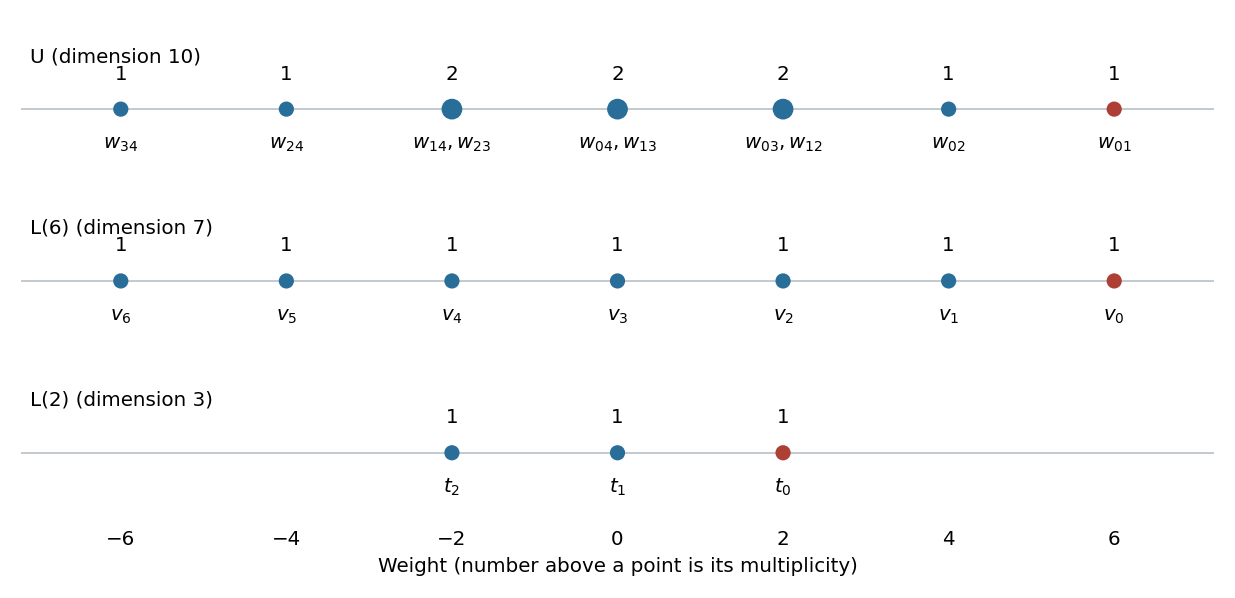
The exterior-square weight diagram and its two irreducible summands; basis labels are defined in part iii
. Details. Use the exterior-power Lie algebra representation:Reorder wedge factors when necessary and interpret repeated factors as zero. The explicit weight basis of the exterior square of Sym4 for sl2 isfor , andfor . Their weights are and , respectively.
Direct application of the displayed operators gives and the lowering chainsThe raising coefficients along the first chain are ; along the second, and . Thus each span is stable and is the required irreducible module. At the common weights , the and vectors are independent; the other weight spaces occur only in the first span. This proves that the ten vectors are a basis of and that the two spans are complementary. The highest-weight vectors are
Let be the basis of the defining representation and its dual. On a diagonal element of the Cartan subalgebra their weights are and , with . Use the tensor product and symmetric square basisIts weight is . For the three repeated weights putIf , the complete weight-space decomposition isThere are six spaces of the first type, three of the second, and three of the third. Their dimensions sum to . The weight diagram below labels every space with all of its basis vectors.
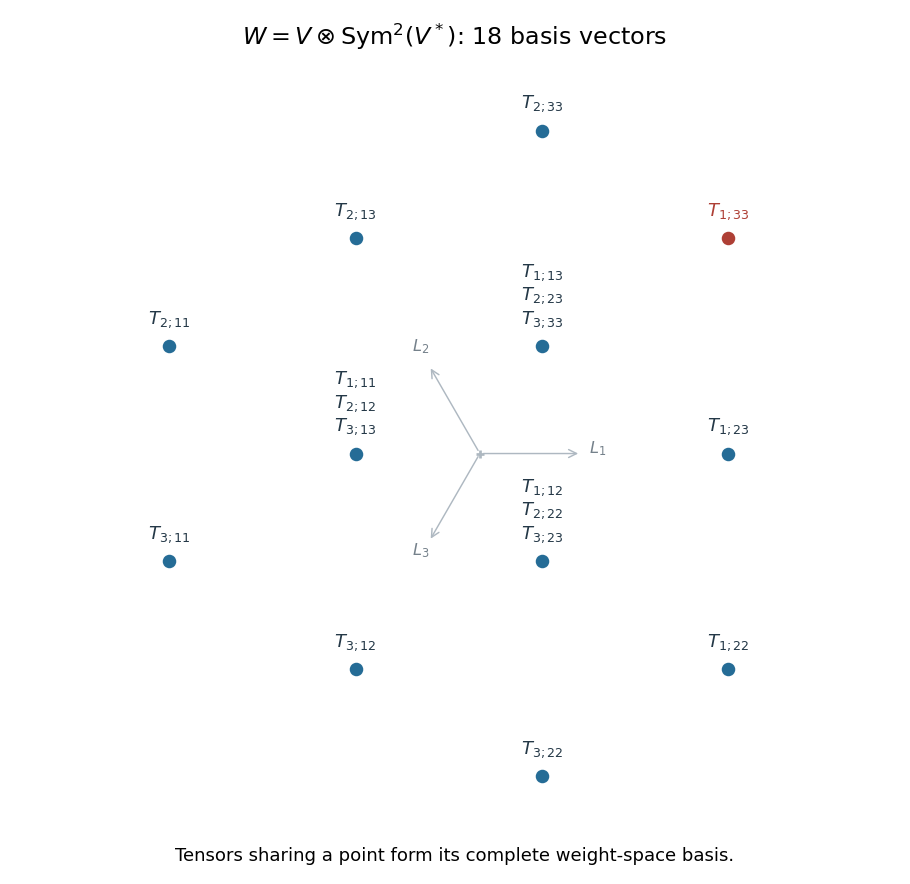
Use the contraction splitting of a defining module tensor a dual symmetric square. For a quadratic polynomial in the dual variables, defineBoth maps are intertwiners. The first is the natural tensor contraction; the second uses the invariant tensor . Directly, , so andThe vector lies in and is killed by both positive simple-root operators . It is a highest-weight vector of weight . By Weyl complete reducibility theorem, it generates the corresponding irreducible summand. The Weyl dimension formula for gives , hence , exhausting the kernel. ThereforeThe kernel has the nine outer weights of multiplicity one and each inner weight of multiplicity two; the dual summand has just the three weights , each once.
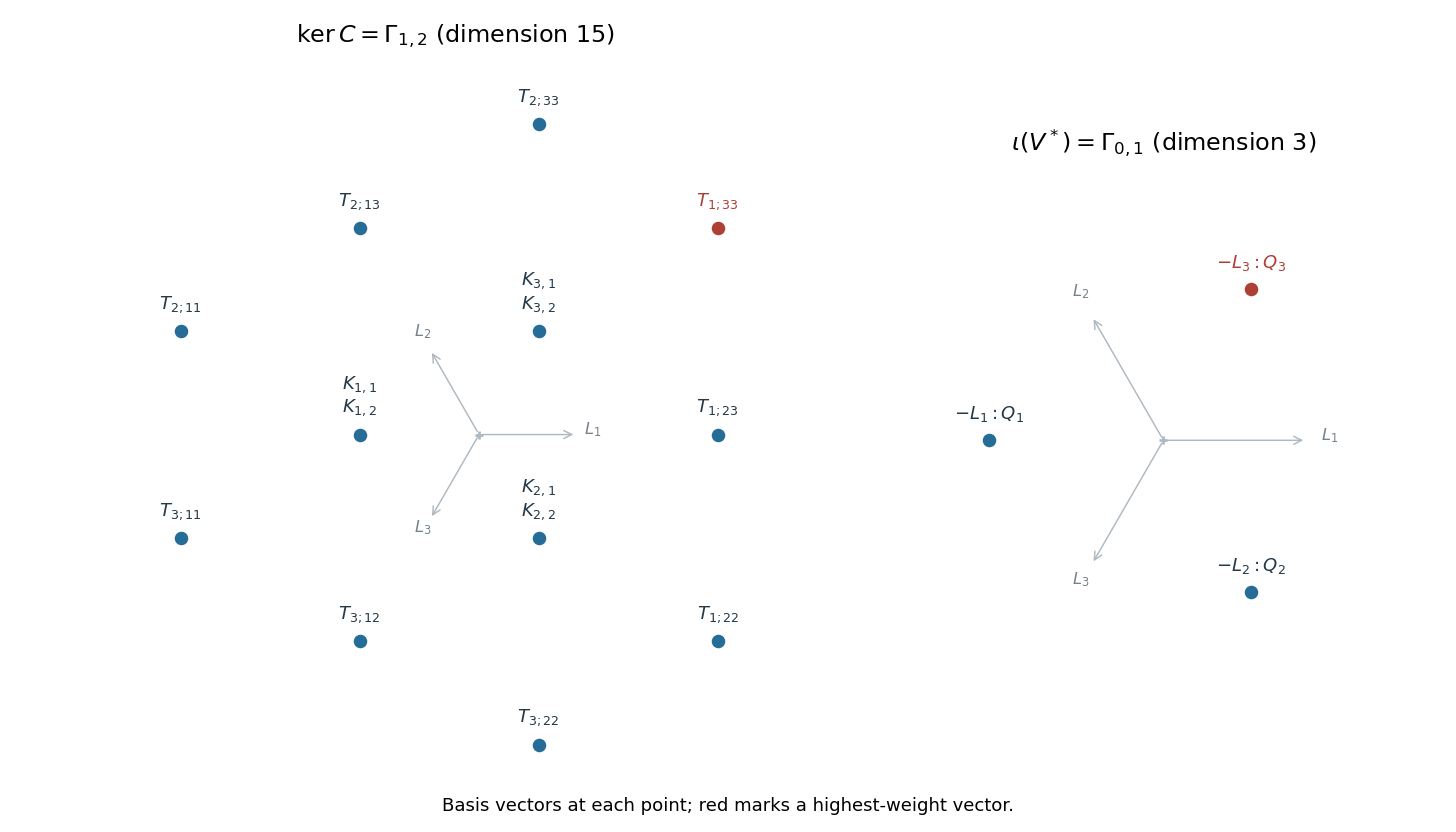
Weight diagrams and basis labels of the fifteen-dimensional kernel and the dual summand
. Details. Use the basis labels in the preceding diagrams. For each , write with , and defineThe contraction satisfies and , so both vectors lie in . They are independent and form a basis of its weight space at .
Thus the bases marked on the weight diagram of areand the diagram of uses the basis at . Each is complementary to the two kernel vectors because its contraction is . All vectors shown are therefore genuine bases, not merely weight counts. The highest-weight vectors areThe latter is highest because intertwines the dual Lie algebra representation and is its highest-weight vector.
For , put , . Then , . The matrix unit identityreads off the root spaces directly. The complete list isThus the C2 root system isAll eight root spaces have dimension one. The zero-weight space is the two-dimensional Cartan subalgebra ; zero itself is not a root.
For the Adjoint representation, the root-space decomposition gives the eight nonzero weightseach of multiplicity one, and weight zero of multiplicity two from the Cartan subalgebra. Thus its weight diagram is the root diagram with a double zero weight, and its total dimension is .
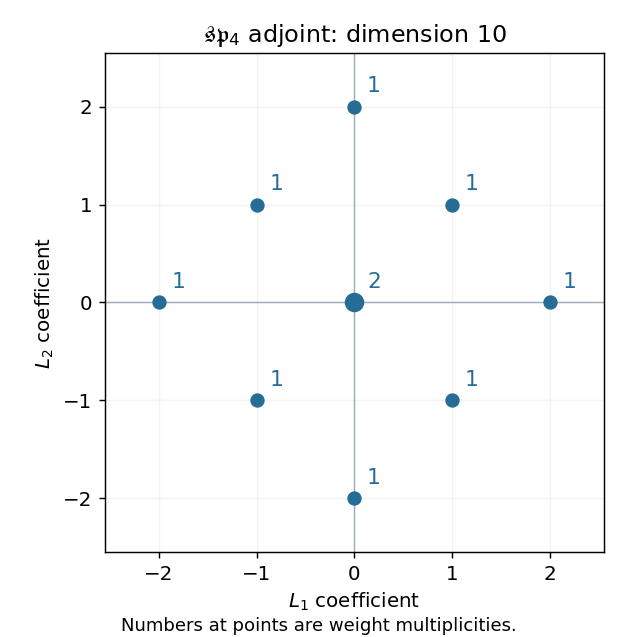
In the defining representation, the diagonal element of the Cartan subalgebra acts on the four standard basis vectors with eigenvalues . ThereforeTheir weight diagram is the four-point cross below.
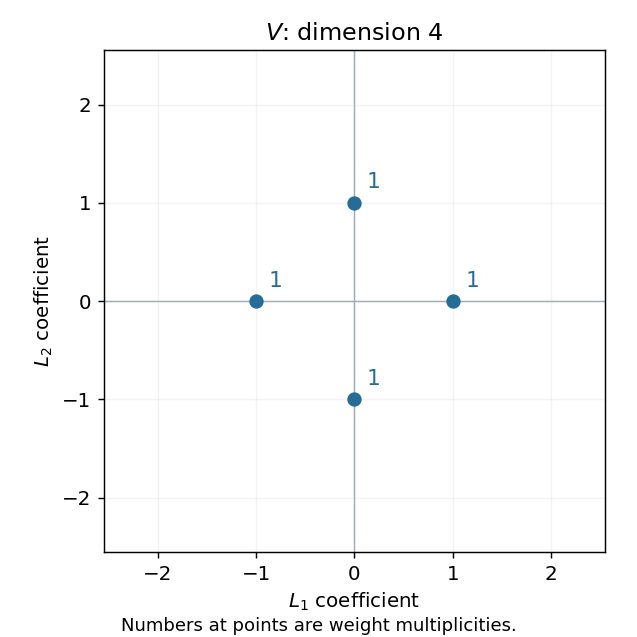
The tensor-product weight diagram is obtained by adding every ordered pair of defining weights. Each occurs once, while each of the four weights occurs twice, from the two orders of the summands. Zero occurs four times, from the ordered pairs and for . HenceThe dimensions sum to , as required for .
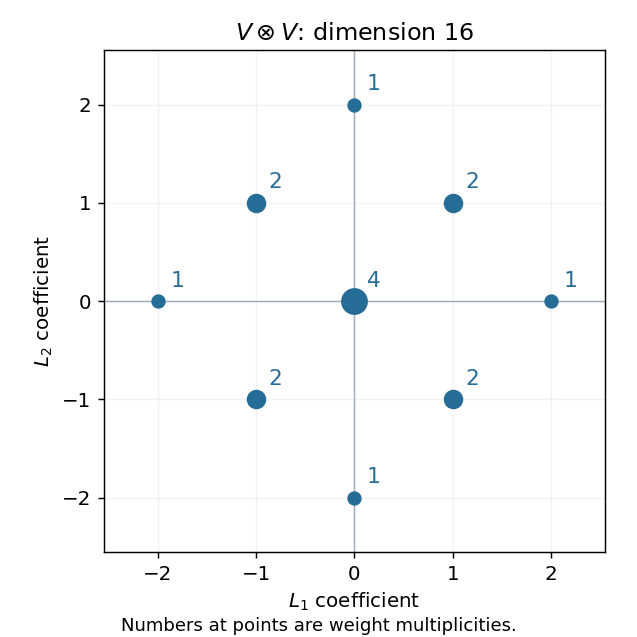


The printed phrase “not reducible” is a misprint: the requested nonzero complementary submodules establish that this tensor square is reducible. The natural reason is that the flip commutes with the Lie algebra representation. Its two eigenspaces are the symmetric square and the exterior square, givingIn the symmetric square, the four weights and four weights each occur once, while zero occurs twice. In the exterior square, the four weights each occur once and zero occurs twice; the are absent because repeated wedge factors vanish. These are the two requested complementary weight diagrams.
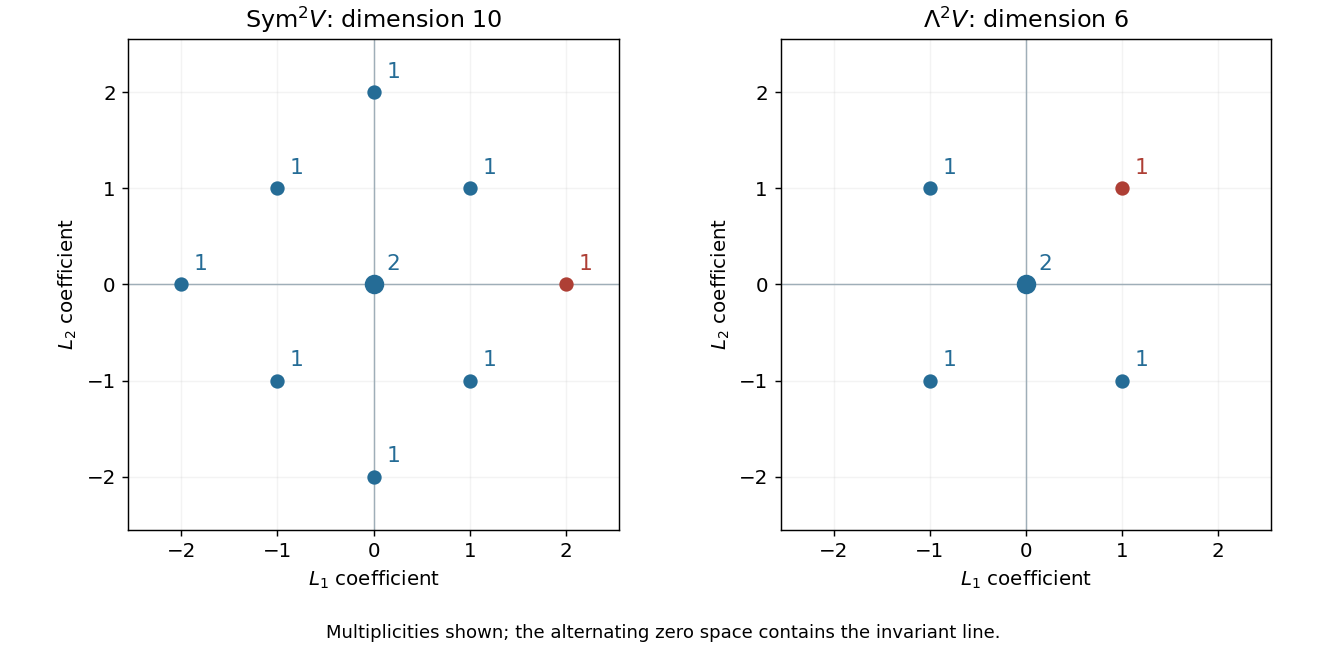
The complementary symmetric and alternating tensor submodules of the defining sp4 representation
. Details. 
More precisely, the tensor-square decomposition of the defining symplectic representation identifies with the irreducible adjoint module . The identification is an intertwiner sending a symmetric tensor to the element of the symplectic Lie algebra . For the exterior square, symplectic contraction of an exterior square has a five-dimensional kernel, the primitive exterior square, and the invariant tensor supplies a complementary line. Thus the full irreducible decomposition isHere and . The two zero weights in the exterior square split into one primitive zero weight and the invariant line.
The ambient group ring of a weight lattice isAddition is coefficientwise, and multiplication uses addition in the weight lattice. For a finite-dimensional Lie algebra representation , its formal character isThe formal character records the dimensions of all weight spaces. The ambient lattice ring should be distinguished from the representation ring of a semisimple Lie algebra, which identifies with its Weyl-invariant subring.
For the module , and the highest weight is . The decomposition givesCollecting equal weights yieldsThe six first weights and three second weights have multiplicity one; each of the three weights has multiplicity two. Their total is , as required.
For and , the tensor product of Lie algebra representations acts byThus its weight space of weight isSubstituting this into the formal character and using provesEvery sum is finite for the Lie algebra representations under consideration.
The Weyl group acts on the weight lattice by its root reflections and extends to ring automorphisms of the group ring of a weight lattice:Weights and their multiplicities in a finite-dimensional Lie algebra representation of a semisimple Lie algebra are permuted by this action, so its formal character is Weyl-invariant.
Choose a set of positive roots and putHere are the fundamental weights, and , where the Coxeter length counts positive roots carried to negative ones. For a dominant integral weight , let denote the finite-dimensional Irreducible Lie algebra representation of highest weight . The Weyl character formula isThe second denominator expression is the Weyl denominator formula. Both alternants change sign under each root reflection; their quotient is invariant. Although written as a fraction, the theorem asserts that it is a finite element of with the nonnegative coefficients given by weight multiplicities. The highest-weight classification specifies which label the irreducibles, while the root system and choice of positive roots determine every other term.
Write with finite support. The root reflection is an involution, and implies . Any fixed weight has coefficient zero. For each nonfixed orbit choose its representative withIntegrality of follows because belongs to the weight lattice; positivity is ensured by our choice of orbit representative. Pairing the orbit coefficients givesFor each pair, elementary finite telescoping showsThere are finitely many chosen orbits, and each inner sum is finite. This proves the root-binomial divisibility of reflection anti-invariants:
For precision, the geometric-series expression is interpreted coefficientwise. Its coefficient at a weight is , which is a finite sum because has finite support. On each coset of , reflection pairs the coefficients with opposite signs, so their total is zero. These cumulative sums vanish both before the smallest occupied weight and after the largest occupied weight. Only finitely many cosets are occupied, hence the product of the formal series with has finite support and equals the boxed quotient.
The individual terms need not vanish for large . For example, is anti-invariant, and its quotient is . Thus “finite sum” means a finite result after coefficientwise cancellation, not an actually truncated geometric series. No analytic convergence assumption is involved.
Work over with finite-dimensional Lie algebras and Lie algebra representation spaces. The adjoint form of Engel theorem isHere a nilpotent Lie algebra has terminating lower central series, , . We prove the stronger linear statement: if , and every member of is a nilpotent endomorphism, then there is a nonzero killed by all of , and can be simultaneously represented by strictly upper triangular matrices.
For the proof of Engel theorem by induction and normalizers, first establish a useful nilpotence fact. If , left and right multiplication by on commute. Expanding their difference givesFor , every summand contains a power of at least , so . Restrictions and induced quotient maps remain nilpotent.
Now prove the common-kernel statement, the Engel lemma, by induction on . The zero algebra is immediate. Choose a maximal proper Lie subalgebra . Its action on by commutators consists of nilpotent maps by the preceding fact. Applying the lower-dimensional induction hypothesis to its image gives a nonzero coset with . HenceThe normalizer of a Lie subalgebra is a Lie subalgebra by the Jacobi identity. Maximality implies , so is an ideal of a Lie algebra. Moreover has no proper nonzero Lie subalgebra, and every one-dimensional subspace is a Lie subalgebra. Thus .
Induction also provides a nonzero common annihilatorIt is stable under : for , , ,because . Choose representing a basis of . The restriction of the nilpotent endomorphism to the nonzero space has nonzero kernel. A vector in this kernel is killed by both and , hence by all of . This finishes the induction. When an action is not faithful, induction is applied to its image, whose dimension is no larger than ; no faithfulness assumption is hidden.
Starting with the common-kernel line, apply the same statement to each successive quotient Lie algebra representation space. It constructs a complete flag of invariant subspacesAn adapted basis represents every member of by a strictly upper triangular matrix. Every product of such matrices is zero, so every iterated commutator with entries is zero as well.
Finally, if every on is nilpotent, apply the linear statement to the Adjoint representation. With , every product of adjoint operators vanishes, so . Conversely, if , then for all , proving the other implication. This proves Engel's theorem and its simultaneous-triangularization form. The hypothesis concerns every element of the algebra, not merely a chosen set of generators.
The Killing form is the symmetric bilinear formThe facts needed here are its invariance, , and the root space identity . Invariance follows from and cyclicity of the trace:Taking , , provesNo normalization of is needed for this identity. Semisimplicity gives nondegeneracy of the Killing form, but that fact is not needed for this particular equality.
Use the standard coroot normalization . The symbols are vectors in the Cartan subalgebra, not the root-space vectors . The root-string theorem gives , so every root takes real values onThe simple coroots form a basis of this real space.
In the root-space decomposition, is zero on and scalar multiplication by on the one-dimensional space . Therefore, for ,For every term is real, so the restricted form is real. Moreover,If it is zero, all vanish. Then commutes with every root space and with , hence is central in . The center of a Lie algebra vanishes for a semisimple Lie algebra, so . Thus the Euclidean subspace of a Cartan subalgebra hasEquivalently, positivity follows because the roots span .
Put . The six roots of take values on , so the root-space decomposition givesUsing the preceding invariant-form identity with ,HenceThis agrees with the Killing form of the special linear Lie algebra, , at .
The weight lattice iswhere the fundamental weights satisfy . The coroots use the normalization fixed above.
The Killing form defines the complex-linear mapBy nondegeneracy of the Killing form on a Cartan subalgebra, this is an isomorphism. For , expand its image in the dual fundamental-weight basis:The coefficients are real by the preceding positivity calculation, and the are in . ConsequentlyIn fact both spaces have real dimension , so this inclusion is equality.
Evaluate the Killing form on the root-space decomposition. For arbitrary ,Thus the Killing dual of a coroot is the root expansionThe factor two in the positive-root expression occurs because the contributions of and are equal.
For , let , ; the positive roots are . On their values are . ThereforeThis uses the unscaled Killing form . Changing that normalization would change the scalar six.
Work with a finite-dimensional complex semisimple Lie algebra. The Dynkin diagram is obtained from its intrinsic root system, with several structure theorems entering the construction.
First choose a Cartan subalgebra . The semisimple structure theory gives the root-space decompositionThe nonzero roots span , root spaces have dimension one, and every root has its negative. The rank is .
Next use the Killing form. Its nondegeneracy on and its positive-definite restriction to the real coroot span identify the real root span with a Euclidean space. Explicitly, if , put . The sl2 subalgebra associated with a root supplies its normalized coroot and the integral pairingThe root-string theorem makes the reflection permute . Together with the absence of multiples other than , this shows that is a finite reduced root system and a crystallographic root system. These properties come from semisimple Lie algebra theory, not from the diagram's definition.
Choose a vector in that is not perpendicular to any root. Define the positive roots by positive inner product with this vector. The simple roots are those positive roots that cannot be expressed as sums of two positive roots. Root-system theory shows that they form a basis , and each root is an integer combination of them with coefficients all of one sign. Distinct simple roots have nonpositive inner product.
Use the standard Cartan matrix conventionThere is one diagram vertex for each simple root. For , the integral off-diagonal entries are nonpositive andConnect the two vertices with respectively zero, one, two or three edges. The corresponding angles are . A multiple edge carries an arrow toward the shorter root. For joined vertices, the length ratio is determined by ; hence the diagram records both angle and relative length.
For example, has simple roots and , giving two equal-length vertices joined by one edge: type . For , take and . Thenso the two vertices have a double edge directed toward , the shorter root: type .
Finally, orthogonal irreducible components of the root system correspond to the simple ideals of a Lie algebra in the semisimple Lie algebra, so its diagram is the disjoint union of their connected diagrams. Conjugacy of Cartan subalgebras and the Weyl group action on choices of positive roots make the resulting diagram independent of these choices up to isomorphism. Thus the vertices, edge multiplicities, arrows and connected components encode the simple-root geometry and the simple-ideal decomposition.
Let be a partition of an integer . Its Young diagram consists of cells with , and its conjugate partition has parts . A numbered Young tableau fills these cells bijectively with . Its row and column stabilizers permute entries within each row and each column respectively. A tabloid remembers the sets in the ordered rows, forgetting their internal order. The Young subgroup is its stabilizer, so the Young permutation module isHere the group acts by permuting numbered entries and extending linearly. A submodule is an invariant linear subspace. Give the tabloid basis its orthonormal symmetric bilinear form, denoted . This form is nondegenerate and invariant under the group. Define the column antisymmetrizer and polytabloid byThus is the Specht module, generated by any one , because the group is transitive on numbered Young tableaux. The orthogonal complement consists of vectors pairing to zero with every polytabloid.
The key calculation isTo prove it, first take . If two entries of one column of occur in one row of , their transposition fixes ; pairing the terms indexed by and cancels . This also works in characteristic two, where the paired equal terms have sum zero. Otherwise each row of contains at most one entry from each column of . The first row has entries and there are columns, so it uses every column once. Removing those entries, the second row must use exactly the columns of remaining positive height, and induction does the same for all rows. Consequently there is a unique with . Uniqueness follows from . In that caseLinearity proves the identity.
Now let be a submodule. If is not contained in , choose and with . The displayed identity puts in , so its group translates put all of in . This proves the James submodule theorem without a semisimplicity assumption.
Put . If , every proper submodule of lies in , by the same theorem. Hence is its unique maximal submodule, and is irreducible. If , the quotient is zero. This conclusion remains true after every field extension : the integral tabloid construction becomes , and the radical of the restricted form is the kernel of its Gram matrix, so it commutes with extension of scalars. A nonzero Gram entry stays nonzero in . Applying the theorem over makes irreducible. Thus a nonzero quotient is absolutely irreducible.
The precise nonvanishing criterion isA regular partition has fewer than rows of each positive length. Here is the integral pairing argument behind this condition. Write for the number of rows of length . Expanding two polytabloids into tabloids, simultaneous permutations of equal-length rows partition of an integer all contributions to their pairing into free orbits of size ; the signs agree within each orbit because the same row permutation is applied in every relevant column on both sides. Therefore every pairing is divisible by . If some , the entire restricted form is zero modulo . Conversely, reverse the order of the entries in each row of a tableau to obtain . Counting the matching column permutations in the two expansions gives, up to the harmless overall sign,Indeed the equal rows of length can be matched independently in each of their positions; after these choices the decreasing row lengths force every other matching. For a regular partition this integer is nonzero modulo , so the form and its radical quotient are nonzero. In characteristic zero it is nonzero for every shape. This supplies the requested justification of the criterion.
The dominance order on partitions is defined byWrite when the shapes are distinct as well. We first explain why the nonzero from regular partitions exhaust the simple modules. The argument also provides the required constraint on composition factors.
For a regular partition and a tableau of that shape, the operator has rank one on : on its image lies in , and the nonzero pairing with the row-reversed polytabloid from Question 1 shows that this image survives in . On , a nonzero requires every row of to meet each column of at most once, by the same cancellation. Consequently the first rows of contain at most entries from column . Summing givesThus nonzero column action forces . In particular, if , its nonzero column operators applied to the realization of either simple as a composition factor of the other's Young permutation module force both dominances; hence .
Over an algebraic closure in characteristic , the number of simple group modules is the number of p-regular elements' conjugacy classes, by the Brauer character basis theorem. Such classes in have cycle lengths not divisible by . The Glaisher partition bijection equates their number with the number of regular partitions: expand a part , with , into copies of , and invert by the base- expansion of each multiplicity. The distinct absolutely irreducible therefore form the complete list. Since they are already defined and absolutely irreducible over the prime field, the same list is valid over any of characteristic . In characteristic zero, the analogous count uses all partitions of an integer and all conjugacy classes.
If occurs in a composition series of , its nonzero action lifts through the subquotient, so . The inequality above proves . When is regular, has rank one on and rank one on . An operator preserving a finite filtration has rank at least the sum of its ranks on the successive quotients: relative to an adapted basis its matrix is block triangular, and nonzero pivot minors of the diagonal blocks combine to a nonzero minor. Therefore can occur at most once. It occurs at least once as the quotient of . We have provedFor a nonregular , equality is impossible because .
Over , Young's rule gives the exact decompositionThe Kostka number counts Semistandard Young tableaux of shape and content : entry occurs times, rows weakly increase, and columns strictly increase. In particular and nonzero multiplicity requires dominance.
For the requested induction, products mean induction of the external tensor product of group representations from to : on , the pair acts as . One can compute using Young's rule alone. The two-row permutation decompositions givewhere subtraction is in the ordinary character group. Reordering row blocks gives isomorphic permutation modules. Inducing after multiplication by the trivial gives . For a direct Kostka number calculation, the differences are one forand zero for every other partition of an integer of seven. To see these counts without enumerating arbitrary fillings, first fill a shape with five entries of content or and then add two 's. The added cells must be a horizontal strip. Removing them leaves, for content , one of with multiplicity one, and for content one of with multiplicity one. The first two shapes cancel, leaving precisely the horizontal two-cell extensions of , namely the five listed shapes. ConsequentlyThe hook-length formula checks the dimensions: .
Since , Question 2 shows that every composition factor of is for a regular partition . If is regular, its radical quotient occurs once: it occurs as a quotient, and its multiplicity is bounded above by the multiplicity one in . All remaining factors have strictly dominating labels. A nonregular row has only strictly dominating regular labels.
Define . Order the row labels, all partitions of an integer of , and the column labels, the regular partitions of an integer, by the same total order refining decreasing dominance. ThenThe matrix is generally rectangular. Its submatrix on regular rows is lower unitriangular in this decreasing convention; placing least dominant shapes first would transpose the visual triangular convention, not the indices.
This is the decomposition matrix, not just an abstract composition factor table. The standard polytabloid basis makes a free invariant integral lattice whose extension to characteristic zero is the ordinary irreducible . Reducing this same lattice modulo gives exactly the modular . On p-regular elements, reduction of its ordinary character is the sum of the Brauer characters of its composition factors, with coefficients . These are the defining decomposition numbers; the resulting class in the modular representation ring is independent of the chosen invariant lattice.
For , take rows in that order. In characteristic zero, or , all three Specht modules are irreducible by Maschke's theorem, andFor the regular labels are andIndeed the sign representation equals the trivial representation. The two-dimensional is the sum-zero subspace of the three-point permutation module. Over an algebraic closure, a -cycle has two distinct nontrivial third-root eigenvalues there, and a transposition exchanges their lines. Neither line is invariant under , proving absolute irreducibility.
For the regular labels are andIn the same sum-zero space the vector now spans an invariant trivial line. Its one-dimensional quotient is sign: the determinant of the sum-zero representation is sign, and the determinant of the invariant line is trivial. Therefore has one trivial and one sign factor, with sign its simple head . The bottom Specht module is itself sign. This proves every entry of the three possible matrices.
Use for the ordinary irreducible character of . Multiplication of different degrees is the product in the induction ring of symmetric-group characters: it induces an external tensor product of group representations. For , the skew Young diagram is the set of cells of outside . A filling of it is a semistandard Young tableau when entries weakly increase along rows and strictly increase down columns. Its content means that occurs times. Its reading word takes each row right to left and the rows top to bottom. A lattice word has, in every initial segment, at least as many 's as 's for every .
The Littlewood–Richardson rule sayswhere the Littlewood–Richardson coefficient counts such skew semistandard fillings with content and lattice reading word. If is not contained in , the coefficient is zero. Over characteristic zero this is an actual direct-sum multiplicity statement; over other fields the analogous statement describes a Specht filtration, not necessarily a decomposition into simple modules.
For the required coefficient, the five skew cells areTheir columns are all distinct. Content uses three 's and two 's. The first reading letter must be by the lattice word condition, and row monotonicity forces both top cells to be . The remaining three cells, in reading order, can then be filled by , , or . The resulting words , , all satisfy the lattice inequalities, and exhaust the possibilities. Thus
For the determinantal form of a symmetric-group character, set in degree zero and for . The one-row character is trivial. The one-row specialization of the Littlewood–Richardson rule is the Pieri rule: multiplication by adds a horizontal strip of cells, since all entries are and no column can contain two of them.
Here is an explicit determinant argument, so that the desired form is genuinely deduced. Under the Frobenius characteristic map, corresponds to the complete homogeneous symmetric polynomial , whose monomials enumerate weakly increasing sequences of entries. Fix variables and rows. Let a directed lattice path run right or up from to , and assign weight to a horizontal step at height and weight one to a vertical step. The sum of its weights is . Expanding the determinant of this path matrix sums signed families connecting the sources to a permutation of the destinations.
Cancel intersecting families as follows. Choose the first intersection in a fixed order of vertices, and then the first pair of paths meeting there. Exchange their tails after that vertex. The total weight is unchanged, while the endpoint permutation changes by a transposition, reversing the sign. Choosing the intersection in this fixed order makes the operation an involution. The surviving families are nonintersecting; the ordered sources and ordered destinations force the identity endpoint pairing. Record the heights of the horizontal steps of path as row of a tableau. Rows weakly increase, and nonintersection of successive paths is precisely strict increase down the shared columns. Conversely every semistandard Young tableau gives one surviving path family. Thus the determinant has the semistandard-tableau generating function .
Young's rule identifies this generating function with the characteristic of : its coefficient at a monomial of weight is , the multiplicity obtained by pairing with the Young permutation module of type . The Frobenius characteristic map is injective and respects induction products. Transposing the path matrix does not change its determinant, soThis is the character version of the Jacobi–Trudi identity.
For the example the matrix isExpanding gives the concise answerAt the identity the six induction-product dimensions are , respectively; their alternating sum is , agreeing with the hook-length formula for .
For a Young diagram , a Removable node of a Young diagram is a cell whose deletion leaves a partition of an integer diagram; equivalently it is the last cell of row with . Let denote the distinct shapes obtained by deleting one such cell. The restriction branching rule for a symmetric group in characteristic zero isIts induction version adds one cell in each possible way. Over an arbitrary field, restriction instead has a Specht filtration with these successive quotients, each once; it need not split.
To prove restriction, list the removable nodes from top to bottom. By the standard polytabloid basis, a basis of consists of with standard. Its entry is necessarily at a removable node. Let be the span of the basis vectors having at one of the first listed nodes, and put . These are -invariant. To verify this, apply a permutation of and straighten the resulting polytabloid by column antisymmetry and Garnir relations. A relation not involving the column containing leaves its row unchanged. In straightening a row descent, cannot be in the top segment of the right column: such a descent would require a left entry larger than . When belongs to the bottom segment of the left column, moving it to the shorter right column can only raise its row. In a relation involving that column, the terms which alter the position of place it in a higher row; the remaining terms have it at its old node. Thus straightening never moves it past the current top-to-bottom cutoff.
On send the class of , with at the th node, to the polytabloid obtained by deleting that node. The same straightening calculation proves equivariance: relations not moving are exactly the relations in the smaller diagram, and terms moving upwards vanish in the quotient. Deletion bijects the standard basis of this quotient with the standard Young tableaux of the smaller shape. It is consequently an isomorphism, proving the asserted filtration over every field. In characteristic zero, Maschke's theorem splits the filtration and gives the direct sum. Finally Frobenius reciprocity gives the induction rule, since a constituent has multiplicity one exactly when .
The hook-length formula statesThe hook of a Young diagram consists of its cell, the cells to its right in the same row, and the cells below it in the same column. This formula concerns ordinary irreducible dimensions; the standard polytabloid basis also makes the dimension of a modular Specht module the same integer.
All transpositions are conjugate, have order two, and generate . In a one-dimensional ordinary representation their common scalar is therefore either or . These choices give precisely the trivial representation and the sign representation . At they coincide. The standard shape has dimension : its standard Young tableau is specified by choosing the bottom entry from . Conjugating the shape preserves the dimension, so has the same degree.
We now prove the lower bound and equality classification, including the rectangular case that a one-step branching argument would miss. Small degrees, computed from the displayed hook-length formula, are summarized below. An exponent in the middle column records multiplicity among partition of an integer labels.
| Complete multiset of irreducible degrees | Least degree of a shape other than the linear and standard shapes | |
|---|---|---|
| No other shape | ||
| at | ||
| at | ||
For example, at the conjugate pairs , , , , have degrees , and the remaining shape has degree . These checks also identify every small equality case.
Induct on , assuming the lower bound for all smaller degrees. If a non-linear, nonstandard shape has at least two removable nodes, none of its predecessors is a single row or single column: adding one cell to a row or column could produce only a linear or standard shape. Hence two predecessors each have degree at least , and branching gives . If it has only one removable node, it is a rectangle with . Its sole predecessor is , which has two removable nodes. Both ensuing shapes of size are non-linear; a linear shape after these two deletions could occur only in the excluded rectangle. Therefore two-step branching gives . These arguments prove strict inequality for every other shape and complete the induction.
Consequently the least non-linear ordinary degree of a symmetric group isFor degree , the only labels are the two standard conjugate shapes, except that at there are also and , both degree five. At the exceptional lower degree is two, while the degree-three labels remain . There is a necessary endpoint qualification to the printed lower-bound claim: has only its two one-dimensional representations, so it has no degree exceeding one. At the listed degree- shapes are exactly its two linear shapes; at the two standard conjugate labels coincide.
The kernel intersection theorem for Specht modules uses maps that move entries between adjacent rows. For and , let replace the row lengths by , keeping every other length unchanged. This is allowed to be a composition rather than a decreasing partition of an integer, and a zero row can be omitted. For a tabloid with row sets , defineby summing over all -subsets : the new row is , the new row is , and all other rows are unchanged. These are module homomorphisms, since relabelling commutes with choosing subsets. The theorem isIt holds over every field. Column cancellation shows the inclusion of in each kernel; the full theorem identifies the common kernel with the Specht module.
For completeness, the semistandard homomorphism theorem concerns a partition of an integer , a composition , and fillings of shape with occurrences of . Such a filling gives : replace its labels by the numbered entries of an input tableau, and sum the output tabloids over distinct permutations of the labels within each input row. Label assigns an entry to output row . The use of distinct assignments avoids dividing by any factorial. Let be its restriction to . The restrictions indexed by Semistandard Young tableaux are linearly independent. They form a basis of when , or when is two-regular. In characteristic two for a two-singular shape they need not span; omitting this exception would make the statement incorrect.
We now prove the invariant vector criterion for a Specht module directly from the first theorem. The group acts transitively on the tabloid basis of , so any invariant vector has all coefficients equal. Thus , where is the sum of all its tabloids and is nonzero over every field. Fix , write , , and count preimages of one output tabloid. The retained entries are prescribed; among the entries of the enlarged row, exactly must have come from its old row. HenceThe common-kernel criterion becomesfor every adjacent pair, where .
Suppose , and let be least with . If , its lowest base- digits are all . For any , adding to creates a carry at the lowest nonzero digit of . At that position the digit of is smaller than the corresponding digit of . Lucas's theorem therefore gives . Conversely, if one of the first digits is not , take . Minimality of gives , while addition at that digit creates no carry. Lucas then yieldsThis proves the claimed equivalence, and thereforeThe invariant space, when present, is one-dimensional. At the last row put ; then and the condition is vacuous. This congruence formulation is for positive characteristic. In characteristic zero the positive binomial coefficients cannot vanish, so an invariant vector exists precisely for the one-row shape .
Finally suppose is regular. It has a unique simple head , by Question 1. The given sign-twisted duality of Specht modules impliesThus is sign exactly when the conjugate shape satisfies the invariant congruences.
Here is an explicit solution of those congruences under regularity. Write the positive column heights of as , so . Regularity says , including , because this difference counts rows of length . Starting with , the congruence for its preceding row forces . Since , the only possibility is . Repeating upwards forces every earlier height to be . Consequentlywhere a zero final part is omitted. Conversely this shape satisfies every invariant congruence, so its conjugate is the desired regular label of the modular sign representation:Zero parts are omitted. For this is , as it should be because sign is trivial. In characteristic zero the answer is .
A rim hook is a connected skew diagram containing no square, whose removal leaves a partition of an integer diagram. Its leg length is its number of occupied rows minus one. The Murnaghan–Nakayama rule states that, if a permutation has cycle type , thenIteration removes one hook for each cycle length; the empty diagram has character one at the empty cycle type.
For shape and cycle type , there are exactly two removable four-cell rim hooks. The remaining shapes are and ; the removed hooks have leg lengths one and two respectively. In shape the only removable three-cell rim hook leaves and has leg length one. In shape the only such hook leaves and again has leg length one. Since the characters of and at a transposition are and , we obtainand henceThe cycle lengths can be taken in any order; using makes the two branches of the computation explicit.
Now consider the ordinary induction product . A hook partition is , equivalently a partition of an integer whose second row has length at most one. If a hook shape occurs in the Littlewood–Richardson rule, then , forcing itself to be a hook. In the skew hook , the new cells consist of a segment in the first row and a segment down the first column, with no shared column between those two segments. Every first-row entry must be : its rightmost entry is the first letter of the lattice word, hence is , and weak row increase forces all entries to its left to be too. The column segment has strictly increasing entries. Thus only can be repeated, forcing the content to be a hook as well. This also proves the assertion when the top segment is empty, since then every entry lies in a strictly increasing column.
Write the two nonempty hook factors as and , with and . Let the prospective resulting hook have top-row length and leg length . Its new top segment has cells and its new column segment has cells. The content consists of ones and the single letters . All those larger letters must be in the new column; its strict increase allows either no or exactly one . There are therefore only two possibilities:In the first case fill the top segment with ones and the column with . In the second, use top ones and column . Each filling is unique and has a lattice word, including the case with an empty top segment in the second filling. This provesBoth displayed multiplicities are one.
To deduce the full-cycle value from this product result, rather than quote the Murnaghan–Nakayama rule again, form the virtual characterFor every proper Young subgroup and every pair of its irreducible characters, the hook-product calculation givesIf a factor is not a hook there are no hook constituents; if both are hooks, their two consecutive leg lengths cancel in this alternating inner product. By Frobenius reciprocity and the completeness of the product irreducible characters, restricts to zero on every such subgroup. Any permutation with more than one cycle preserves a nonempty proper subset and is conjugate into one of these subgroups. Thus is supported only on the class of -cycles.
Its inner product with the trivial character is one, since only the one-row hook contributes. That class has size , so , giving . For any irreducible character, the support calculation then yieldsBy character orthogonality, the left side is for and zero otherwise. These are real integers, provingFor the same conclusion holds directly. This derives the requested special case from the Littlewood–Richardson rule and Frobenius reciprocity.
Choose , pad the partition of an integer with zeros, and define its beta numbers byThey form a strictly decreasing set of nonnegative integers. Conversely, from its decreasing enumeration recover . With these are exactly the first-column hook lengths, since . Padding changes the numbers: increasing by one replaces by , and leaves the represented partition of an integer unchanged.
Arrange positions on runners, putting position on runner at height . A bead occupies each position in the beta set. This is the abacus of a partition. The hook criterion in a beta set says that a bead and a gap correspond to a hook of length ; replacing by removes the corresponding rim hook. In particular removing a rim -hook moves a bead from to the vacant position immediately above it on the same runner. Its leg length counts the beads in the intervening positions of the full linear numbering.
For an explicit example, take , , and . Its beta set is . Runner zero has beads at , runner one has a bead at , and runner two is empty. Packing upwards gives , which represents ; thus the three-core is and the weight is two.
Every bead slide reduces the sum of occupied positions, so repeated slides terminate. The number of beads on each runner is unchanged. At termination they must occupy exactlyon runner , since any gap above a bead would allow a further slide. Hence the final beta set is uniquely determined by the initial runner counts, independently of the order of hook removals. Increasing the number of beads by replaces by , adds one bead to each runner, and gives exactly the same represented core after packing. General changes in padding follow by applying ; packing commutes with this operation up to the cyclic relabelling of runners. Therefore the result is independent of both removal order and padding:The weight of a partition is .
A block of a group algebra is an indecomposable two-sided summand , where is a primitive central idempotent. The identity decomposes into pairwise orthogonal such idempotents; a module belongs to a block when its idempotent acts as identity and the other block idempotents act as zero. For ordinary characters, use a splitting p-modular system , or extend the residue field first: the block idempotents lift to , and determine which ordinary irreducible -modules lie in each -block. The symmetric group is split over its prime field, so extending introduces no change to the resulting partition of an integer labels.
The Nakayama block theorem, traditionally called the Nakayama Conjecture for symmetric groups, isThe simple modules in that block are exactly the with regular labels having that core. At fixed , the common core also fixes the weight. Here is an essay proof route through central characters, specifying the main algebraic and combinatorial steps and why each is needed.
First introduce the commuting Young–Jucys–Murphy elementsTheir commutators vanish because contributions supported on each triple of letters cancel. Symmetric polynomials in the are central: for adjacent transpositions , the relations , show that commutes with symmetric expressions in , and it commutes with the other . Since these transpositions generate , the symmetric expressions commute with the whole group algebra.
The substantial generation ingredient is the integral Jucys–Murphy description of the center of a symmetric-group algebra: every conjugacy-class sum is an integral symmetric polynomial in the . Its proof expands symmetric monomials in these sums of transpositions and organizes the resulting class sums by the number of moved letters and cycle filtration; triangular elimination supplies integral spanning, rather than merely rational spanning. A useful first identity in this construction isIndeed, when adjoining the letter , either choose and leave it as a singleton cycle, or choose a transposition and insert it into the cycle containing ; this gives every permutation uniquely. The full generation step distinguishes the individual class sums which this first identity groups together. Its integrality is essential: a description only over could use denominators divisible by and would not prove generation of the modular center. Since class sums form the integral basis of the center, this integral theorem reduces to the same generation statement over .
Next determine their scalar action. In the characteristic-zero tableau basis of , is diagonal with entry the Content of a Young-diagram cell occupied by , namely column minus row. This follows recursively along the multiplicity-free branching chain: the commuting operators preserve each path line, and determines the successive eigenvalues. Consequently a symmetric polynomial acts on byThis is independent of the ordering of the cells. The scalar identity holds on the integral Specht lattice, so after modular reduction it depends only on the multiset of contents modulo . Every composition factor has this same central character of a block.
Two simple modules are in the same block exactly when their central characters agree. The center of a block is a commutative local finite-dimensional algebra; its semisimple quotient gives one scalar character, while the orthogonal block idempotents separate different blocks. By the generation theorem, equality on all symmetric polynomials in the is enough. Conversely, different residue multisets are detected by elementary symmetric polynomials: the monic polynomial over recovers the multiplicity of each residue by unique factorization, including multiplicities larger than . Thus block equivalence is exactly equality of the integersThis gives the residue-content criterion for symmetric-group blocks without assuming that the sum of contents alone distinguishes blocks.
Finally identify residue content with the core. A removable rim -hook has consecutive contents modulo , hence removes one cell of each residue. Therefore shapes with the same core and the same size have the same residue counts. For the converse choose divisible by and at least , and write for the runner charges. Starting from the empty partition of an integer gives . Adding a cell of residue moves a beta-number bead from residue to residue , increasing and decreasing . The same changes occur in when increases by one. Induction on the cells therefore givesEqual residue counts give equal charges and hence equal packed runner configurations, so they give the same core. This completes both directions of the block criterion. The argument exposes the three essential bridges: integral center generation, its scalar content evaluation, and the abacus identification of residue data with a unique core.
Take to be linear in its first argument and conjugate-linear in its second, with . For a Hermitian form over a quadratic finite field, . We first establish the quadratic finite-field norm and trace surjectivity needed for orthonormalization of a finite-field Hermitian form. The field norm maps onto because the multiplicative group of a finite field is cyclic of order . The field trace is an -linear map into . It is nonzero: a nonzero polynomial of degree cannot vanish at all elements. It is therefore onto, including in characteristic two.
There must be with . Otherwise, for any , expanding the diagonal value givesIf , varying contradicts the surjectivity of the field trace. Thus all pairings would vanish, contrary to nondegeneracy. Choose with ; then has norm one. Every decomposes uniquely asThe restricted Hermitian form over a quadratic finite field on the orthogonal complement for a sesquilinear form is nondegenerate: a vector there orthogonal to that complement is also orthogonal to , hence to all of , and is zero. Induction produces an orthonormal basis .
The unitary group over a finite field is the group of invertible -linear maps preserving . In the orthonormal basis just constructed, its concise description isThe notation here uses the size of the matrix field; it is also frequently written . There is no determinant-one condition in this definition.
We construct a Hermitian hyperbolic plane over a finite field inside each successive two-dimensional piece. By the field norm surjectivity proved above, choose with . From two vectors in an orthonormal basis, form . Then , so is a nonzero isotropic vector. Nondegeneracy supplies with ; rescaling the second argument achieves this normalization. In fact already works in this two-dimensional piece. By quadratic finite-field norm and trace surjectivity, choose with and put . Direct expansion givesThus are linearly independent, and their Gram matrix is , which is invertible even in characteristic two. Their span is nondegenerate, so its orthogonal complement for a sesquilinear form is again nondegenerate. Repeat the construction there. In even dimension this exhausts ; in odd dimension the final one-dimensional complement has a nonzero diagonal value, which can be normalized to one using the field norm. Calling its vector , we obtainwith the terms present only in odd dimension. This proves all the requested pairings and the basis assertion.
The printed hint needs a qualification. If is irreducible over , its two roots are conjugate, so and ; the hinted vectors then do work. They need not work when it splits. For example, over its roots are , fixed by conjugation in . For either choice the proposed has norm , respectively or , rather than zero. The norm-and-trace construction above proves the assertion without that restriction.
Use the course convention that a root system is finite and is a reduced root system satisfying the crystallographic root system condition. These hypotheses are essential for the angle restriction. For roots , the two Cartan integerssatisfy . If are not parallel, the strict Cauchy-Schwarz inequality and integrality give . These values give angles , or , or , and or , respectively. If the roots are parallel, reducedness implies , giving or . ThereforeHere are examples accounting for every angle. In the A1 root system, the pairs and give . Two roots from different summands of give . The six unit vectors at angles form an A2 root system: taking one root at angle zero and another at or gives those two angles. In the B2 root system , pair with or to obtain . In a G2 root system, take short unit roots at angles and long roots of length at angles . A short root at zero paired with long roots at gives the remaining angles.
If the roots are parallel, their Euclidean norms are equal by reducedness. For nonparallel, nonorthogonal roots, the Cartan integers above are nonzero integers of the same sign and have product or . AlsoThe absolute pairs are , , or . HenceMore precisely, angles require equal lengths; angles require a long-to-short ratio ; and angles require a ratio . The exclusion of orthogonality matters: orthogonal irreducible components can be scaled independently.
Choose a fundamental system of a root system . Distinct simple roots have nonpositive inner product. Their Cartan matrix has diagonal entries two and off-diagonal entries , where either , or are positive integers. The root-system finiteness lemma gives . After exchanging the simple roots, the possibilities areTheir angles and relative lengths determine the two simple roots up to an orthogonal transformation and common scaling, except that the two orthogonal components can be scaled separately.
To see that no extra roots remain unspecified, write a positive root with nonnegative integer coefficients. If it is not simple, some simple root has : otherwise . The root reflection in subtracts a positive integer multiple of . The other coordinate stays nonnegative; since is not proportional to , it is positive, so the reflected root must still be positive by the defining sign property of a fundamental system of a root system. Its height decreases. Repeating reduces to a simple root. Thus every root is in a Weyl group orbit of a simple root.
For the four matrices, applying their simple reflections gives, respectively, the following positive roots:where in the last two rows is long, short. For example, and for the displayed matrices when the convention is . The sets comprising these positive roots and their negatives are invariant under both reflections, as direct substitution verifies. The height argument therefore shows they are the whole root system. This proves the classification of rank-two root systems:
A Dynkin diagram has one vertex for each simple root. Vertices are joined by bonds, where are the off-diagonal Cartan integers. No bond means orthogonality; one, two and three bonds mean angles . A multiple-bond arrow points to the shorter root. Thus the Dynkin diagram determines the Cartan matrix, including the relative lengths inside each connected component.
An irreducible root system corresponds to a connected Dynkin diagram. The classification of finite crystallographic Dynkin diagrams givesHere is already represented by , and by . General systems are orthogonal direct sums of these, with separate component scales. The following diagrams specify all the types; dots denote a continued chain, not additional vertices.
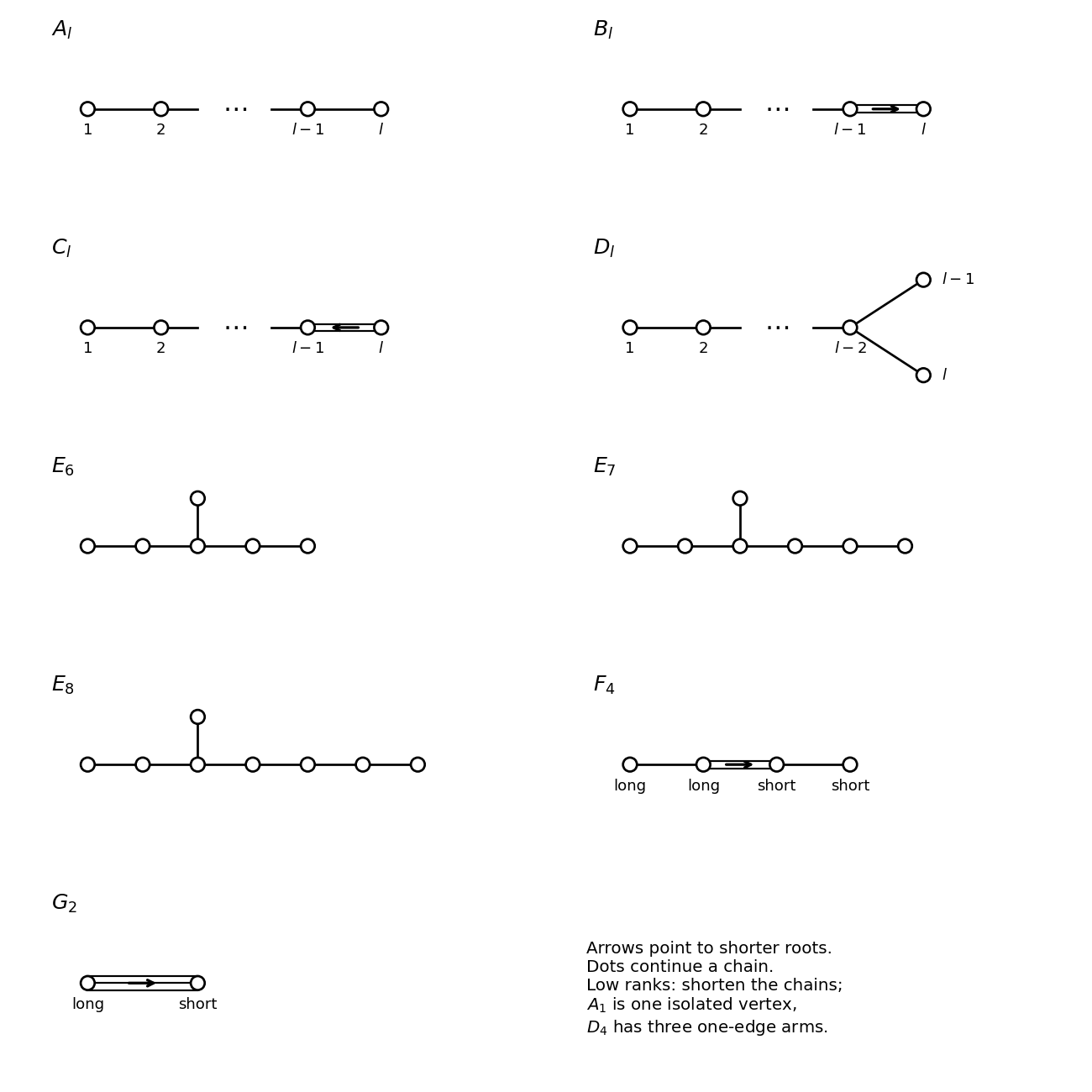
Finite irreducible crystallographic Dynkin diagrams, with every arrow pointing toward the shorter root
. Details. 
For orientation, the An Dynkin diagram is a single chain, the Bn Dynkin diagram has a terminal double bond pointing to its terminal short root, and the Cn Dynkin diagram reverses that arrow. The Dn Dynkin diagram has arm lengths . The En Dynkin diagram has arm lengths ; ; or . The F4 Dynkin diagram has a central double bond and the G2 Dynkin diagram a triple bond.
The positivity behind this finite list is the positive-definite Gram matrix of the simple roots. In particular the underlying graph is a tree: if it contained a cycle, the sum of its normalized roots would have squared norm at most zero, since each bonded inner product is at most . This contradicts linear independence. Restricting the possible bonds and branches by positive definiteness gives precisely the listed chains and trees. Conversely their Cartan matrices are positive definite after symmetrization and their reflection-generated root sets give the indicated finite root systems.
Put and . These elementary matrices belong to the special linear group. Let have determinant one. If , elementary row elimination givesThe remaining diagonal matrix is also a product of the given generators. Indeed, for , direct multiplication givesHence . If , its determinant forces , and has upper-left entry . The established case applies to it, and is again generated. No division by two was used, so the proof works over every field. The upper and lower elementary unipotent matrices generate .
Articles were limited to the first 100 out of 1908 total.
Articles by others on the same topic
There are currently no matching articles.