For put . The equilibrium points are and , withThe positive branch is always a saddle. The negative branch is a sink for and a source for ; it is a node or focus according as is positive or negative. At the two branches meet in a saddle-node bifurcation when ; at the double zero eigenvalue with a nontrivial Jordan block gives a Bogdanov–Takens bifurcation. There are no real equilibrium points for .
The Hopf bifurcation curve is , equivalently on its positive- branch. Its frequency is . To determine the direction, shift , at this threshold; thenSet , to obtain , . A quadratic near-identity transformation, or harmonic averaging with its quadratic correction retained, gives the radial cubic coefficientwhere . The radial equation is . Hence the Hopf bifurcation is subcritical, with an unstable small periodic orbit on the stable-focus side .
The saddle's outgoing separatrix can return to its incoming separatrix, creating a homoclinic orbit. This global bifurcation cannot be detected from the equilibrium point's Jacobian matrix alone. The weakly Hamiltonian scaling below locates its curve and shows how the unstable Hopf cycle grows into the saddle loop. The final diagram includes the local saddle-node and Hopf curves and this global curve; it describes the neighborhood of the double-zero point.
Set and use the stated weighted spatial and parameter scales. Dividing the two equations by and respectively giveswhere prime now means differentiation with respect to . The Hamiltonian function satisfiesThus is conserved for .
For , let . The conservative system has a center at with and a saddle at withClosed contours in the left potential well have . At the left-hand separatrix is a homoclinic orbit, sinceIt leaves and returns to , with its left turning point at . The right separatrix branches are unbounded. The energy levels above the saddle value are open, as are the separate right-hand components of lower energy levels. For there is no nondegenerate potential well and no such saddle loop.
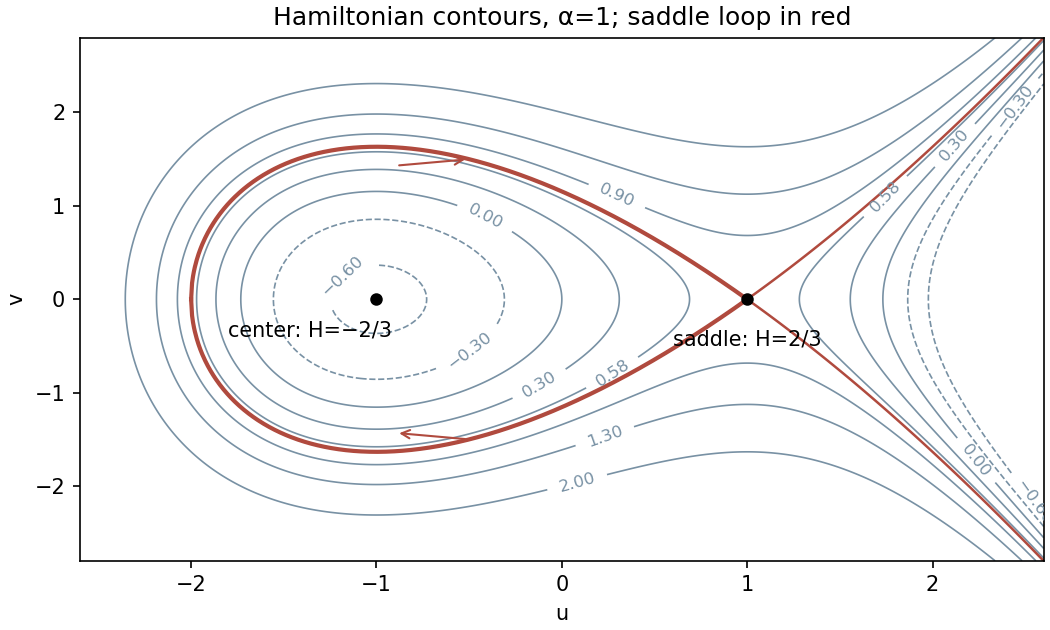
Conserved-energy contours, center and saddle loop of the leading Hamiltonian system
. Details. 
The displayed orbit has the normalization . To verify it put and . Then , , soAlso , and , exactly the same expression as . Therefore the conservative equations hold. As , ; at the orbit reaches . Its conserved energy is , so this is the required homoclinic orbit.
For a general positive set . Rescaling the verified solution givesDirect differentiation gives and , and the endpoints are . This restores the parameter dependence implicit in the normalized printed orbit.
A persistent saddle loop must return with the same energy. The Melnikov energy-balance method therefore requires, at first order,For the normalized orbit of part (c), put . Since , and ,For the general orbit has and . The energy mismatch is therefore proportional to , whose derivative with respect to is nonzero. This simple zero selects the saddle-loop curve:The remainder can be sharpened. Reversal of and interchanges and without changing the saddle-loop condition. Smoothness of the homoclinic splitting thus makes the selected an even function of , givingThe leading coefficient alone is enough to separate it from the Hopf curve . The integral hint in the PDF equals for nonnegative even integers ; for odd its integrand is odd and the integral is zero. Only even powers enter the calculation above.
Near the double-zero point, and with the stipulated absence of further bifurcations, the distinct open regions are:
- : no equilibrium points or local periodic orbits; wherever , and the flow passes through the bottleneck region.
- , : a saddle and a stable node or focus, with no local periodic orbit.
- , : a saddle, a stable focus and an unstable periodic orbit surrounding the focus. This cycle is its local basin boundary.
- , : a saddle and an unstable node or focus, with no small periodic orbit.
On the homoclinic curve the cycle becomes a saddle loop; its positive saddle trace makes the loop repelling on the cycle side. At the Hopf curve the unstable cycle shrinks into the negative equilibrium point. The node–focus discriminant curves merely change the spiral appearance and are not additional bifurcations. The impossibility of a periodic orbit for can also be seen without a picture: at a local minimum of periodic one would have and , but at its maximum the same strictly positive expression would be required to be nonpositive.
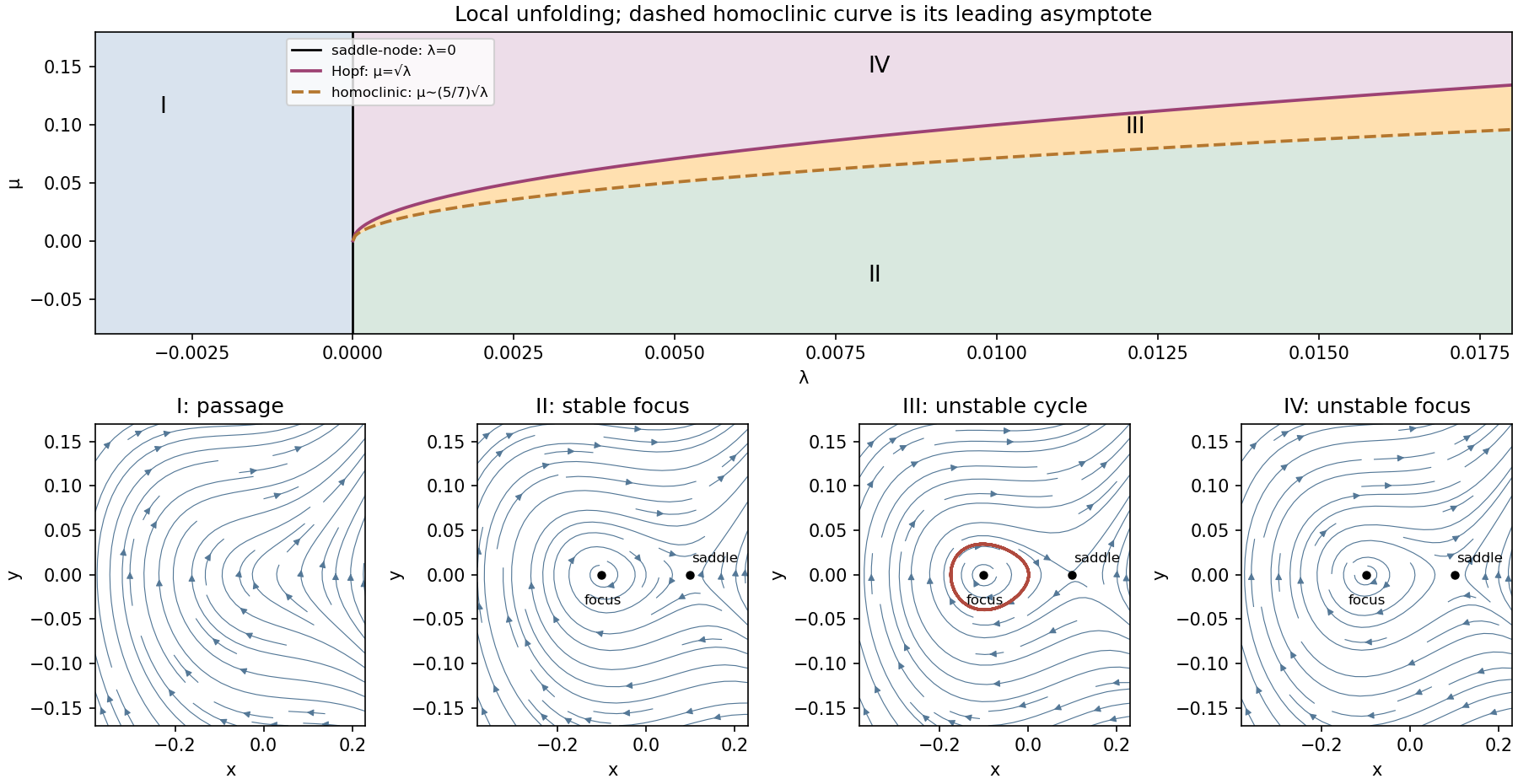
Local saddle-node, subcritical Hopf and homoclinic curves with the four nearby phase portraits
. Details. 
Articles by others on the same topic
There are currently no matching articles.