Choose depth positive downwards, the free surface at and the interface at . A Love wave has only transverse displacement field . Take , , and defineA trapped mode requires , so both are positive. The SH equations are in the layer and in the half-space. Zero shear traction at the free surface and decay at large depth selectContinuity of displacement field and shear traction at gives and . ConsequentlySubstituting the definitions of yields the requested speed-frequency dispersion relation. For negative frequency use in both vertical wavenumbers; the real displacement field has conjugate frequency partners. Neither equality in the trapped-speed interval gives a strictly localized finite-frequency Love mode.
Refer all layer wave amplitudes to the lower interface. Let a downward incident SH displacement field have unit wave amplitude there, an upward reflected wave have wave amplitude , and the decaying half-space wave wave amplitude . Interface continuity givesSolving these equations proves the Love-wave interface reflection phase and transmission wave amplitude:Thus : the evanescent substrate field has nonzero wave amplitude but no net downward mean flux. At the traction-free top, an upward incident wave and its downward reflection must have canceling derivatives, so their displacement field reflection coefficient is .
A layer wave acquires wave phase during a complete round trip. Constructive interference requiresTaking the tangent gives again . The reflection phases, rather than only geometric travel distance, are essential to the mode condition.
At , the half-space decay exponent tends to zero and the dispersion relation requires . These are the Love-wave cutoff frequencies,An overtone exists strictly above its cutoff. At the cutoff its half-space field is constant in depth rather than decaying, so it is a limiting nonlocalized state, not a trapped finite-energy eigenfunction. The fundamental has cutoff zero and exists for every positive frequency. Each fixed branch approaches from above at high frequency. The half-space penetration depth diverges on approach to cutoff.
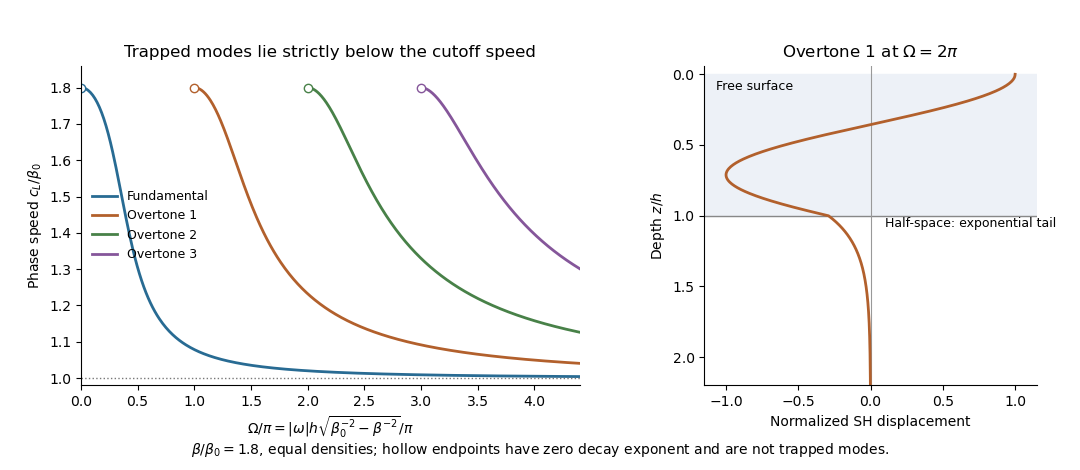
Love-wave dispersion branches above their cutoffs and an overtone displacement profile across the layer interface
. Details. 
Articles by others on the same topic
There are currently no matching articles.