Take a stable isotropic elastic material with mass density and Lamé parameters , where and . Its elastic stiffness tensor isThe P wave is longitudinal and the S wave transverse. The wavefront-transport alternative and all three steps of the Love wave alternative are given below.
Assume the coefficients are sufficiently differentiable in the region considered, with no material discontinuity or caustic at the front. Let describe arrival time, the slowness vector, and the unit elastic wave propagation normal. For any field, its jump is the value immediately behind the front minus that immediately ahead. If the first nonzero jump occurs in the kth time derivative, , writeA smooth background may be added without changing these leading jumps. Since , differentiation expresses spatial jumps in terms of and time-derivative jumps. The restriction lets displacement field and its first time derivative remain continuous and avoids an imposed impulsive source at the front.
Insert this local expansion in . The coefficient of isFor isotropic elasticity the slowness acoustic matrix is . Its longitudinal eigenvalue is . The P branch therefore gives the eikonal equation and polarizationThe next coefficient, , isThe matrix on the left is symmetric and annihilates . Project onto to obtain its solvability condition. Put . The two projected terms can be evaluated without dropping gradients of mass density or moduli:These identities use , hence , and . Their curvature terms cancel, leavingMultiplying by proves the requested P-wavefront discontinuity transport law,The wave amplitude here is real for a real jump; a complex wave amplitude uses the corresponding modulus-squared law. An elastic ray follows , with arclength and . If is the infinitesimal cross-sectional area of a neighboring ray tube, . Thus is constant along that tube, the ray-tube conservation for a P-wave jump. This defines the geometrical spreading and shows why the wave amplitude changes with material properties even before attenuation is considered. At a caustic the simple ray-tube wave amplitude is singular and a uniform local description is needed.
Choose depth positive downwards, the free surface at and the interface at . A Love wave has only transverse displacement field . Take , , and defineA trapped mode requires , so both are positive. The SH equations are in the layer and in the half-space. Zero shear traction at the free surface and decay at large depth selectContinuity of displacement field and shear traction at gives and . ConsequentlySubstituting the definitions of yields the requested speed-frequency dispersion relation. For negative frequency use in both vertical wavenumbers; the real displacement field has conjugate frequency partners. Neither equality in the trapped-speed interval gives a strictly localized finite-frequency Love mode.
Refer all layer wave amplitudes to the lower interface. Let a downward incident SH displacement field have unit wave amplitude there, an upward reflected wave have wave amplitude , and the decaying half-space wave wave amplitude . Interface continuity givesSolving these equations proves the Love-wave interface reflection phase and transmission wave amplitude:Thus : the evanescent substrate field has nonzero wave amplitude but no net downward mean flux. At the traction-free top, an upward incident wave and its downward reflection must have canceling derivatives, so their displacement field reflection coefficient is .
A layer wave acquires wave phase during a complete round trip. Constructive interference requiresTaking the tangent gives again . The reflection phases, rather than only geometric travel distance, are essential to the mode condition.
At , the half-space decay exponent tends to zero and the dispersion relation requires . These are the Love-wave cutoff frequencies,An overtone exists strictly above its cutoff. At the cutoff its half-space field is constant in depth rather than decaying, so it is a limiting nonlocalized state, not a trapped finite-energy eigenfunction. The fundamental has cutoff zero and exists for every positive frequency. Each fixed branch approaches from above at high frequency. The half-space penetration depth diverges on approach to cutoff.
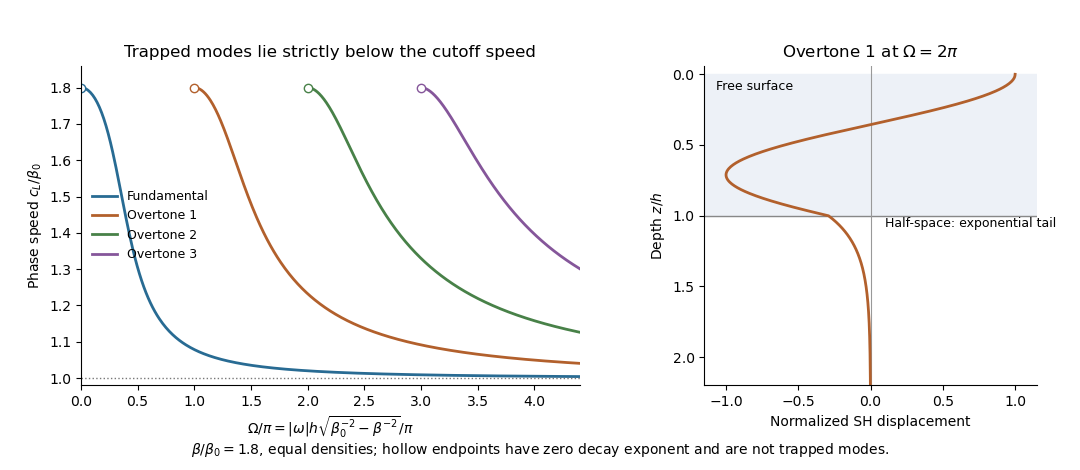
Love-wave dispersion branches above their cutoffs and an overtone displacement profile across the layer interface
. Details. 
Articles by others on the same topic
There are currently no matching articles.