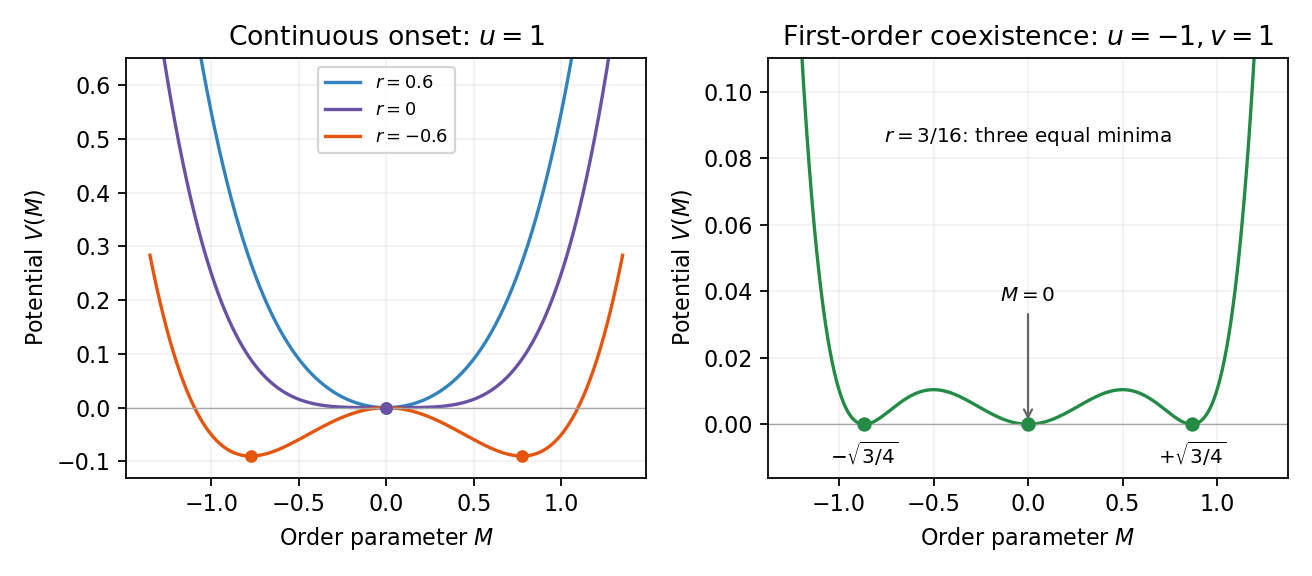
At a continuous phase transition the equilibrium order parameter tends continuously to its critical value, there is no latent heat, and the correlation length diverges. For at zero field, minimizing gives when and when . These minima join continuously at . The minimized singular free-energy density is zero above and below, so its first thermal derivative is continuous, while its second derivative has a finite jump in mean-field approximation.
A first-order phase transition instead has competing minima whose free energies cross while their order parameters remain distinct. The first derivatives of the equilibrium free energy generally jump; along a temperature-driven crossing this gives latent heat. For the symmetric sextic potential with , let . At phase coexistence, the stationary points and equality of the two free energies requireEliminating gives , henceAt coexistence , proving that all three degenerate minima are global. The equilibrium order parameter jumps from zero to one of the two nonzero values even though . The disordered minimum loses local stability at , and the nonzero stationary points first appear at . These spinodal points delimit metastability and are not the equilibrium transition line. Cubic terms, when symmetry permits them, provide another common route to a first-order transition.

Articles by others on the same topic
There are currently no matching articles.