An order parameter distinguishes phases by a macroscopic quantity that changes at the transition. For an Ising model ferromagnet it is the magnetization per Ising spin, . At zero magnetic field the statistical Hamiltonian is invariant under spin inversion symmetry. The disordered phase preserves this symmetry, whereas a selected ordered phase has and a spin-reversed partner with . At finite volume with symmetric boundary conditions the expected value is zero even below the transition; spontaneous magnetization means taking the thermodynamic limit before sending a symmetry-breaking field to zero.
Landau-Ginzburg theory introduces a coarse-grained local order parameter and a symmetry-constrained free-energy functional. For a short-range system with scalar spin inversion symmetry, a useful expansion isThe coefficients vary smoothly with microscopic control parameters at the level of the Landau approximation; normally with . The gradient term penalizes spatial variation. The magnetic field is conjugate to the order parameter, and odd powers at are excluded by spin inversion symmetry. With , the sextic term may be omitted locally; with , a stabilizing positive is essential. The equilibrium uniform order parameter minimizes the local potential , givingThis equation of state follows from minimization, rather than being imposed as an independent assumption. Vector or tensor order parameters and their allowed invariants describe other symmetry classes.
Use the connected correlation function , so that the constant ordered contribution is removed. Away from a thermodynamic critical point its long-distance decay defines the correlation length: when this limit exists. In a massive rotation-invariant phase the exponential decay is typically multiplied by an algebraic factor.
Expand the Landau-Ginzburg theory free energy about a stable uniform minimum , writing . To quadratic order,integration of the Gaussian field theory gives the Fourier-space connected correlation function . Thus the Ornstein--Zernike correlation function hasFor an ordinary quartic transition, above the transition and below, so and , respectively. The correlation length diverges as on both sides, with different amplitudes. At criticality the mass vanishes and the Gaussian correlation function is proportional to for . Interactions can change this power to .
At a continuous phase transition the equilibrium order parameter tends continuously to its critical value, there is no latent heat, and the correlation length diverges. For at zero field, minimizing gives when and when . These minima join continuously at . The minimized singular free-energy density is zero above and below, so its first thermal derivative is continuous, while its second derivative has a finite jump in mean-field approximation.
A first-order phase transition instead has competing minima whose free energies cross while their order parameters remain distinct. The first derivatives of the equilibrium free energy generally jump; along a temperature-driven crossing this gives latent heat. For the symmetric sextic potential with , let . At phase coexistence, the stationary points and equality of the two free energies requireEliminating gives , henceAt coexistence , proving that all three degenerate minima are global. The equilibrium order parameter jumps from zero to one of the two nonzero values even though . The disordered minimum loses local stability at , and the nonzero stationary points first appear at . These spinodal points delimit metastability and are not the equilibrium transition line. Cubic terms, when symmetry permits them, provide another common route to a first-order transition.
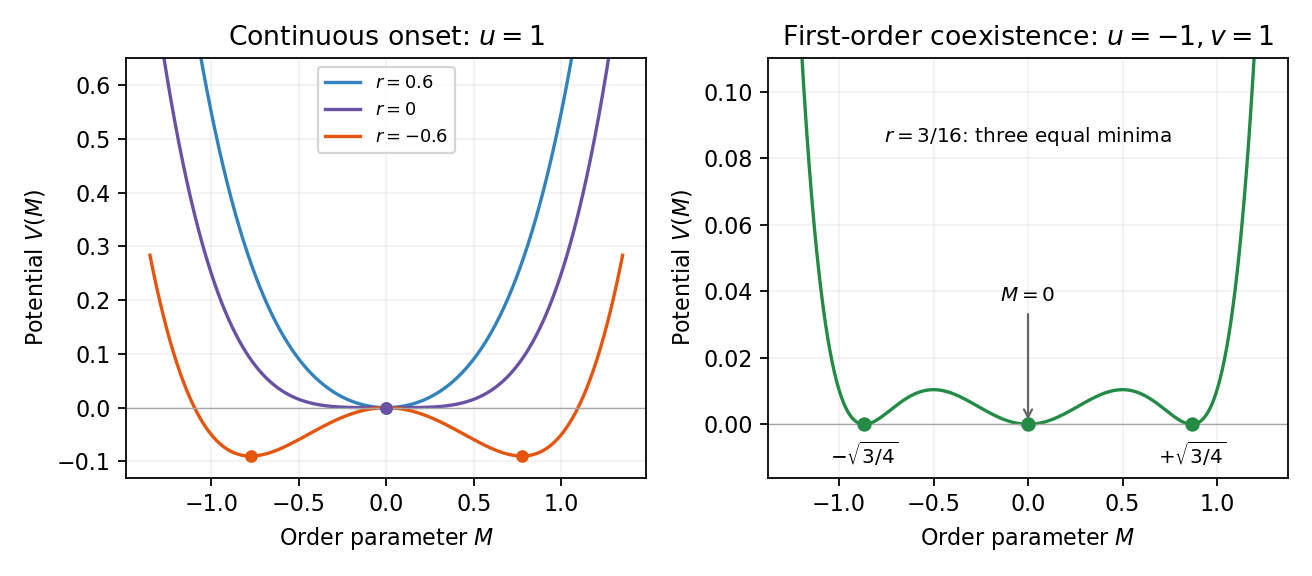
Quartic Landau minima through a continuous transition and three degenerate sextic minima at first-order coexistence
. Details. 
Universality means that systems with different microscopic interactions can have the same asymptotic critical behaviour. Under renormalization-group flow, irrelevant microscopic differences shrink, and systems whose critical flows approach the same renormalization-group fixed point belong to one universality class. Important determinants are spatial dimension, order-parameter symmetry and number of components, the range of interactions and any additional relevant constraints. Microscopic Bravais lattice shape alone does not normally change the short-range scalar universality class.
Critical exponents, properly normalized scaling functions and certain dimensionless amplitude ratios are universal within a universality class. For example, the universal specific-heat amplitude ratio compares the two singular amplitudes above and below the transition, canceling their common normalization factors. Scaling functions require choices of thermal, field and length metric factors before comparisons between microscopic systems make sense. The critical temperature, critical field, Bravais lattice spacing, individual correlation-length and magnetic susceptibility amplitudes, and analytic free-energy backgrounds are not generally universal. Thus two models can share critical exponents without sharing their transition temperature or the absolute size of their response.
Let , and suppose with while and remain finite at the transition. Critical exponents describe the leading singular powers: below the transition, , , , , and .
The quartic equation of state immediately gives at zero field below the transition, so . Differentiating with respect to the conjugate field gives , which is above and below; therefore . At , with its real sign, giving . The quadratic correlation function has and critical Ornstein--Zernike correlation function proportional to , giving and .
Finally the minimized potential below the transition is , while it is zero above. Its second temperature derivative is a finite step, so the mean-field heat-capacity critical exponent is . In particular,These are derived mean-field critical exponents. In the fluctuation-dominated critical region of a phase transition, one instead derives exponents from the scaling eigenvalues of the renormalization-group fixed point, as in the next question. A zero heat-capacity power exponent can also accompany logarithms in other theories, so specifying the power alone does not completely describe that singularity.
A tricritical point occurs when the continuous and first-order transition lines meet. In the symmetric sextic Landau free energy this requires tuning two coefficients, , while stabilizes the potential. For , the zero-field transition lies on and is continuous. For , the coexistence curve is . The order-parameter jump satisfies and shrinks to zero as the tricritical point is approached. The labelled phase diagram below uses as local coordinates; two independent physical controls, such as temperature and composition, can provide these coordinates.
Along the tricritical tuning , the equation of state is . At zero field the ordered solution is , and the critical isotherm has . The inverse magnetic susceptibility is above and below. The minimized singular potential is below, so differentiating twice thermally gives a singularity. These calculations giveThe correlation-length and correlation-function exponents follow from the same quadratic gradient term. A generic path with a nonzero positive quartic coefficient instead has ordinary critical behaviour; observing tricritical powers requires the extra tuning. The sextic coupling is marginal in three dimensions, giving tricritical upper critical dimension three and logarithmic corrections there.
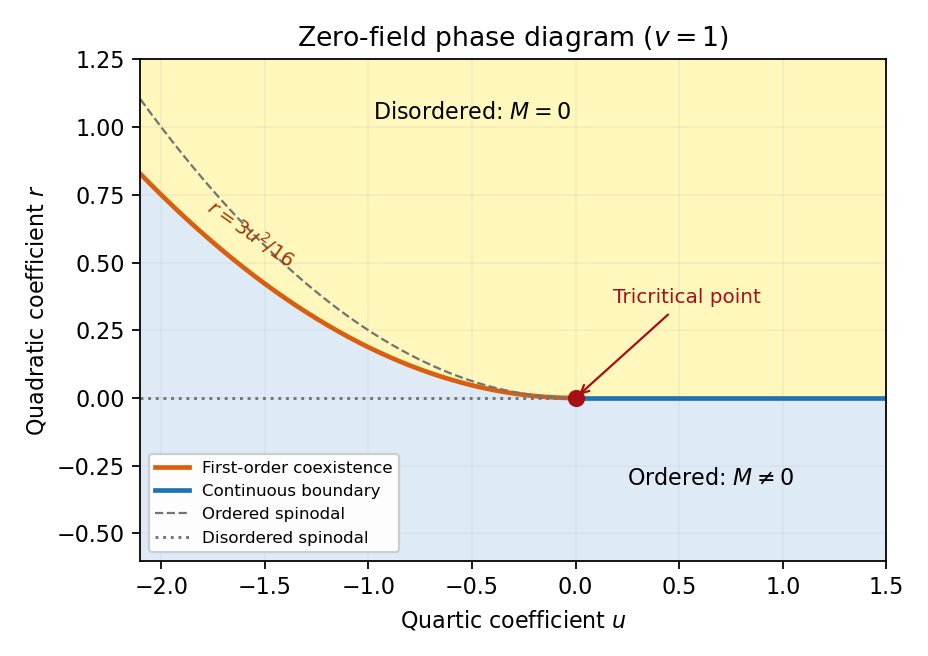
Zero-field sextic Landau phase diagram with continuous and first-order boundaries meeting at the tricritical point, and dashed spinodal limits
. Details. 
The mean-field approximation replaces each site's fluctuating surroundings by a self-consistent average. On a cubic lattice each spin has coordination number of a lattice , even though summing only over positive basis directions counts each bond once. Write and drop products of deviations. Each Ising bond becomes , so the approximate statistical Hamiltonian isThe constant corrects counting each bond twice. The resulting independent-spin partition function is , where . The one-spin probabilities giveEquating this average with the assumed givesHere is assumed; a ferromagnetic order parameter is not the appropriate choice for an antiferromagnetic coupling. Put . For , at any , so only is possible. For , the function has positive slope at zero, is strictly concave on and is negative at . It therefore has exactly one positive zero and a spin-reversed negative zero. Expanding at the bifurcation givesThe transition is continuous, with order-parameter critical exponent . Stability can also be checked from the Bragg-Williams free energy of the Ising model per Ising spin:Its derivative is , giving the same self-consistency equation. Near zero,The quartic coefficient is positive at , the stable minima approach zero continuously, and the minimized free energy has no first-derivative jump. Thus mean-field approximation predicts a second-order transition at . This is the mean-field Ising critical bifurcation.
For short-range interactions, large dimension gives many neighbours and suppresses the relative fluctuations of their average. More quantitatively, Gaussian field theory fluctuations averaged over a correlation volume have variance of order , while the squared ordinary mean-field order parameter is of order . Their ratio is proportional to . The Ginzburg criterion therefore makes neglect of critical fluctuations asymptotically consistent above four dimensions, inconsistent below four, and marginal at four, where logarithms occur. Large dimension is a route to validity; sufficiently long-range or infinite-range interactions can also produce mean-field behaviour. In low-dimensional short-range systems even the existence and location of a transition can differ from this approximation.
Articles by others on the same topic
There are currently no matching articles.