A vierbein is a local orthonormal coframe, consisting of four linearly independent covectors such thatHere label spacetime coordinates, while label a Lorentz frame with . Its inverse obeys and . The vierbein converts tensor indices between the coordinate and orthonormal descriptions.
The metric is unchanged under an arbitrary local Lorentz transformation , since . This is local frame redundancy, with corresponding transformations of fields and connections; it is distinct from coordinate diffeomorphism covariance. A generic curved spacetime does not have global Lorentz isometries. Rather, local tangent frames have Lorentz freedom, and the field equations can be written covariantly under their changes. On flat spacetime, global Lorentz transformations are also spacetime isometries.
A spinor field is a section of the spinor bundle associated to a spin structure. Local components transform in a Spinor representation of the Lorentz group, more precisely a representation of its spin double cover. For the proper orthochronous group in four dimensions, that cover is . Thus a spinor field transforms as under frame changes, rather than as a coordinate-index tensor. The double-valued lift of a frame rotation requires a consistent spin structure globally; local spinor calculations alone do not choose that global structure. One can use a Dirac spinor for the gamma-matrix calculation below.
Write for the Lorentz-frame spin connection. Expanding the tetrad postulate givesMultiply by the inverse vierbein to solve for the connection:With the torsion-free Levi-Civita connection, metric compatibility makes antisymmetric in . For constant flat gamma matrices obeying , define . The spinor covariant derivative isUnder a local Lorentz transformation, the matrix connection acquires the inhomogeneous term needed to make transform as a spinor. The derivative of the vierbein in the boxed formula is therefore essential.
For the conformally flat metric, choose and . Let and raise these coordinate indices temporarily with the flat metric . Directly evaluating the Christoffel symbols givesSince , the connection formula yieldsThis is the spin connection of a conformally flat metric in the specified conformal frame. It is frame dependent, unlike an invariant curvature tensor.
Set . Antisymmetry of makes its action on spinorsFor with , we have . The Clifford algebra gives , soThe curved gamma matrices are and . ConsequentlyThus the rescaled field is a twistor spinor. Multiplying this last equation by , symmetrizing in and using provesThis is the conformal rescaling of a parallel spinor to a twistor spinor. It does not claim that the rescaled spinor remains parallel in the conformal metric; the nonzero connection and the derivative of combine precisely into its gamma-trace part.
Let and . The geometry is the five-dimensional Schwarzschild-Tangherlini metric. Introduce a tortoise coordinate by . Decomposing the integrand givesAn irrelevant additive constant has been fixed. Set and . Substituting or respectively gives the ingoing Eddington-Finkelstein coordinates and outgoing Eddington-Finkelstein coordinates:The radial-time block in each has determinant , so the apparent singularity at has disappeared. The ingoing chart crosses the future event horizon, and the outgoing chart crosses the past horizon. Radial null geodesics in the ingoing chart obey either or , displaying how outward light is trapped when .
For the maximal extension, the exterior radial metric is . Since the surface gravity is , choosein the right exterior. Their product and the extended metric areThe coefficient at the horizon is finite and nonzero, . The product relation therefore extends smoothly through either horizon. For , gives two exterior regions. For , gives the future black-hole interior with and the past white-hole interior with . The Kruskal extension of the five-dimensional Schwarzschild-Tangherlini metric has a bifurcation three-sphere at .
The singularity corresponds to . It is a curvature singularity: for example, its Kretschmann scalar is . Since in the interior, constant- surfaces are spacelike there, and the singularities are spacelike boundaries. Define , , then compactified coordinates , . Radial null curves have . Moreover, gives at the two singularities. This constructs the Penrose diagram, not just its horizon labels:
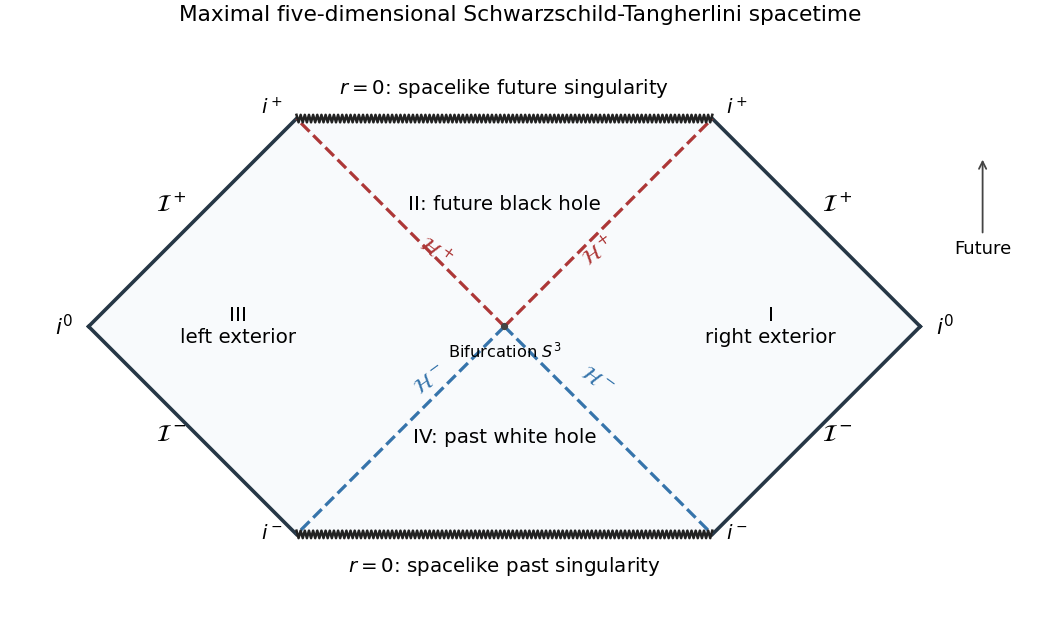
Maximal five-dimensional Schwarzschild-Tangherlini extension with two exteriors, future and past horizons, and spacelike singularities
. Details. 
Each point away from the singular boundaries represents a three-sphere, not a two-sphere. The diagram has two asymptotically flat exteriors with separate past and future null infinities, a future black hole and a past white hole. The diagram of a collapse spacetime would omit the second exterior and the white-hole region; the maximal extension of the metric given here contains both.
For the Komar integral, normalize the stationary Killing vector field as , with unit norm at infinity. The Killing equation makes antisymmetric, and its divergence is proportional to . In a vacuum exterior this vanishes, so Stokes theorem makes the flux independent of the enclosing sphere. In the weak-field limit its radial component measures the derivative of the gravitational potential; its large-sphere flux is therefore proportional to the asymptotic gravitational mass. Normalization of is needed because rescaling it would rescale the integral.
Specify the surface orientation to fix the sign and factor. On a static exterior slice take future unit normal , outward radial normal andThen and , with both antisymmetric components included. Since ,The three-sphere area is , and . ThusReversing the binormal orientation gives ; a convention with half the antisymmetric binormal gives half this magnitude. The question does not fix those conventions, so the choice above is explicit.
For comparison with physical mass, the Komar mass normalization in higher dimensions isIn five dimensions this givesThe metric parameter has dimensions of length squared and is not itself the physical mass. An independent horizon check is with , which reproduces the same integral. The dimension-adjusted normalization also agrees with the ADM mass; the four-dimensional Komar prefactor should not be reused unchanged.
The black-hole area theorem is a statement about classical future event horizons, with both a local focusing condition and global horizon regularity assumptions. Assume the null energy condition, an appropriately predictable exterior and no future termination of horizon generators before the focusing argument can be applied. Future-complete generators provide a particularly direct sufficient version of the last assumption. Strong asymptotic predictability is the usual global condition used to exclude the pathological alternatives; the energy condition by itself is not the whole theorem.
On a smooth part of the horizon, choose a future-directed affinely parametrized generator and affine parameter . Its expansion is the fractional rate of change of an infinitesimal transverse area element:The horizon is a null hypersurface, so its generator congruence is hypersurface-orthogonal and has zero twist. The transverse screen metric is positive definite, hence . In four dimensions the Null Raychaudhuri equation isThe Einstein field equations and the null energy condition imply the null convergence condition , so .
Suppose at . As long as the congruence remains smooth, integrating shows focusing within affine distance at most . Equivalently, comparison with the equality solution givesIts denominator tends to zero at finite future affine parameter. The corresponding transverse area collapses, giving a conjugate point to a spacelike surface. Beyond a focal point a generator cannot remain on an achronal boundary, since nearby points can then be joined by a timelike curve. But a regular future event horizon is such a boundary, and its generators cannot leave it to the future. With the stated future-extension assumption this is a contradiction. Therefore on the smooth horizon.
Following generators from one horizon cross-section to a later one now gives a noncontracting area map. Generators entering at past endpoints or merger crease sets can add area, whereas the global hypotheses exclude generators disappearing from the future horizon. ConsequentlyThis is the future-complete horizon focusing proof of the area theorem. In spacetime dimensions, the coefficient is replaced by and the same proof gives a focusing distance at most . It therefore also applies to the three-dimensional horizon cross-sections of the preceding five-dimensional example.
A cosmological constant does not invalidate the local focusing step. Contract the modified Einstein field equations with the null generator. Since , both the scalar-curvature term and the term disappear:Thus a cosmological constant preserves null convergence, whatever its sign. Under suitable global assumptions for the relevant asymptotic region, the black-hole area argument still works. A nonzero changes the asymptotic geometry and can introduce cosmological horizons, so the statement concerns the appropriate future black-hole horizon; it is not an assertion that every horizon-like surface automatically obeys the same area ordering.
A classical real canonical massless scalar field also preserves the area theorem's energy condition. Its stress tensor hasThis proof is independent of whether the field gradient is spacelike, timelike or null: the metric term vanishes and the remaining real square is nonnegative. It is the null energy condition for a canonical scalar field. Adding this field to other matter satisfying the null energy condition retains null convergence. With the same global regularity assumptions, area still cannot decrease; when the derivative along a generator is nonzero, it supplies an additional nonnegative focusing source.
The conclusion uses the given minimally coupled classical stress tensor. A wrong-sign kinetic term or a nonminimal curvature coupling would require another calculation. Likewise, a renormalized quantum stress-energy tensor need not obey the classical pointwise condition; the quantum radiation considered next is not covered by this classical proof.
Use a free real scalar field obeying a linear Klein-Gordon equation, for example . This linearity is the assumption that permits mode evolution by a Bogoliubov transformation. Work with a complete set of normalized modes, or normalizable wave packets when the spectrum is continuous. The stationary asymptotic regions supply time translations relative to which positive-frequency solutions and their complex conjugates can be distinguished.
For solutions define the conserved Klein-Gordon inner productHere is a Cauchy surface with future-directed normal. Its conservation follows by applying the wave equation to the divergence of its current, provided boundary flux is included or vanishes. Let be a positive-frequency basis in the past and one in the future, each propagated as a solution through the intermediate geometry. Normalize them by , and , with the corresponding identities for the future basis. The two field expansions areThe canonical commutation relations give and . The in-vacuum satisfies , while the out-vacuum satisfies . They are generally different vacua.
Fix the coefficient convention by expanding future modes in past modes:The minus sign is due to the negative norm of the conjugate modes. Taking the Klein-Gordon inner product with the field, which is antilinear in its first entry, givesBoth frequency sectors are needed: if , a future annihilation operator contains a past creation operator. This is the mechanism of particle number from Bogoliubov coefficients, not a classical nonzero mean field.
Computing and explicitly gives the canonical identities for a bosonic Bogoliubov transformation:Completeness also gives the inverse . Thus the evolved past vacuum, viewed in the future Fock space, obeysFor a finite-mode treatment with invertible , solve this condition by a multimode squeezed vacuum:The canonical identities make symmetric. Commuting through the exponential gives , which directly verifies the vacuum condition. Its normalization is . A general initial state is obtained by applying its initial creation-operator polynomial and expressing those operators in the future basis. In infinitely many modes, a common unitary Fock representation requires the creation-mixing coefficients to be Hilbert-Schmidt; finite wave-packet counts avoid treating delta-normalized modes as individual normalizable states. These are the bosonic mode mixing implementability conditions, rather than an assumption of arbitrary finite total creation over an infinite time interval.
For the requested number operator of one future mode, set . Expectations below are in the evolved past vacuum , equivalently in using the Heisenberg-mode operators above. Acting on the past vacuum gives , whose squared norm isThe mean particle number vanishes exactly when that mode has no negative-frequency mixing.
The second moment needs the anomalous contractionThe canonical commutation relations give . Moreover,Its vacuum and two-particle pieces are orthogonal. Applying the commutation relations twice showsThe two pairings each contribute to the squared norm. Hence the full answer isThus . These are the out-mode number fluctuations in the in-vacuum. Omitting would assume a property not given in the general question. A thermal single mode has , giving . A single-mode squeezed vacuum state instead has , giving .
If the counted observable is the total number over a finite set of future modes, its moments follow by retaining cross-mode correlations as well. Define and . The same vacuum pairings give . Thus and , with and . Independent thermal counts cannot be assumed for a general correlated squeezed state.
For Hawking radiation, choose the incoming vacuum at past null infinity of a collapse spacetime and propagate late outgoing modes backwards. Near a nonextremal forming event horizon, the logarithmic tortoise-coordinate divergence leads to the Hawking exponential ray mapwhere is late retarded time, is an early regular affine null coordinate and is the final surface gravity. A late positive-frequency mode therefore becomes proportional to on rays escaping just before horizon formation. This is not positive-frequency with respect to : it has both frequency signs and hence nonzero .
The thermal factor can be seen directly. With , and a regulator , the relevant Fourier integrals areAs , the arguments of the two complex factors approach . Their squared-modulus ratio for the suppressed and enhanced frequency branches is . Thus the thermal ratio of Hawking Bogoliubov coefficients, combined with the canonical normalization, yields the bosonic occupationin units . Scattering through the exterior potential multiplies the asymptotic occupation by the appropriate greybody factor.
A complete future mode description includes modes crossing the horizon as well as modes reaching future null infinity. The global incoming vacuum develops correlations between these sectors; restricting to the exterior gives approximately thermal outgoing occupation rather than a claim that the complete pure state became a thermal mixed state. This is the particle-production picture of a collapsing black hole, not an incoming thermal bath on an eternal geometry. Including backreaction turns the emitted positive energy into black-hole mass loss. The renormalized quantum stress tensor is not subject to the pointwise classical positivity used in the black-hole area theorem, so this does not contradict its classical proof.
Articles by others on the same topic
There are currently no matching articles.