Follow successive photons from the same comoving source. Their comoving radial distance is fixed, soIt follows that . Taking the logarithmic derivative of , with both endpoints allowed to vary, givesTherefore the observer-time redshift drift isHolding the emission time fixed would omit the second term and would not compare successive observations of the same source.
At the present epoch, define and . For flat matter plus a cosmological constant, neglecting radiation,In an Einstein-de Sitter universe, , henceThe redshift drift is zero at , has initial slope , and decreases monotonically because . Its second derivative is , so the sketch bends downward, with at large positive redshift.
A pure positive cosmological constant in a flat universe gives constant , the expanding de Sitter model. ThusThe redshift drift is a straight line through the origin with positive slope. Here the source and observer expansion rates are equal; the factor in the observer contribution makes every positive-redshift comoving source drift toward still larger redshift.
For the specified flat matter-vacuum model,Its small-redshift behaviour is , since . At high redshift, matter dominates and , so the initially positive redshift drift must turn negative. To locate the crossing, square ; both sides are positive, so squaring introduces no positive- spurious root. Factorization givesBesides , the physical nonzero redshift-drift root in flat matter-Lambda cosmology isThe redshift drift is positive for and negative for . Its maximum satisfies and lies near , where . This zero is distinct from the acceleration transition at : redshift drift compares expansion at two epochs, while acceleration is local to one epoch.
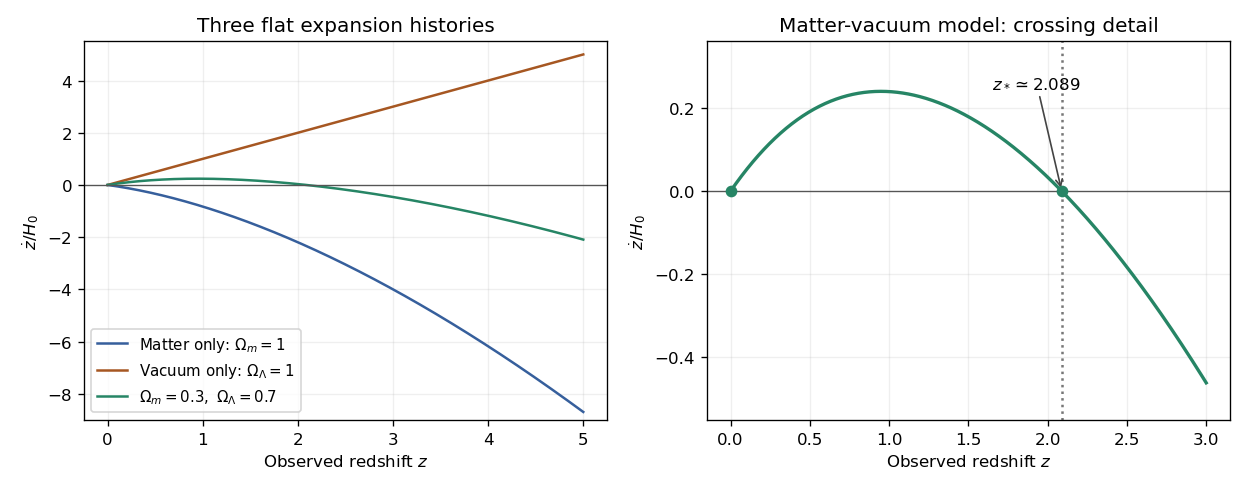
Redshift drift in three flat cosmologies, with the positive-to-negative crossing of the matter-vacuum model
. Details. 
For fixed cosmological density parameters, the redshift drift has the form . Multiplying the Hubble constant changes the vertical scale of all three sketches but leaves their zeros unchanged. Thus the drift-zero redshift is independent of at fixed density fractions. Every model has the trivial zero; only the specified mixed model has a further positive zero, . If instead physical matter and vacuum densities are held fixed while changes, their density fractions change too, so that is a different family of models.
Use the observed wavelength in . Since ,For an Einstein-de Sitter universe at , , and the redshift drift is . With the rounded numerical values supplied in the paper,Therefore the spectroscopic velocity drift accumulated over ten years isThe negative sign means a shift toward shorter observed wavelength. Omitting the factor would overestimate the apparent velocity shift by four.
The Lyman-alpha forest supplies many relatively narrow absorption features along each bright distant quasar sightline. These arise in intervening intergalactic hydrogen rather than in the quasar's rapidly varying emission region. A repeat high-resolution spectrum can be fitted against the same absorption template, and the information from many lines and many sightlines can be combined to estimate a common spectroscopic velocity drift. Diffuse intergalactic absorbers also generally have smaller peculiar accelerations than gas close to galactic nuclei, although their peculiar accelerations and changing line profiles still require control.
The preceding calculation requires a relative wavelength displacement over a decade. This is much smaller than one instrumental resolution element. Accurate line centroids can nevertheless be measured to a fraction of a resolution element when the signal-to-noise ratio and template information are sufficient. The real obstacles are long-term wavelength calibration, instrumental drift, sufficient photon counts and corrections for observer motion, along with astrophysical variability. Statistical averaging reduces independent errors; a common calibration error remains common to all lines. The Sandage-Loeb test therefore needs large collecting area, stable high-resolution spectroscopy and a long time baseline. The original absorption-forest strategy is described in Loeb's 1998 proposal.
The measurement is feasible in principle but demands exceptional long-term stability. It directly probes the change of redshift with observer time, giving rather than a distance inferred from a standard candle. Measuring its sign and redshift dependence would distinguish the expansion histories in part (ii).
Articles by others on the same topic
There are currently no matching articles.