For pressureless matter, the Friedmann acceleration equation with vanishing cosmological constant isEvaluating at the present cosmic time and using the definition of the deceleration parameter givesThe denominator is the critical density, so the cosmological density parameter satisfies the dust relationThis uses pressureless matter and ; spatial flatness has not been assumed.
Write . Conservation of pressureless matter gives . The Friedmann equation, retaining spatial curvature, isSince and , multiplication by givesIn the curvature convention , this also fixes .
Put and parametrize the scale factor byOn the expanding branch , the equation from part (ii) givesConsequently,Choose the origin of cosmic time at the Big Bang, , . Integration proves the closed matter-dominated Friedmann solution:The same parametrization continues through maximum expansion at to collapse at : remains nonnegative while changes sign. The maximum scale factor is , reached at ; the total lifetime is twice this time. The squared equation alone does not prescribe the sign of , so this continuation supplies the collapsing branch explicitly.
For , the expanding Friedmann equation reduces to . Separating variables and placing the Big Bang at givesThus the flat pressureless Einstein-de Sitter universe hasIn particular its present age is .
Put and introduce throughThe expanding equation becomesDividing these expressions yieldsIntegrating from the Big Bang at proves the open matter-dominated Friedmann solution:The scale factor grows indefinitely. At early times , as in the matter-dominated flat case, whereas at late times and as curvature becomes dominant.
Follow successive photons from the same comoving source. Their comoving radial distance is fixed, soIt follows that . Taking the logarithmic derivative of , with both endpoints allowed to vary, givesTherefore the observer-time redshift drift isHolding the emission time fixed would omit the second term and would not compare successive observations of the same source.
At the present epoch, define and . For flat matter plus a cosmological constant, neglecting radiation,In an Einstein-de Sitter universe, , henceThe redshift drift is zero at , has initial slope , and decreases monotonically because . Its second derivative is , so the sketch bends downward, with at large positive redshift.
A pure positive cosmological constant in a flat universe gives constant , the expanding de Sitter model. ThusThe redshift drift is a straight line through the origin with positive slope. Here the source and observer expansion rates are equal; the factor in the observer contribution makes every positive-redshift comoving source drift toward still larger redshift.
For the specified flat matter-vacuum model,Its small-redshift behaviour is , since . At high redshift, matter dominates and , so the initially positive redshift drift must turn negative. To locate the crossing, square ; both sides are positive, so squaring introduces no positive- spurious root. Factorization givesBesides , the physical nonzero redshift-drift root in flat matter-Lambda cosmology isThe redshift drift is positive for and negative for . Its maximum satisfies and lies near , where . This zero is distinct from the acceleration transition at : redshift drift compares expansion at two epochs, while acceleration is local to one epoch.
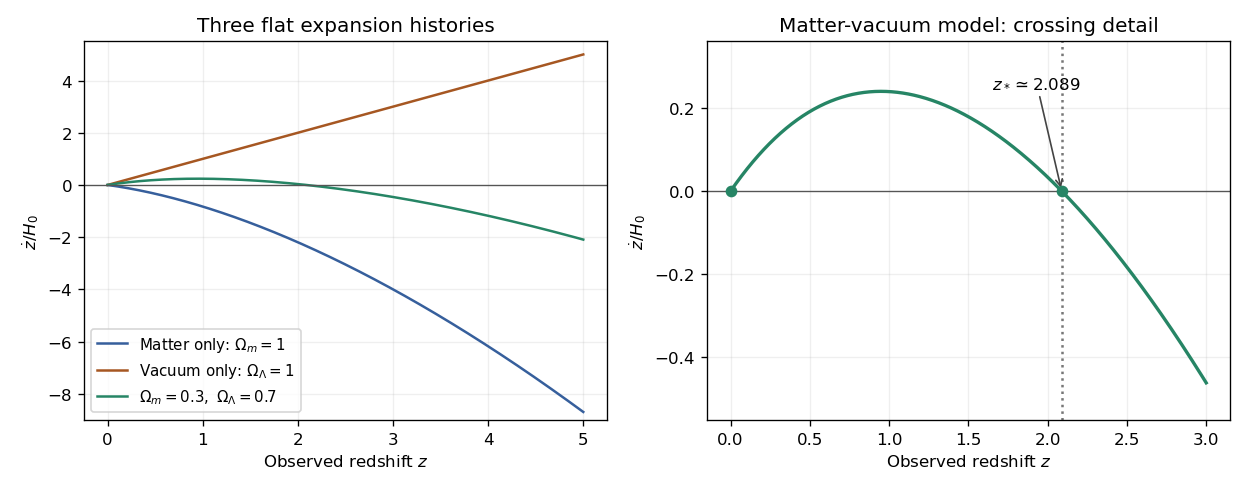
Redshift drift in three flat cosmologies, with the positive-to-negative crossing of the matter-vacuum model
. Details. 
For fixed cosmological density parameters, the redshift drift has the form . Multiplying the Hubble constant changes the vertical scale of all three sketches but leaves their zeros unchanged. Thus the drift-zero redshift is independent of at fixed density fractions. Every model has the trivial zero; only the specified mixed model has a further positive zero, . If instead physical matter and vacuum densities are held fixed while changes, their density fractions change too, so that is a different family of models.
Use the observed wavelength in . Since ,For an Einstein-de Sitter universe at , , and the redshift drift is . With the rounded numerical values supplied in the paper,Therefore the spectroscopic velocity drift accumulated over ten years isThe negative sign means a shift toward shorter observed wavelength. Omitting the factor would overestimate the apparent velocity shift by four.
The Lyman-alpha forest supplies many relatively narrow absorption features along each bright distant quasar sightline. These arise in intervening intergalactic hydrogen rather than in the quasar's rapidly varying emission region. A repeat high-resolution spectrum can be fitted against the same absorption template, and the information from many lines and many sightlines can be combined to estimate a common spectroscopic velocity drift. Diffuse intergalactic absorbers also generally have smaller peculiar accelerations than gas close to galactic nuclei, although their peculiar accelerations and changing line profiles still require control.
The preceding calculation requires a relative wavelength displacement over a decade. This is much smaller than one instrumental resolution element. Accurate line centroids can nevertheless be measured to a fraction of a resolution element when the signal-to-noise ratio and template information are sufficient. The real obstacles are long-term wavelength calibration, instrumental drift, sufficient photon counts and corrections for observer motion, along with astrophysical variability. Statistical averaging reduces independent errors; a common calibration error remains common to all lines. The Sandage-Loeb test therefore needs large collecting area, stable high-resolution spectroscopy and a long time baseline. The original absorption-forest strategy is described in Loeb's 1998 proposal.
The measurement is feasible in principle but demands exceptional long-term stability. It directly probes the change of redshift with observer time, giving rather than a distance inferred from a standard candle. Measuring its sign and redshift dependence would distinguish the expansion histories in part (ii).
Use the small-angle, thin gravitational lens equation geometry. An undeflected ray seen at angular position would have transverse source position . Bending that ray through physical angle at the lens changes its source intercept by . Thusand the required physical deflection isAlso . Define the reduced deflection as the angular difference . Dividing the first equation by givesThese are angular diameter distances; in a cosmological spacetime one must not replace by as if the distances were ordinary collinear Euclidean lengths.
Substituting and into the previous geometric relation verifiesFor a point mass gravitational lens, the given physical deflection yieldsAn aligned source has , and therefore . Rotational symmetry turns these signed intersections into an Einstein ring, whose Einstein radius isFor an offset source, multiplying by gives a quadratic equation. Its two image positions areFor , lies on the source side of the lens and lies on the opposite side.
Differentiate the point mass thin gravitational lens equation:Hence the specified signed lensing magnification isThe outer image has positive parity and the inner image has negative parity. Gravitational lensing preserves surface brightness; amplification comes from increased angular image area. The observed flux magnifications are and ; a negative determinant reverses orientation, not flux. Substitution of the two roots, with , givesAt , axial symmetry produces an Einstein ring. For an ideal point-like astronomical source, the lensing magnification diverges: near alignment . Finite source size gives a finite observed flux and a ring of finite thickness.
For , there are two images on opposite sides. Their separation is , approaching at alignment. For , their positions are and : both images are bright, with the outer one slightly brighter. Moving away from alignment reduces the total amplification and makes the inner image relatively fainter.
For , expanding the two image roots givesThus the distant source has one almost unaltered bright image and an extremely faint opposite-parity secondary, with total flux magnification . The secondary persists for every finite nonzero source offset in the point mass model.
It is useful to rewrite the local lensing convergence asFor positive core radius, the requested limits areA singular isothermal sphere lens instead has , which diverges at the centre. The finite core of the softened isothermal lensing potential regularizes this central lensing convergence; at large angular radius the two models have the same leading profile.
For an axisymmetric gravitational lens, the reduced deflection is . The specified mean lensing convergence therefore givesThe derivative is smallest at the centre, where . If , the mapping is monotone and an offset source has only one image. If , the derivative is negative near zero and positive at large radius, producing two stationary points and a range of source offsets with three images. Thus the condition for a nonempty multiple-image region isThis condition permits multiple images; a particular source must additionally lie inside the multiple-image caustic of a softened isothermal lensing potential. At equality the critical radii collapse to the origin and there is no finite three-image region.
Put and write the vector thin gravitational lens equation as . A tangential displacement at fixed radius has eigenvalue . A radial displacement has eigenvalue . From the definition of the mean lensing convergence,Since , this gives . Consequently,The two requested gravitational-lensing critical curve conditions are thereforeThey correspond respectively to a tangential critical curve of an axisymmetric lens and a radial critical curve of an axisymmetric lens.
The tangential condition gives , henceThis is a nonzero gravitational-lensing critical curve precisely when . It is also the radius of the Einstein ring for an aligned source in this cored model, so the strength parameter itself is not the cored model's ring radius.
For completeness the radial condition is equally explicit. Subtracting the mean lensing convergence from twice the local one givesThus the radial critical curve of an axisymmetric lens has radiusagain nonzero exactly when .
The conditions are singularities of the image-plane Jacobian matrix, where the formal lensing magnification of a point-like astronomical source diverges. A small source is strongly stretched in the corresponding eigenvector direction: tangentially near , radially near . Their mapped loci are source-plane gravitational-lensing caustics, which determine where image counts change.
The tangential circle maps to and gives the aligned Einstein ring. To find the radial caustic, put . At , and . Substitution in the signed lens mapping gives a negative source position for positive ; its magnitude isAn offset source with has three images. For , one outer image is on the positive side and two are on the negative side, as the sketch shows. The central and outer images have positive parity; the intermediate image has negative parity. On the radial caustic the inner pair merges, with a separate outer image remaining; outside it only the outer image survives. At exact alignment a central image coexists with the ring. Finite source extent smooths the formal divergences. The singular zero-core limit removes the central image, so its image-count rule differs from the finite-core case.
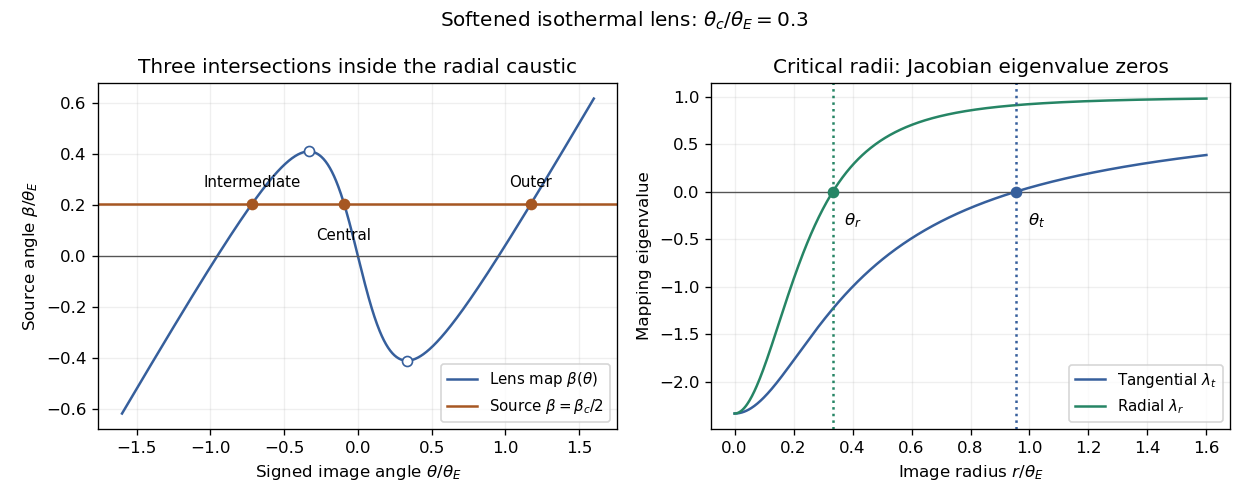
Three images inside the radial caustic of a softened isothermal lens and its radial and tangential critical radii
. Details. 
The cosmological principle assumes statistical spatial homogeneity and cosmological isotropy on sufficiently large scales. Spatial homogeneity means that coarse-grained statistical properties do not depend on location; cosmological isotropy means that they do not depend on direction. The claim concerns a large-scale description, allowing individual galaxies, clusters and voids. It motivates the FRW metric and makes cosmic expansion describable by a single scale factor and a small number of matter variables.
Its adoption combines empirical large-scale regularity with the Copernican principle, the assumption that our location is typical. The resulting models provide a coherent account of cosmic expansion, the cosmic microwave background and primordial abundances. Neither the Einstein field equations alone nor cosmological isotropy around just one observer proves global spatial homogeneity: a spherically symmetric universe specially centred on that observer would also look isotropic. Observations of a finite past light cone support the principle over sampled scales without establishing it beyond the observed region.
Three supporting observations probe complementary aspects. First, after the observer-motion dipole and local foregrounds are removed, the cosmic microwave background is extremely isotropic, with intrinsic temperature fluctuations of order and a nearly identical thermal spectrum across the sky. Second, suitably corrected all-sky counts of distant radio sources and extragalactic background intensities show no large preferred direction; Galactic obscuration and survey selection must be accounted for. Third, three-dimensional galaxy redshift surveys show that clustering and voids average toward statistically similar distributions in sufficiently large regions: large-volume number counts approach volume scaling and correlations weaken on large separation scales. The first two primarily test cosmological isotropy, while the third adds evidence for large-scale spatial homogeneity. The principle is a well-supported large-scale working hypothesis whose observational and typicality assumptions remain explicit.
Interpret the quoted values as the paper's 2006-era rounded cosmological benchmark. The Hubble constant is the present slope of the Hubble law, at sufficiently small redshift. A cosmic distance ladder begins with geometrical distance anchors, calibrates the Cepheid period-luminosity relation of Cepheid variables, and uses those distances to calibrate secondary indicators such as Type Ia supernovae. Distances to objects far enough away that peculiar velocities are a small fraction of recession velocity then determine the slope. Extinction, metallicity effects, distance-anchor calibration, sample selection and peculiar velocities contribute to its uncertainty.
The Hubble Space Telescope Key Project final result was , combining random and systematic uncertainty, supporting the rounded value . Independent approaches include distances inferred from gravitational-lens time delays and from cluster X-ray and Sunyaev-Zeldovich effect measurements; each brings different model uncertainties. Joint fits to the cosmic microwave background and large-scale structure also constrain within an assumed cosmological model. Thus the evidence for a value near combines calibrated distances with independent cross-checks; the approximate precision in the question should not be read as an identical uncertainty for every method.
Separate the observables before combining their parameter constraints. The baryon fraction is included within total matter: for the benchmark, , rather than adding to a second time. With , the physical density combinations areFor baryons, Big Bang nucleosynthesis predicts primordial light-element abundances as a function of the baryon-to-photon ratio; deuterium is especially sensitive. Independently, baryon inertia changes the relative heights of compressional and rarefaction peaks in the cosmic microwave background through the baryon loading parameter. Agreement of these two physical-density estimates supports a baryon abundance near the quoted value. For example, the three-year WMAP cosmological analysis found in its fitted model.
For total matter, matter-radiation equality affects the microwave-background peak pattern and fixes a characteristic turnover in the matter power spectrum. galaxy clustering therefore constrains matter density, with corrections for galaxy bias and peculiar-velocity distortions. Cluster baryon fractions combine observed gas and stars with total masses inferred dynamically or by gravitational lensing; comparison with the cosmic baryon fraction also constrains . Galactic rotation, cluster dynamics and gravitational lensing give independent evidence that visible baryons alone cannot supply the gravitating mass. The precise estimate comes from quantitative joint fits, rather than from a rotation curve by itself. Different 2006 data combinations gave somewhat different best fits, so is a rounded benchmark rather than a universal exact fit.
For a cosmological constant, standardized high-redshift Type Ia supernovae measure the shape of the luminosity-distance relation. In a flat matter-vacuum model,The observed supernova dimming relative to simple decelerating matter models favours late accelerated expansion. The original evidence is given by Riess and collaborators' 1998 supernova analysis. Combining the distance curve with matter constraints selects a positive vacuum fraction close to the quoted benchmark; it gives .
For curvature, the angular scale of the Cosmic microwave background acoustic peaks compares the sound horizon with the angular diameter distance to last scattering. This strongly constrains spatial geometry, but curvature and late-time expansion parameters can partly compensate one another. Independent distances, notably baryon acoustic oscillations and supernova distances, help break that degeneracy. The 2005 SDSS acoustic-peak detection supplies a low-redshift standard ruler complementary to the microwave-background ruler. In combination, these observations support near-flat geometry and the closure relation .
The benchmark is supported by mutually constraining abundance, clustering, angular-scale and distance measurements. Its uncertainties are correlated and depend on model assumptions. An exactly zero curvature parameter has no meaningful percentage error; observational evidence establishes consistency with zero and an absolute uncertainty, not a literal fractional accuracy better than ten per cent on zero.
The numerical fractions describe physically very different components. Use so that pressure and energy density have the same units. The stress-energy conservation equation for a homogeneous component, together with its equation of state , givesNonrelativistic baryons and cold dark matter have and dilute as ; radiation has and dilutes as ; vacuum energy has and remains constant. The curvature term scales as in the Friedmann equation but is a geometric contribution, not an additional material fluid.
There is consequently a coincidence in the present mixture. Normalize . ThenAt early times vacuum is negligible, while at late times it dominates overwhelmingly. Observing order-unity matter and vacuum fractions during their comparatively recent crossover motivates the cosmic coincidence problem: why should this crossover occur near our observing epoch?
The absolute scale gives a second puzzle. Restoring SI units, yieldsIts energy density is . Quantum vacuum contributions associated with ordinary particle-physics scales can be far larger than this observed value. Explaining the tiny net value, including cancellations among contributions, is the cosmological constant problem. The required negative pressure also differs qualitatively from ordinary dilute matter.
The matter budget supplies another explanatory gap: only is baryonic, while must be nonbaryonic matter in this benchmark. Together with in vacuum energy, most of the cosmic density is in components whose microscopic explanation is not supplied by fitting their fractions. Finally, near-zero curvature raises the flatness problem. For nonzero ,During radiation domination , so ; during matter domination , so . Near-flatness today therefore requires extremely small early curvature in an unmodified decelerating history. Cosmic inflation offers a mechanism that reduces this curvature fraction through accelerated expansion.
The apparent contrivances are the recent matter-vacuum coincidence, the tiny vacuum-energy scale, the near-flat initial geometry and the unexplained microscopic dark components. Their observationally inferred values impose concrete requirements on a deeper physical account.
Articles by others on the same topic
There are currently no matching articles.