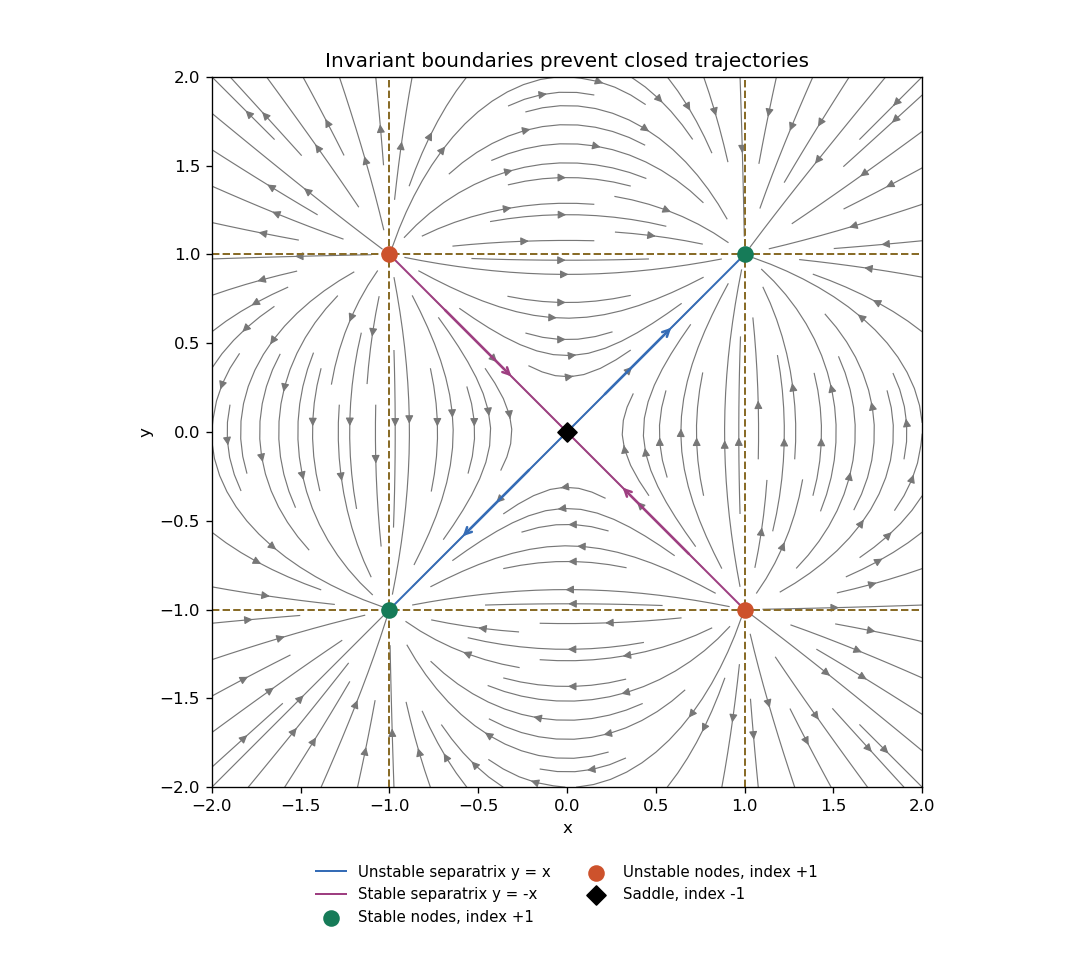
The simultaneous zeros are the origin and the four corners . The Jacobian matrix isAt the origin its eigenvalues are , with eigenvectors , so the origin is a saddle equilibrium of Poincaré index . At a corner . Thus and are stable nodes; and are unstable nodes, all of index . Although the node eigenvalues coincide, the equilibria are hyperbolic and their stability follows from their strictly signed real eigenvalues.
The lines and are invariant and divide the plane into nine convex regions. A nonconstant periodic trajectory cannot cross any of these lines by uniqueness, and cannot be contained in one of them because one-dimensional autonomous flows have no nonconstant periodic solutions. It must therefore lie inside one region. The central region contains only the origin, whose index is ; all other regions contain no equilibria. But a simple periodic orbit has index , equal to the sum of the enclosed equilibrium indices. Its interior stays in the same convex region, giving a contradiction in either case. There are no periodic orbits.
Away from the invariant lines, trajectory curves have the first integralsince both logarithmic derivatives equal . The diagonal is the unstable separatrix of the origin, leading toward the two sinks; is its stable separatrix, coming from the two sources. The diagram shows these separatrices, the invariant lines and the direction field.

Articles by others on the same topic
There are currently no matching articles.