Write . In Gauss's lemma, for the multiplier 2, precisely the integers with give residues . Their number isIt is even, so the Legendre symbol : 2 is a quadratic residue modulo . For completeness, the sign rule follows by replacing those large residues by their negatives; the resulting absolute residues permute . Multiplying them and cancelling their nonzero product gives , equivalent to the residue assertion by Euler's criterion.
Now take the prime . The condition gives , so . Thus divides . For integers , (true at 4 and preserved on increasing ), so this divisor is proper and is composite. At , the divisor is the number itself: . The congruence still holds, but it does not establish compositeness.
Choose a point of with both coordinates positive, so its product is positive. The set is nonempty and compact; the continuous function therefore attains its maximum there. A maximizer cannot lie on either axis, where the product is zero. It consequently belongs to and also maximizes the product on that set.
For uniqueness, the function is strictly concave on the positive quadrant: its Hessian is , negative definite. If two distinct positive points attained the same maximal product, their midpoint would belong to by convexity and strict concavity would give a larger value of , hence a larger product. This contradiction proves existence and uniqueness of the positive product maximizer. This argument is positive-product maximization on a convex set; compactness should be applied to the closed quadrant intersection, not directly to the potentially noncompact set .
Here a planar lattice means a discrete subgroup of the additive Euclidean plane; full rank is not required. Discreteness at zero gives an such that distinct lattice points are at least apart. Consequently every bounded set contains only finitely many lattice points, by placing disjoint small disks around them. If the group is zero, it has the stated one-generator form with .
Otherwise choose a shortest nonzero lattice vector . Every lattice point on its line is an integer multiple: subtract the nearest integer multiple of from a putative noninteger multiple to obtain a nonzero shorter vector, a contradiction. This already proves the one-generator case when all lattice points lie on that line.
For the remaining case choose the perpendicular orientation so that some point has positive height above the line of . Reduce its parallel component modulo into . Among reduced points of positive height there is a least height . Indeed, heights tending to zero would give infinitely many points in a bounded strip, contrary to the finiteness just proved; bounded sets also ensure that a positive infimum is attained. Choose at height .
Given any lattice vector , subtract an integer multiple of so that its height lies in , then reduce its parallel component modulo . Minimality of forces the residual height to be zero, and the one-dimensional argument forces the residual to be an integer multiple of . ThereforeTogether with the rank-one and zero cases this proves the planar discrete-subgroup basis assertion. Under the alternative convention that a Euclidean lattice must have full rank, only the two-generator case is called a lattice.
A digital signature lets the holder of a private key authenticate a message so that anyone with the corresponding trusted public key can verify its origin and integrity. The signature does not conceal the message. Public-key certification, a suitable message hash and protection of the signing key are needed for that interpretation.
For the ElGamal signature scheme, choose a large prime and a primitive root modulo . The secret key is , and the public key is with . Represent the message by a hash modulo . Choose a fresh secret nonce coprime to and setThe signature is . After checking the prescribed ranges, the verifier accepts whenA genuine signature passes because . The security aim is that someone without cannot efficiently produce a valid signature on a new authenticated message. Nonce secrecy and freshness matter: reuse gives linear congruences relating two message hashes, the nonce and the secret key. Signing unhashed arbitrary messages also permits algebraic forgeries, so the hash is part of the practical scheme.
The independent Laplace distribution responses have log likelihoodFor every fixed positive , maximizing this expression means minimizing the sum of absolute residuals. Thus is a least absolute deviations estimate, not a least-squares estimate. Such a minimizer exists: minimize the distance in the finite-dimensional closed column space of the design matrix. It need not be unique if the data or design allow multiple minimizers.
Write . For , differentiating the profiled log likelihood gives . Its unique maximum isIf the fitted residual sum is zero, the likelihood instead increases without bound as : there is no joint maximum with the stated positive scale parameter. The displayed estimate then denotes the boundary limit, not an admissible positive-scale MLE.
An ordinary exponential dispersion family has log density , so changing the mean changes the log density by an affine function of . For two distinct Laplace locations , their log-density difference is , with different slopes on the intervals separated by the two locations. It is not affine in . Equivalently the kink at moves with the parameter. The Laplace location family is not an ordinary exponential dispersion family.
First-season recruits in year contribute . Seeds produced in year that survive two winters, fail first-season germination and germinate in their second season contribute . HenceThis treats recruitment from older seeds as absent; otherwise the two-season recurrence would need further terms. The characteristic polynomial is . For distinct roots,with constants determined by two initial values. For , the recurrence is first order after the initial step; for it gives . These describe the zero-root degeneracies without interpreting in the formula.
Since , . The positive root is less than one exactly when : the polynomial is nonpositive at zero, has only one positive root, and its value at one is . ThereforeThis is the decay condition for the two-season seed-bank recurrence. The deterministic model describes expected or averaged abundance; literal eventual integer extinction requires that interpretation. A corresponding branching model with geometrically decaying expected abundance becomes extinct almost surely, since the probability of any surviving plants is at most the expected number.
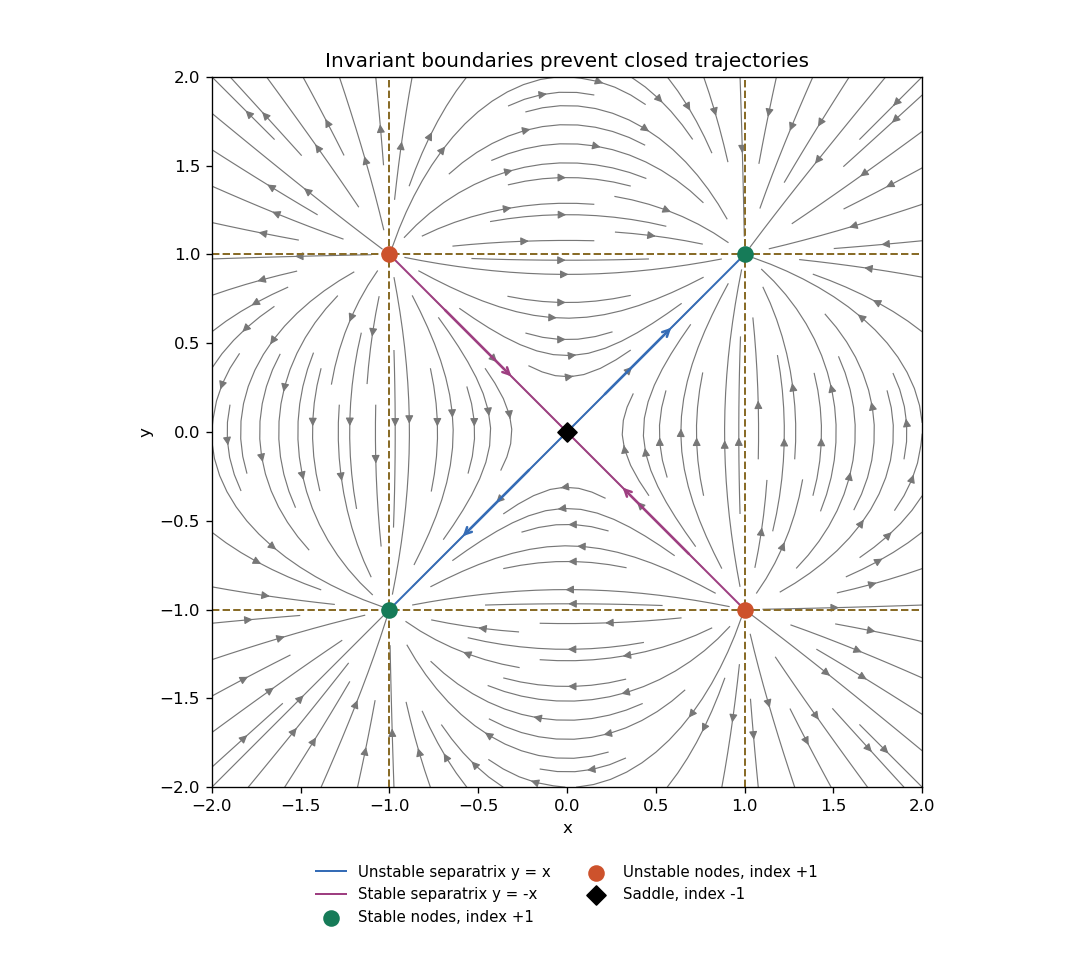
The simultaneous zeros are the origin and the four corners . The Jacobian matrix isAt the origin its eigenvalues are , with eigenvectors , so the origin is a saddle equilibrium of Poincaré index . At a corner . Thus and are stable nodes; and are unstable nodes, all of index . Although the node eigenvalues coincide, the equilibria are hyperbolic and their stability follows from their strictly signed real eigenvalues.
The lines and are invariant and divide the plane into nine convex regions. A nonconstant periodic trajectory cannot cross any of these lines by uniqueness, and cannot be contained in one of them because one-dimensional autonomous flows have no nonconstant periodic solutions. It must therefore lie inside one region. The central region contains only the origin, whose index is ; all other regions contain no equilibria. But a simple periodic orbit has index , equal to the sum of the enclosed equilibrium indices. Its interior stays in the same convex region, giving a contradiction in either case. There are no periodic orbits.
Away from the invariant lines, trajectory curves have the first integralsince both logarithmic derivatives equal . The diagonal is the unstable separatrix of the origin, leading toward the two sinks; is its stable separatrix, coming from the two sources. The diagram shows these separatrices, the invariant lines and the direction field.

Near zero the integrand is asymptotic to , and at infinity it decays exponentially. The defining integral therefore converges and is analytic for , by locally uniform domination, also allowing logarithmic factors for differentiation. Multiplication by the entire function does not enlarge the domain of the unevaluated integral itself.
On , subtract the two convergent integrals and useThe substitution gives . Thusfirst there and then wherever the two analytic continuations agree. The Riemann zeta function is meromorphic on the plane with its only pole a simple pole at one. The prefactor has a simple zero there, . It cancels the pole, giving . Elsewhere both factors are holomorphic. The analytic continuation of is entire; it is the Dirichlet eta function.
The Euler-Lagrange equations areUsing time independence of the vector potential gives , which is the component form ofTaking its scalar product with the velocity shows : the kinetic energy is constant, since the magnetic force does no work.
For , the equations give and . Thus and are constants of motion. Substitution into yieldsThe constant in this representation is nonpositive. The gauge choice also makes the conserved transverse canonical momenta explicit.
Set . Free propagation in the homogeneous expanding universe redshifts frequencies by and dilutes physical number density by . Number conservation in corresponding frequency intervals givesInserting the initial Planck spectrum, the factor becomes , while its exponent is . HenceThe shape is preserved even without collisions maintaining thermal equilibrium; it follows from redshift of an initially Planckian distribution.
For the total photon number density put . For the energy density include the energy of each photon. Thenwhere and . Both integrals are finite positive constants. Thus and , with the extra power supplied by photon-energy redshift.
For a discrete memoryless channel, its channel capacity in bits per use is . The Shannon second coding theorem identifies this with the supremum of rates achievable by arbitrarily long block codes with error probability tending to zero: every rate below is achievable, and no rate above can have vanishing error. The channel is used independently at each transmission, and coding rate is measured using base-two logarithms.
Let be the probability of using the second input symbol. The second output symbol occurs with probability , so . The first input has deterministic output and the second has one bit of conditional output Shannon entropy; hence andFor , its derivative is , which vanishes at . Strict concavity of binary entropy makes this the unique global maximum. Substituting givesThus Shannon's theorem supplies operational coding rates arbitrarily close to this value from below, and rules out reliable transmission above it.
For fixed , let have the binomial distribution with parameters . The Bernstein polynomial is . Continuity on the compact interval gives uniform continuity and a finite bound .
Given , choose so whenever . Since and , Chebyshev's inequality givesThe bound is independent of , including both endpoints. Taking the supremum and then letting tend to infinity proves uniformly on . This provides the required polynomial-approximation theorem with its proof.
For each node define the Lagrange interpolation polynomialThe nodes are distinct, so this is well defined, has degree , and satisfies . Its square has degree , within the assumed exactness range. ThereforeThe strict inequality follows because is not the zero polynomial. Exactness for the constant polynomial also gives . Thus the quadrature is a positive weighted average; the requested nonnegativity follows in stronger form.
Choose a polynomial with , using part (i). For all sufficiently large , its degree is at most , so . Positive weights summing to one give , and . HenceSince is arbitrary, the quadratures converge to the integral of every continuous . The positivity established in part (ii), not just polynomial exactness on its own, controls the approximation error uniformly in .
The diffusive flux is by Fick's first law. Conservation in any fixed control volume gives . The divergence theorem and arbitrariness of yieldAfter the initial point injection, and with , so radial symmetry gives . Total mass is .
A spreading radius and typical concentration obey and . Thus . In the proposed ansatz this givesDirect substitution, including the time derivative of , givesMultiplying by makes the left side . Regularity and zero radial flux at the origin set the integration constant to zero, so . On the positive region . Nonnegativity, compact support and continuity at its edge giveIts normalization is . Therefore the spherical nonlinear-diffusion source profile isThe concentration and flux vanish at the free boundary, so there is no distributional flux jump despite the derivative kink. The solution satisfies the diffusion equation weakly across that boundary and classically inside its positive region. Its support shrinks to the origin as , and testing against a continuous compactly supported function gives the limit times its value at zero. This verifies the prescribed point injection as well as the mass normalization.
For the Laplace-type contour ansatz, differentiating under the integral and putting gives the differential-equation residualIntegration by parts turns this into . Thus it vanishes whenever the endpoint contribution vanishes and . The latter condition is , solved byup to a constant multiplier. Closed contours avoiding the poles make the endpoint contribution zero.
Choose separate positively oriented small circles around 2 and . The residue theorem gives, after division by ,ThereforeThe Wronskian of the two basis functions is , nonzero for . They span the two-dimensional solution space on every regular domain, and both extend entire across the apparent singular point at zero. Their initial values satisfy and . Thus every solution has , and the requested combination , is impossible. No additional logarithmic solution is lost: the two independent functions already span the solution space away from zero.
Hamilton's equations generate the phase-space vector field . Its divergence vanishes:by equality of mixed derivatives. The Jacobian of the flow obeys with . Consequently is preserved for every time on which the smooth flow exists. This proves Liouville theorem in Hamiltonian mechanics directly; explicit time dependence of the Hamiltonian would not change the divergence argument.
For a time-independent function , Hamilton's equations giveThus a constant of motion has . For and the given Hamiltonian, . Simultaneous translation leaves every difference , and hence , unchanged. Differentiation with respect to gives , so also in this example. This is conservation of total momentum from translational symmetry.
A canonical transformation preserves the symplectic form and therefore the form of Hamilton's equations for arbitrary Hamiltonians. In one degree of freedom,Thus the transformation is canonical exactly when . Equivalently the chain rule gives for arbitrary transformed functions, so the bracket and Hamiltonian dynamics are preserved precisely with this factor one. The condition also makes the Jacobian nonzero and hence supplies local invertibility; a global canonical change of variables additionally requires the stipulated global bijectivity on its domain.
A deduction from premises in propositional logic is a finite sequence of formulas, each an allowed logical axiom instance, a member of , or obtained from earlier formulas by an inference rule, such as modus ponens. For example a Hilbert system can use the schemas , , and , with modus ponens as its rule. Its last formula is the conclusion. A finite deduction uses only finitely many premises. The completeness theorem for propositional logic says implies ; together with soundness, syntactic consistency is equivalent to existence of a satisfying valuation.
For compactness, if had no model, completeness would give a deduction of a contradiction. That deduction uses a finite subset of , which therefore also has no model. Contrapositively, if every finite subset has a model, so does .
Fix the given valuation on and let be its collection of true literals. Suppose were inconsistent. A finite subset of its literals, with conjunction , would satisfy by the deduction theorem and classical logic. But whereas the given valuation makes true, contradicting that it satisfies all of . Hence is consistent.
If had a model, restrict that valuation to and apply the preceding consistency result. Completeness supplies an extension to making true and preserving those values. Combine its values with the original model's values. Disjointness of makes this a well-defined valuation satisfying and , contradicting soundness of . Thus is inconsistent.
Compactness now supplies with . Put . ThenThis proves propositional interpolation. The empty conjunction is the truth constant; if the language omits truth and falsehood symbols, use an equivalent tautology when is nonempty, or adjoin those constants for the empty-common-language case.
Let be the two-colour clique Ramsey number. At a vertex of , either its red neighbourhood has at least vertices or its blue neighbourhood has at least . In the first case a red -clique extends through the vertex, or there is a blue -clique; the second case is symmetric. HenceWith , induction and Pascal's identity give . Taking provesThe four-vertex graph is the paw graph, a triangle with a pendant edge; the copy need not be induced. For the lower bound, colour two disjoint triangles in red and all edges between them blue. Red components have only three vertices and blue is bipartite, so neither colour contains a paw. Thus .
For the upper bound, guarantees a monochromatic triangle in , say red on a vertex set . A red edge from to any outside vertex immediately supplies a red paw. Otherwise all edges from to the remaining four vertices are blue. If those four vertices contain a blue edge , then and any vertex of form a blue triangle, and another vertex of joined to supplies its pendant edge. If they contain no blue edge, they are a red , which contains a red paw. Therefore
An automorphism sends the primitive root of unity to another primitive root of unity, hence uniquely to with . Define . Composition multiplies exponents, and an automorphism with exponent one fixes the generator and thus all of . Therefore is an injective group homomorphism and is abelian.
The extension is finite Galois: it is the splitting field of , whose roots are all present and distinct. Existence of a root of order in positive characteristic implies that the characteristic does not divide . The Fundamental theorem of Galois theory identifies an intermediate field with . Since is abelian, is normal; the normal-subgroup criterion gives Galois, with group .
For a non-surjective nontrivial example, take and . Its cyclotomic extension has degree two, and its image is inside the four-element group . For and prime , is irreducible: is Eisenstein at . Thus the extension has degree , equal to the unit group's order, proving surjectivity.
For , let . The cyclic Galois group of order six has exactly one subgroup of each order dividing six, so there are exactly four fields:Here . To identify the quadratic field without guessing, put and . Multiplication gives and , so . The order-three subgroup fixes , and , proving the quadratic identification. The real field is cubic because complex conjugation is , with fixed subgroup of order two.
For a complex irreducible representation, every central element acts as a scalar by Schur lemma. If the representation is faithful, these scalars embed in . Every finite subgroup of is cyclic: if its order is , all its elements satisfy , and the th roots of unity form a cyclic group. Thus is cyclic.
The trivial group satisfies the conclusion immediately. Otherwise let be a finite -group with cyclic centre, and decompose a faithful representation as a direct sum of irreducibles using Maschke's theorem. The nontrivial cyclic -group has a unique subgroup of order . Some component does not kill , since otherwise the whole representation would kill it. If that component had a nontrivial kernel , the kernel would be a normal subgroup and the allowed intersection theorem gives . Every nontrivial subgroup of cyclic contains , contradicting the choice of component. That irreducible component is faithful.
Finally the regular representation is faithful, since left multiplication by a nonidentity element does not fix the basis vector at the identity. A cyclic centre therefore supplies a faithful irreducible component of it. The first argument proves the converse, giving a finite -group has a faithful irreducible complex representation exactly when its centre is cyclic.
Since , the ring of integers is , with field norm . Norms and are impossible: modulo five they would require a square congruent to 2 or 3. An algebraic integer is a unit exactly when its norm is .
If 2 factored into two nonunits, their absolute norms would both be 2, since ; this is impossible. The same argument for excludes a factorization of 3. Finally has norm 6, so a nonunit factorization would require absolute norms 2 and 3, also impossible. Hence 2, 3 and are irreducible. The conjugate is irreducible by the same argument.
The equality gives inequivalent factorizations into irreducibles: no norm-six factor is associated to either 2 or 3, whose norms are 4 and 9. A principal ideal domain is a unique factorization domain. Consequently is not a principal ideal domain.
Write . The ideals are , and , with residue fields of orders 2, 3 and 3 respectively. Thus their ideal norms are 2, 3 and 3.
The generators of are . They are multiples of 2, and the integer combination of 4 and 10 giving 2 proves . Similarly is generated by . The difference of the middle generators is 6; together with 9 this generates 3. Therefore the product is .
The ideals and are coprime, so their product equals their intersection. The element belongs to both, hence . Both ideals have norm 6, so equality holds. Likewise belongs to and , and its norm is . ThusThe discriminant is 40. The Minkowski bound for ideal classes in a real quadratic field is , so every ideal class has an integral representative of norm 1, 2 or 3. The only possible prime ideals with those norms are the ones just listed. Their classes satisfy and . Thus there are at most two classes. The ideal is not principal, since a generator would have norm , already ruled out. Therefore the class number is exactly two.
The element has norm . To prove that it is a fundamental unit, let be a positive real unit with . Its conjugate is , so . For norm , the increasing function gives ; for norm , . Either contradicts integer . There is no positive unit between one and . For any positive unit, multiply by a suitable integer power of to place it in ; it must then equal one. HenceTo classify the norm-six elements, a principal ideal generated by such an element has norm 6. Unique prime-ideal factorization and part (b) force it to be either or . Therefore its generator is an associate of one of these two elements. Since their norms are respectively 6 and , the unit multiplying the first must have even exponent and the unit multiplying the second must have odd exponent. Combining the two cases gives all integer solutions:Conversely every displayed element is integral, since is a unit, and has norm 6. This proves completeness of the norm-six equation in the quadratic field of square root ten.
The PDF's restriction to misses conjugate solutions. In particular satisfies the equation but is not in that restricted family; it is the member. A nonnegative-index version becomes correct by adding the conjugates of every displayed element, with both signs. The restriction as printed cannot describe all signed integer pairs.
Use simplicial homology with a fixed coefficient group or ring. The Mayer–Vietoris sequence isThe inclusion maps define and . To define , split a simplicial cycle as with a chain in and in . Since , this boundary lies in , and . At degree zero the unreduced sequence ends with .
Conversely if , choose and with . The chain is a simplicial cycle in . Its splitting into the chain and chain gives . Hence , the requested exactness at .
Let be the open unit ball. Since is not meagre in , at least one closure has nonempty interior. A ball contained in that closure, subtracted from itself, gives a ball about zero contained in . Scaling yields some withNo completeness of is used here; the hypothesis is second category in , not merely in the relative image topology.
If , choose with . Then choose so the new residual is below , and continue. The series converges in the Banach space , has norm less than one, and continuity of gives . Thus .
The linear subspace contains a ball about zero, so it is all of : is surjective. Translated and scaled unit-ball images show that every open-set image is open. If is injective, its inverse is linear and the ball inclusion gives , by scaling and taking a limiting bound. Thus exists and is bounded.
For the first nonlinear counterexample use : its image is of second category but is not all of . For the second use the continuous surjection for , for , and for . The open interval maps to the nonopen singleton . Linearity is essential to the conclusions.
Put . On , the modulus of the th summand is at mostThe resulting Gaussian majorant is summable, independently of the unbounded real part of . The Weierstrass test proves uniform convergence on every such strip. Since the summands are entire, locally uniform convergence implies is entire. It is not identically zero: integrating over extracts its nonzero Fourier coefficient.
Logarithmic differentiation of the two supplied transformation laws givesThese hold as meromorphic identities, with poles at zeros of . For a translated fundamental parallelogram with no boundary zeros, opposite edges parallel to cancel by the first identity. The other edge pair contributes by the second, so the argument principle counts exactly one zero, including multiplicity, in that parallelogram.
Changing the summation index shows , hence . Quasiperiodicity makes every lattice point a zero. Every generic fundamental parallelogram contains exactly one lattice point, which already accounts for its one zero; varying its position rules out any additional zeros and proves the lattice zeros are simple. ThereforeIn particular the centred parallelogram in the question has no lattice points on its boundary and its unique zero is zero. Using generic translated contours first avoids assuming this boundary fact before determining the zeros.
For the proposed sum, the first period always holds, while . Thus it is -periodic exactly when . Meromorphicity follows from the meromorphic logarithmic derivatives. Finally differentiation removes the additive shift in , so has both periods for every .
A minimal surface has zero mean curvature ; equivalently its area is stationary under compactly supported normal variations. Its principal curvatures satisfy , so its Gaussian curvature isEquality occurs precisely where its second fundamental form vanishes.
Let be the self-adjoint shape operator. In an orthonormal principal basis, , with diagonal coefficients . The Gauss map is conformal with nonzero factor exactly when .
If the surface is minimal and has no umbilics, and , so this equality holds. Conversely equality of the squares gives either or . The first possibility is excluded by the no-umbilic hypothesis. Hence , proving minimality is equivalent to conformality of the Gauss map under the stated hypothesis. The factor is automatically positive because it equates positive definite inner products. The hypothesis is essential: a sphere has conformal Gauss map and nonzero mean curvature.
At a non-planar point of a minimal surface, the shape operator is not zero. Minimality gives nonzero opposite principal curvatures, so nearby and is invertible. The inverse function theorem makes the Gauss map a local diffeomorphism onto a patch of the sphere; part (ii) makes it conformal.
Choose stereographic coordinates on that sphere patch. Their metric is . Pulling them back by , the conformal identity givesThe positive coefficient shows that these are local isothermal coordinates. No general isothermal-coordinate existence theorem is needed: the nondegenerate conformal Gauss map supplies them explicitly.
The first Borel-Cantelli lemma says that implies , without an independence assumption. Indeed, for every ,The decreasing intersection of these tail unions is the infinitely-often event; continuity of probability from above proves the assertion. The second lemma says that for independent , divergence of the probability sum implies .
Convergence in probability supplies a subsequence converging almost surely to : choose it so , then apply the first Borel-Cantelli lemma. For each fixed , the tail of this subsequence lies in , and its almost sure limit is . Thus has a version measurable with respect to the completed tail sigma-field of the independent sequence.
By Kolmogorov's zero–one law, every event in that tail sigma-field has probability zero or one. Consequently for every rational . Since is a finite real random variable, its distribution function has limits zero and one at the two infinities; monotonicity then identifies a single threshold with . Hence is almost surely constant. Completion only adds null events and does not alter the zero-one conclusion.
Under complete convergence of random variables, for each integer the first Borel-Cantelli lemma gives . Intersecting these probability-one conclusions over the countably many shows that every tolerance is eventually satisfied. Therefore complete convergence implies almost sure convergence, without independence.
Almost sure convergence implies convergence in probability, so part (b) identifies the limit as a constant almost surely. For each , the events are independent. Almost sure convergence gives . If their probability sum diverged, the second Borel-Cantelli lemma would instead give probability one. Hence the sum is finite for every , proving almost sure convergence implies complete convergence for independent sequences.
Let be one uniform random variable on , and defineFor every the sequence is eventually zero, so almost surely. But , whose sum diverges. This sequence is not completely convergent; the exceedance events are nested and dependent.
For the generator entry is . Its diagonal is the negative total departure rate, . ThusEvery row sums to zero, as required for a continuous-time Markov-chain generator.
When all rates vanish. Every state is absorbing and the communicating classes are the singletons, all closed. There are no open communicating classes. Every probability distribution is stationary in this degenerate case.
For , the chain has one communicating class exactly when every . Sufficiency follows from the positive direct transition rate between each distinct pair of states. For necessity, if and there is another state, no other state can jump to , either directly or as the final step of a path, so cannot communicate with them. The one-state case also satisfies the condition because . A single class containing the entire state space is automatically closed.
Let , nonempty since . Every pair of distinct states in communicates directly, and no transition leaves for a zero-rate state. Hence is the unique closed communicating class. Each zero-rate state forms an open singleton: it has total departure rate , goes into , and can never be revisited. This includes the case that itself is a single absorbing state.
The stationary equation reads , because . ThereforeIt is the unique stationary law and vanishes on the open classes. For distinct , . Thus the chain is reversible in its equilibrium law, including the reducible cases; on the closed class this is the usual reversible irreducible chain. This structure is the destination-dependent reset chain.
At a state with positive departure rate , the next-jump probabilities areIf at least two rates are positive, every state has positive departure rate and the normalizing constant is positive. The jump-chain equilibrium law isIndeed is symmetric, proving both stationarity and reversibility. Jump observations weight the continuous-time equilibrium by the departure rate, so is generally different from .
If exactly one rate, , is positive, state is absorbing and the denominator vanishes. There is no next jump from that state: the genuine embedded jump sequence terminates there. Under the usual extended-chain convention set ; every other state jumps to with probability one. Its equilibrium law is and it is trivially reversible there. The normalized formula cannot be used in that absorbing case.
The likelihood-ratio statistic for nested parameter spaces isUnder the null, Wilks theorem gives when the full model and null submodel are smooth and identifiable, the true parameter is an interior regular point, Fisher information is nonsingular in the identifiable directions, and the usual differentiability and likelihood-asymptotic conditions hold. A level- test rejects for exceeding the upper quantile of that chi-square law. The approximation is for large samples; boundary parameters, singularities or nonidentifiability can give a different limiting distribution.
The unrestricted categorical MLE is , so the multinomial combinatorial factor cancels from the likelihood ratio andAssume the true cell probabilities are positive and the null has identifiable dimension with full-rank information. With probability tending to one, all are positive. Put . Regular estimation gives and of order . Expanding yieldsThe linear terms cancel exactly because . ThereforeThe full probability simplex has dimension , explaining the degrees of freedom. Existence and uniqueness of an MLE alone do not supply all Wilks regularity assumptions; positivity, smoothness and the local rank condition are also needed. The displayed approximation is not a finite-sample prescription for division by a zero observed count.
An arbitrage is a portfolio with nonpositive initial cost, nonnegative terminal payoff almost surely, and a strict benefit either from a negative initial cost or a positive payoff with positive probability. An equivalent martingale measure is a probability law equivalent to the physical law under which discounted traded prices are martingales. The bond has constant price one, so no discount factor is needed here.
Order the four states as . Equivalence requires positive probability in every state, since the physical product law has full support. Each stock has risk-neutral up probability , obtained by solving . Thus all equivalent martingale laws areThe two risky returns need not be independent under a pricing measure.
A replicating portfolio pays , so its four payoffs satisfyConversely this condition suffices: take , , and choose the bond holding to match . The relation then matches the fourth state as well. Its unique price is .
For the same-direction claim, the payoff vector is and its price under is . Thus the possible strictly arbitrage-free prices fill and the lower arbitrage bound is the infimum zero. It is not achieved by an equivalent measure, and pricing the nonnegative nonzero claim at zero would itself permit arbitrage by buying it. Its payoff is not replicable, since the displayed payoff relation fails. A buyer may pay a positive amount for its insurance against joint downward moves, for a view about dependence, or according to risk preferences. Under the stated physical independent law its expected payoff is , illustrating that a zero lower bound does not make the payoff economically worthless.
Articles were limited to the first 100 out of 131 total.
Articles by others on the same topic
There are currently no matching articles.