The fixed-point equation is . Thuswhen the discriminant is nonnegative. At zero the multiplier is , so it is linearly stable for and unstable for . At a nonzero fixed point, eliminate to obtain the branch and its multiplier:The branch is stable precisely when . These formulas specify stability throughout the diagram, including any extra flip points outside the region requested.
If and , the two nonzero branches exist for and have multiplier . Thus is a subcritical pitchfork bifurcation. If , the branch through zero has and ; its stability exchanges with zero at , a transcritical bifurcation. The two nonzero roots meet atwhere . The graph of has nonzero second derivative , proving a saddle-node bifurcation. At zero and , the multiplier is , indicating a period-doubling bifurcation; generically its nondegeneracy coefficient is . If , necessarily here, composition at instead gives . For small, the leading return equation is , producing a two-cycle with leading amplitudes . Its return multiplier is . Thus this special case still has a flip bifurcation, but it is degenerate and subcritical rather than the generic cubic normal form.
For , the fold lies above . Between it and the transcritical point, the branch is stable provided its multiplier remains above , while the other branch is unstable. For , the fold lies below : immediately above it the branch is stable and the branch between and zero is unstable; the branch crossing zero becomes stable for . All these statements are subject to the displayed exact multiplier criterion if the diagram is extended. The sketch uses representative parameter values and stops before additional flips, as stipulated.
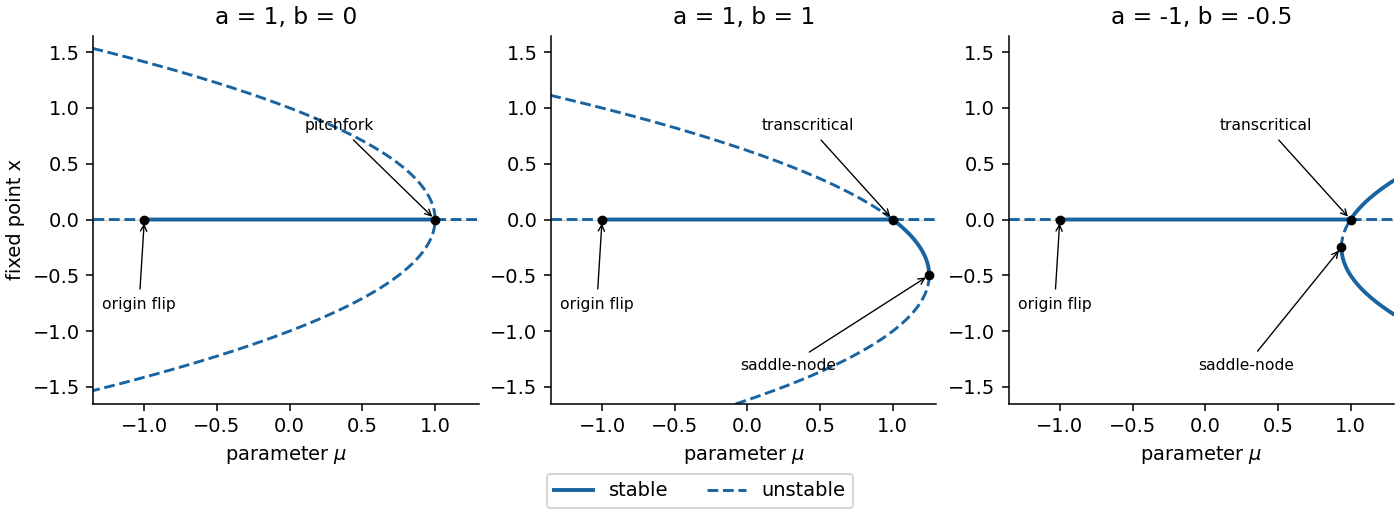
Fixed-point branches and stability for three representative cubic maps, with folds, transcritical or pitchfork crossings, and the origin flip
. Details. 
Articles by others on the same topic
There are currently no matching articles.