Let be the primes not exceeding , where , and let count integers divisible by none of these primes. Every surviving integer other than is prime: a composite integer at most has a prime factor at most its square root. Conversely, the surviving primes are exactly those between and . Thus the Legendre prime-counting formula isBy inclusion-exclusion,where the empty product is one. To cover literally every positive real , replace the subtraction of by : for , both counts are zero and there is no surviving integer .
The two-dimensional Brouwer fixed-point theorem states that every continuous map from a closed filled triangle to itself has a fixed point. Use the triangle , which lies in a two-dimensional affine plane. Strict positivity of the matrix entries ensures for every . Thereforeis a continuous self-map of , in fact into its interior. Its fixed point satisfies , where . Since lies in the interior, has an eigenvector all of whose entries are strictly positive. This is positive matrix eigenvector from simplex normalization; it uses strict positivity, not merely nonnegative entries.
For a Euclidean circle with centre and radius , two distinct finite points are inverse when they lie on the same ray from and their distances from have product . Points on the circle are fixed, and and infinity are inverse to each other. In complex coordinates this uniquely defines inversion in a circle byUniqueness follows from the ray and product conditions, including the specified centre–infinity pair; the formula also gives . A circle through infinity is a straight line in the complex plane; its inversion is reflection in that line, fixing infinity. For a line through with direction angle , its formula is .
Thus every inversion is an anti-Möbius transformation, of the form with nonzero determinant. If , write such an inversion as with a Möbius transformation. Since is the Möbius transformation with conjugated coefficients, the product of two inversions is , hence Möbius. Pairing consecutive inversions proves every composition of an even number of inversions is a Möbius transformation.
A binary linear-feedback shift register stores bits, shifts them at each clock step, and inserts a fixed linear combination over of the stored bits. Its output obeys a recurrence . Write its connection polynomial as ; the corresponding monic feedback polynomial is .
The Berlekamp-Massey algorithm maintains the shortest recurrence fitting the observed prefix. Initialize , length , displacement , and previous nonzero discrepancy . At symbol , calculate . If , increase . If , save and replace by . If , replace by , by , by , and by ; otherwise only increase . In the binary field subtraction equals addition. The shifted previous discrepancy polynomial cancels the current discrepancy while preserving earlier equations. A failed recurrence of length at position requires a corrected length at least when this exceeds , explaining the length update. Thus the algorithm recovers the shortest compatible register; a known bound and at least output symbols suffice to identify its minimal recurrence.
For the printed twelve-bit prefix, the nonzero discrepancies occur at positions (indexing from zero). The successive updated pairs areAll remaining discrepancies vanish. ThereforeThe first four observed bits are the fill. Length four is necessary: a length-three recurrence would need to hold already at and no such recurrence fits the prefix. Indeed the equations at force , , , a contradiction. Finite observations cannot rule out longer nonminimal registers.
The normal-model log-likelihood is up to a constant. Differentiating gives the maximum-likelihood estimatorsLet . The fitted component and residual are orthogonal jointly normal projections and hence independent. ThereforeThe prediction error is normal with mean zero and variance , and is independent of the residual variance estimate. Dividing by the independent estimated standard deviation yieldsThus the prediction interval in a normal linear model isThe extra includes the new observation's independent noise; omitting it would give a confidence interval for its conditional mean instead.
The terms and represent intrinsic exponential population growth. The losses and describe competition between the species; and describe crowding within each species. The positive constant sets the relative time scale of the second population.
The four equilibrium points in the nonnegative quadrant areThe last follows by solving and and is strictly positive under the assumptions. The Jacobian matrix isAt the origin its eigenvalues are , so it is unstable. At the first single-species equilibrium they are and ; at the second they are and . Both are asymptotically stable. At coexistence,Thus coexistence is a saddle; either species-only equilibrium is stable, and extinction is unstable. The saddle's stable manifold separates the competing basins of attraction.
Choose binary expansions that do not end in an infinite string of ones. The doubling map deletes the first digit: . Given and any neighbourhood of it, choose sufficiently large that its binary cylinder of length is small enough, and choose a point sharing that prefix but with a prescribed tail. After shifts, the tail of may be chosen arbitrarily in . Choose it close to zero or close to one, whichever is at distance more than from . Then but . Hence the map has sensitive dependence on initial conditions, with a uniform separation constant. At dyadic endpoints the cylinder sharing the chosen terminating expansion still contains points arbitrarily close to the endpoint.
Every nonempty relatively open interval contains a binary cylinder whose points share a finite prefix. Given nonempty open sets , choose such a cylinder of length . After binary shifts, contains with the usual half-open cylinder convention. In particular, some point of maps into . Thus is topologically transitive: . Equivalently, concatenate a prefix placing the point in with a tail placing its th iterate in .
Given a binary cylinder with finite prefix , repeat a finite block beginning with that prefix indefinitely. The resulting binary sequence is periodic under the shift and represents a periodic point of an interval map of in the cylinder. If the given prefix consists entirely of ones, append a zero to the block so that its value is less than one; this still preserves the prefix. Since cylinders can be taken inside any nonempty open interval, periodic points are dense.
A point fixed by satisfies , so for . The points with period dividing two are , corresponding to . All other twelve points have least period four. Multiplication by two modulo fifteen groups them into the three cyclesThis exhausts the requested four-cycles. The displayed order is the dynamical order, and cyclic changes of the starting point describe the same cycle.
For the Euler integral to converge directly, assume and . At zero it is the beta function . The normalization is thereforeOutside these initial parameter conditions the hypergeometric function is defined by analytic continuation wherever the parameters permit it.
For , differentiation under the convergent Euler integral giveswhere and are Pochhammer symbols. Thus its Taylor series iswhich is symmetric in . In the common region of parameter convergence for the two Euler integrals, this proves equality near zero. The identity theorem extends it throughout their common principal slit domain, and parameter continuation gives the usual identity wherever both sides are defined:
Assume the spheroid is homogeneous, as implicit in the stated moments. Put and map a uniform solid sphere by , preserving total mass by adjusting density. For the sphere, symmetry and its moment give for each coordinate. The transformed squared-coordinate integrals are consequently . Reflection symmetry makes the off-diagonal inertia entries vanish. ThusThe original PDF gives the correct solid-sphere factor , rather than the converted TeX's .
Put . The third of the Euler equations for a torque-free rigid body gives . The first two become , , whereTherefore . In body coordinates, and is constant. The angular momentum precesses about the body symmetry axis, with periodFor positive this is the printed expression. In the inertial frame the torque-free angular momentum is constant; the precession here is its changing representation in the rotating body frame. If or , this body-frame precession rate is zero.
Here , so the perturbation equation becomes . A trial gives , with roots . ThusThe pure growing mode obeys ; for generic data the decaying component eventually becomes negligible, though the growing-mode normalization must be determined from both initial data.
With , the physical wavelength is . Equating it to the Hubble radius , and using , givesGrowing-mode evolution from crossing to today multiplies the perturbation amplitude by . Hence the supplied horizon-crossing variance givesThis conclusion uses the stated matter-dominated growing-mode approximation over the relevant evolution, rather than an additional radiation-era transfer function.
Reduce the polynomial modulo , obtaining a nonzero degree- polynomial over the field . If is a root, polynomial division gives . Any different root is a root of , because is invertible. Induction on degree therefore proves there are at most distinct roots modulo .
Every nonzero residue is a root of by Fermat's little theorem. The difference between this monic polynomial and the product over all its nonzero roots has degree at most , yet has roots. The root bound forces it to vanish identically over . Thus all coefficients of the corresponding integer polynomial are divisible by .
For the requested failure modulo , take : , and is not divisible by seven. Hence the prime-square strengthening fails, even though some special primes do satisfy it.
Compare constant terms in the polynomial identity proved above. The constant term of is , while that of the product is . For odd , this gives . For , the same conclusion holds because . Thus Wilson's theorem follows:
For odd , pair the terms with denominators and . Since both denominators are coprime to ,has numerator divisible by and denominator not divisible by . Summing these pairs over a common denominator coprime to gives a numerator divisible by . Cancelling common factors cannot remove a factor , since none occurs in the denominator. Therefore the numerator of in lowest terms is divisible by . Equivalently, inversion permutes the nonzero residues and .
A Kleinian group is a discrete subgroup of , acting as orientation-preserving hyperbolic isometries of and as Möbius transformations of its boundary sphere. Its limit set consists of the accumulation points on the boundary of an orbit with ; it is independent of that interior base point and is closed. A nonidentity parabolic transformation is conjugate to , . Its iterates on the upper half-space tend to its unique fixed boundary point, infinity in these coordinates. Consequently every parabolic fixed point belongs to the limit set.
The displayed matrix has determinant one, trace two, and is not the identity because . Its fixed-point equation is , so it has exactly the double fixed point . It is therefore parabolic, and its fixed point is .
The determinant-one Gaussian-integer matrices form a subgroup of . They are discrete because their entries lie in a discrete lattice: a matrix sufficiently near the identity has every entry equal to the corresponding identity entry. Passing through the quotient by preserves discreteness, so their Möbius transformations form a Kleinian group.
For , and , set . This gives the Gaussian-integer parabolic constructionAll entries lie in , the determinant is one, and its parabolic fixed point is . The points with nonzero are dense in the finite complex plane, and their closure on the sphere includes infinity. Since the limit set is closed and contains all these parabolic fixed points, the limit set is the whole Riemann sphere.
Use the exponential dispersion family convention . For the Gamma distribution, takeSubstitution reproduces the gamma density exactly. Differentiating its normalization with respect to yields and : the first identity follows from zero mean score, and differentiation again gives the variance. ThereforeThe canonical link function is . Some conventions reverse the sign and call the reciprocal link; this only reverses the regression coefficients. We retain the genuine natural parameter .
In the Gamma regression with canonical link, and . Differentiating the independent-observation log-likelihood givesHere , so the negative Hessian equals this information matrix. Fisher scoring or Newton iteration iswith the means and information recalculated at each iteration; damping can preserve and increase the likelihood. Full column rank makes the information positive definite for positive means.
The saturated model has mean . Subtracting fitted from saturated log-likelihood yields the unscaled devianceTwice the actual log-likelihood ratio is . In particular, the printed parenthetical is incorrect for this nonidentity link: estimates , and .
The fixed-point equation is . Thuswhen the discriminant is nonnegative. At zero the multiplier is , so it is linearly stable for and unstable for . At a nonzero fixed point, eliminate to obtain the branch and its multiplier:The branch is stable precisely when . These formulas specify stability throughout the diagram, including any extra flip points outside the region requested.
If and , the two nonzero branches exist for and have multiplier . Thus is a subcritical pitchfork bifurcation. If , the branch through zero has and ; its stability exchanges with zero at , a transcritical bifurcation. The two nonzero roots meet atwhere . The graph of has nonzero second derivative , proving a saddle-node bifurcation. At zero and , the multiplier is , indicating a period-doubling bifurcation; generically its nondegeneracy coefficient is . If , necessarily here, composition at instead gives . For small, the leading return equation is , producing a two-cycle with leading amplitudes . Its return multiplier is . Thus this special case still has a flip bifurcation, but it is degenerate and subcritical rather than the generic cubic normal form.
For , the fold lies above . Between it and the transcritical point, the branch is stable provided its multiplier remains above , while the other branch is unstable. For , the fold lies below : immediately above it the branch is stable and the branch between and zero is unstable; the branch crossing zero becomes stable for . All these statements are subject to the displayed exact multiplier criterion if the diagram is extended. The sketch uses representative parameter values and stops before additional flips, as stipulated.
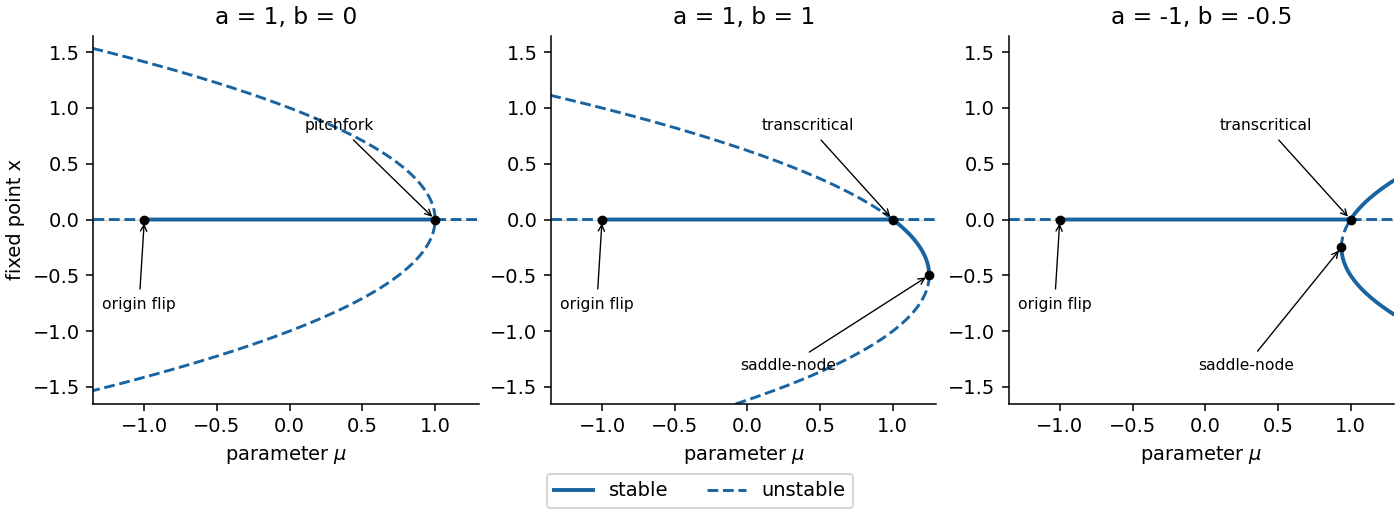
Fixed-point branches and stability for three representative cubic maps, with folds, transcritical or pitchfork crossings, and the origin flip
. Details. 
Separate fixed points from roots of . Fixed points are zero, and for . The remaining factors in the given factorization yield first . For these form the symmetric two-cycle because . Its multiplier is , so this cycle is always unstable.
The quartic factor gives for , hence . Positive roots require . At they give the fixed points , not genuine cycles. For , and , giving exactly two additional cycles:There are therefore at most three two-cycles. For either of the latter two, its multiplier isThus they are stable for and unstable for , with a flip at . The nonzero fixed points have multiplier , hence are stable for . Zero is stable for . At there is a supercritical pitchfork; at both nonzero fixed points lose stability to these two-cycles. The symmetric unstable cycle terminates at zero at the subcritical flip . These are the cubic map period-two branches.
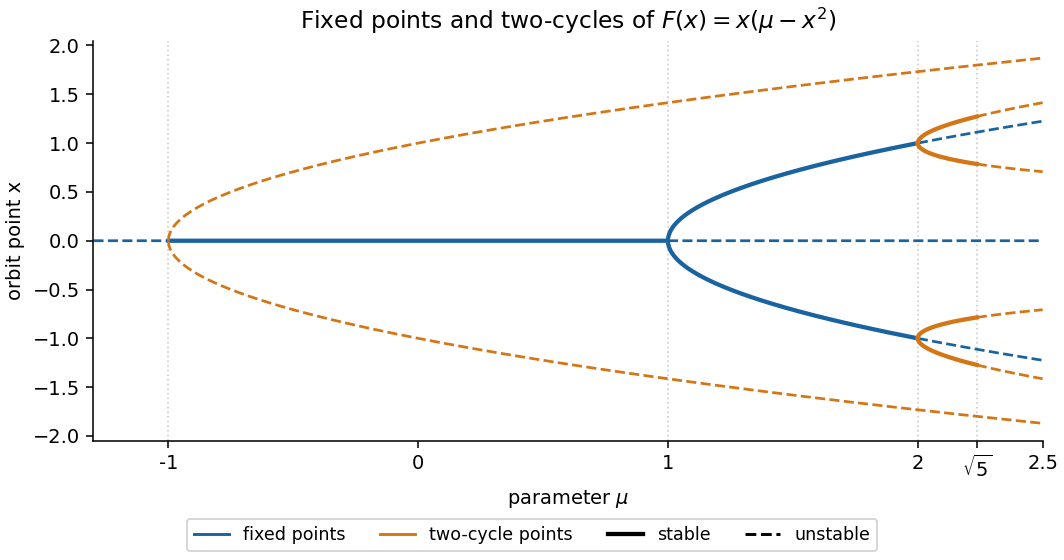
Fixed points and all three two-cycle branches of x maps to x times (mu minus x squared), with stable branches solid and unstable branches dashed
. Details. 
Beyond one expects period-four branches and further period doublings, potentially a cascade toward chaotic behaviour. This local argument does not claim that every larger parameter is chaotic; periodic windows and escape may also occur.
The Hamilton equations are and . Applying the chain rule to , their two phase-space contributions cancel, giving .
For fixed , a closed periodic orbit of energy has . Thus its action variable isThe sign matches the direction on each half of the orbit, making the enclosed phase-plane area positive. Since , differentiating under the integral givesFor slowly varying , the exact energy equation averaged over a nearly frozen cycle gives to the retained adiabatic order. Using , the two chain-rule terms therefore cancel:Here the angle brackets differentiate the explicit parameter dependence along the frozen cycle, not an independently chosen family of energies. The action is an adiabatic invariant, with errors beyond the slow-cycle approximation.
For , scale . ThenThe integral is a positive constant depending only on . Constancy of gives constant, hence
A binary relation on a set is a well-founded relation if every nonempty subset has an -minimal member, that is, a member with no predecessor inside that subset. Here write when .
Suppose is well-founded and fix any . Call a partial function consistent if is downward closed under and for . Two consistent partial functions agree on their common domain: otherwise the set of points where they disagree has a minimal member, all of whose predecessors are in both domains and agree, so applying gives agreement at that member as well, a contradiction. Thus the union of all consistent partial functions is itself a function , on a downward-closed domain, and remains consistent. This union is a set, because every such graph is a subset of .
If , choose a minimal member of . All predecessors of lie in , so extend to by the prescribed value . The enlarged domain remains downward closed and consistent, contradicting the union's maximality. Hence . The same minimal-disagreement argument proves uniqueness. This establishes the required recursion directly, without invoking an unproved well-founded recursion theorem.
Conversely, if is not well-founded, choose a nonempty such that each has a predecessor in . Let be all points reachable from by a finite chain of upward steps, including . ThenFor a point reached by a nonempty chain, its preceding point is in ; for a point of , use its predecessor in . The converse follows by appending the final step to a chain. Choose and if , zero otherwise. Both and satisfy the required recursion, and they differ because . This contradicts recursiveness. Therefore is recursive exactly when its predecessor relation is well-founded, the characterization of a recursive powerset mapping.
Let be the vertex degrees and let count common neighbours of distinct vertices. Count unoriented length-two paths by their centre or endpoints:If no four-cycle occurs, , so . By Cauchy-Schwarz inequality, . Solving givesIf , the same bound and monotonicity of in this range give (the small cases are immediate). Every pair of common neighbours supplies a four-cycle, counted twice through its two opposite vertex pairs, so four-cycle counting by common neighbours givesLet and . Convexity of gives . For , this function is increasing on the needed range, givingFor the printed right-hand side is nonpositive and the conclusion is trivial. At the printed cycle bound is false: a single edge meets the edge hypothesis but has no four-cycles, while the right-hand side is . Thus this particular bound needs the intended restriction; the other counting statements above do not have this defect.
On four chosen vertices there are three distinct cycle subgraphs, each present with probability in the stated random graph. Extra edges do not destroy these subgraphs. ThereforeFor positive expectation, Markov inequality giveswhen . If , the cycle count is identically zero and the requested event has probability one.
The squared Vandermonde product defining the polynomial discriminant is symmetric in all roots. By the fundamental theorem of symmetric polynomials, it is a polynomial in the elementary symmetric functions, which are the signed coefficients of the monic polynomial. Hence it is a polynomial function of those coefficients over the base field.
For , . Eliminating the two leading rows in the Sylvester determinant reduces the resultant toThusFor , the only possible rational roots are , and neither is a root. The cubic is therefore irreducible, so its Galois group is a transitive subgroup of . Its discriminant is . The Vandermonde product changes sign under odd permutations, and its square being a rational square implies that the product itself is rational; hence all Galois permutations are even. The only transitive subgroup of is itself. Consequently, writing for its splitting field,
We consider finite-dimensional continuous complex representations of SU(2). Its maximal torus is . The irreducible representations areThey may be realized as homogeneous polynomials of degree in two variables, with the induced linear substitution action. Their torus weights are , each once. The centre acts by , so precisely the even- representations descend to SO(3). In physics labels integral or half-integral spin .
Here is a classification argument. Average any positive definite Hermitian form over the compact group using normalized Haar measure. The averaged form is invariant, so the orthogonal complement of an invariant subspace is invariant. Repeatedly splitting gives complete reducibility. Differentiate an irreducible representation and complexify to the Lie algebra , with generators satisfying , , and . Torus periodicity gives integer -weights. Choose a vector of maximal weight ; then . Induction on using the commutators givesThe chain terminates: if and , the displayed formula forces . The vectors have distinct weights, span an invariant subrepresentation, and hence span the irreducible representation. Their generator action agrees with . Invariance under the Lie algebra is equivalent to invariance under the connected group, completing the classification. Conversely, a nonzero invariant subspace of a symmetric power contains a weight vector by projection onto torus weights. Raising it to the highest weight and then lowering generates every monomial, proving that the symmetric power is irreducible.
The character on the torus iswith the endpoints interpreted by continuity. Every representation has a unique decomposition . Its multiplicities can be computed from character inner products,The sine orthogonality directly verifies orthonormality of the irreducible characters. Alternatively, if is the dimension of the weight- subspace, the weight lists give , so for . This gives a constructive decomposition from torus weights. In particular, multiplying weight characters yields the Clebsch-Gordan decomposition . Arbitrary unitary Hilbert-space representations of this compact group similarly decompose into Hilbert direct sums of these finite-dimensional irreducibles; the finite-dimensional statement above is the standard representation-theory setting.
Since , reduction gives . The maximal ideals of this quotient are precisely those generated by the distinct irreducible factors . Their inverse images are thereforethe distinct prime ideals above . In fact is a field of size . Every prime containing arises this way; independence of the choice of lift follows because another lift differs by a multiple of .
To prove the ideal factorization, set . A generator of the product either contains a factor , and hence lies in , or is the product . The latter also lies in , since its polynomial reduces to and . Thus . The ideal norm is multiplicative for nonzero ideals in the ring of integers; henceEqual finite indices together with the containment imply equality. ThereforeThis proves the Dedekind factorization theorem in the stated monogenic case by containment and norms, rather than assuming the desired factorization.
Cut the second circle factor at . This divides the torus into two annuli whose boundary circles are exactly the two collapsed circles. Collapsing each annulus's two boundaries separately produces a two-sphere; the two spheres then share their two poles. In particular, the two collapsed circles give two distinct vertices, not a single common collapsed point.
For an explicit cellular homology calculation, each suspended circle contributes one edge from the first vertex to the second and one two-cell attached with zero cellular boundary. Thus , , , with no higher cells. Both edges have boundary , so has rank one and kernel generated by the difference of the edges. Each two-cell's attaching loop traverses its edge in opposite directions, so . Consequently the homology of a torus with two parallel circles collapsed isCollapsing either connecting edge as a maximal tree also exhibits the homotopy type .
For a bounded operator on a complex Banach space, the resolvent set is , and the resolvent operator is . The spectrum is its complement ; the point spectrum consists of with . For a real Banach space these definitions use its complexification.
If , the norm-convergent Neumann series gives , so the spectrum is bounded. If , factorThe second factor is invertible by a Neumann series whenever . Thus the resolvent set is open and the spectrum is closed and bounded.
The point spectrum need not be closed. On , define . Every is an eigenvalue, but zero is not: forces every coordinate of to vanish. No other eigenvalues occur, so is not closed.
Finally, if is self-adjoint and , , then is real and equals under the convention linear in the first argument. Therefore every eigenvalue of a self-adjoint operator is real.
Take an open neighbourhood on which is one-to-one and a homeomorphism onto its image. By invariance of domain for topological surfaces, that image is open. Shrink so the image lies in a complex chart of , and use as a chart of . These charts cover . On any overlap their transition is the transition between the original charts of , restricted to an open set, so is holomorphic with holomorphic inverse. They define the desired complex structure, and in these charts is locally the identity. Thus is holomorphic. The openness supplied by invariance of domain is important when the hypothesis is phrased only as a homeomorphism onto the image.
Let be holomorphic and let be the stated covering. Choose a lift of . The covering-space lifting theorem says that a map from a simply connected, locally path-connected domain has a unique lift after fixing this initial point: lift paths from zero, and homotopy lifting makes their endpoint independent of path. Since is simply connected, this constructs with . On a small neighbourhood, the lift is a biholomorphic local inverse of composed with , so it is holomorphic. Its modulus is less than one, and Liouville theorem therefore makes it constant. Hence every holomorphic map is constant.
A geodesic with affine parameter is a curve whose velocity is parallel along itself, . Its energy on a fixed parameter interval is . For a smooth fixed-endpoint variation with variation field , metric compatibility and the torsion-free connection giveThe endpoint term vanishes. Thus a geodesic is a critical point; conversely, vanishing for every interior variation field implies . Affinely parametrized geodesics are precisely the fixed-endpoint energy critical points.
Write . The geodesic energy density is constant, because an affine geodesic has constant speed. Its Euler-Lagrange equations give, with ,The requested expression isDifferentiate, using and :Therefore is independent of the affine parameter, the Liouville metric geodesic integral. The assumption of affine parametrization is the standard geodesic convention here.
A measurable set is invariant when , or modulo a null set in the measure-theoretic version. A measurable function is invariant when , similarly almost everywhere if appropriate. The map is a measure-preserving transformation when for every measurable set. A measure-preserving map is ergodic when every invariant measurable set has measure zero or has null complement. On a finite positive measure space, normalize the measure to obtain the equivalent probability-space definition.
As printed, is not a self-map of , so it is not an ergodic transformation of the specified space. No reduction modulo one is stated; if it were imposed it would instead be the identity, also nonergodic.
The map is not Lebesgue measure-preserving: the inverse image of is , of a different measure. It also has nontrivial invariant sets if ergodicity is defined using invariant sets alone. For example,is invariant under squaring because the logarithm inside the fractional part increases by one. Both it and its complement contain intervals of positive length, so their measures are positive. Thus is not ergodic under either convention.
Reflection preserves Lebesgue measure, but is invariant of measure , so it is not ergodic. Finally exchanges the two equally weighted atoms. The only invariant subsets are the empty and full sets, hence is ergodic despite having period two.
The Birkhoff ergodic theorem says that for a measure-preserving transformation on a finite measure space and , the averages converge almost everywhere to an invariant integrable function . This limit is the conditional expectation of given the invariant sigma-algebra, and . If the transformation is ergodic and , then equals the constant almost everywhere.
Since the measure is finite and is bounded, . By Birkhoff ergodic theorem, almost everywhere. If , then and therefore almost everywhere. For any finite ,and this constant is integrable because . The dominated convergence theorem gives . Thus the ergodic averages converge in every , , without assuming ergodicity.
The nonzero off-diagonal rates arewith a transition involving a negative coordinate omitted. These represent arrival, the two metamorphoses, and death. The diagonal generator entry is consequently , so the holding rate is .
Put . The proposed stationary probability is the productIt sums to one. Divide the balance equation at by this probability. Incoming immigration from contributes ; incoming first metamorphosis from contributes ; the next metamorphosis contributes ; incoming death from contributes . Their sum is precisely the outgoing rate. Missing boundary terms contribute zero, as the corresponding coordinate is zero. Thus .
For the chain is irreducible: with positive probability all current insects progress and die before another arrival, and from the empty state specified finite arrivals and stage transitions can reach any state. It is nonexplosive, since only finitely many Poisson arrivals occur in a finite interval and each individual makes at most three stage/death transitions. The existence of this normalized stationary law for an irreducible nonexplosive chain implies positive recurrence and uniqueness of the stationary probability law. “Only solution” here means only probability solution; the homogeneous equation itself also admits zero and scalar multiples.
The three stage counts are independent Poisson variables of mean under the product law. HenceDividing the joint law by this mass givesThus the conditional stage composition is multinomial with equal stage probabilities.
The chain is positive recurrent, by irreducibility, nonexplosion, and the normalized stationary probability law established above. In particular it is neither null recurrent nor transient. The positive arrival and stage rates are understood in the population model.
Treat each arriving caterpillar as one customer in an M-G-infinity queue, with arrival rate and service time equal to the sum of its three independent exponential stage lifetimes. This is an Erlang distribution of shape three and rate , of mean . Poisson arrivals independently retained according to whether their service has ended give, in stationarity, a Poisson number in service with meanThis is exactly the marginal law of found above. Each individual remains in service across both metamorphoses; counting a fresh service arrival at each stage would be incorrect.
Assume a common support, a differentiable likelihood, and dominated differentiation under the integrals. The score function has mean zero. Its second moment is the Fisher information . If is unbiased, differentiation of gives , hence . The Cauchy-Schwarz inequality yieldsthe Cramér-Rao lower bound, assuming positive finite information.
Equality holds precisely when the centred estimator and score are linearly dependent almost surely. The covariance fixes the factor, giving . If the same unbiased estimator is efficient for every parameter on a regular interval, integrate this identity in :Exponentiation gives , an exponential family. This proves efficient unbiased estimator implies exponential family under the stated common-support regularity, rather than asserting it for nonregular support-dependent models.
In the Black-Scholes model, the stock follows geometric Brownian motion , with constant volatility, and a risk-free account earns constant rate . Frictionless continuous self-financing trading and no arbitrage lead to risk-neutral drift . With , risk-neutral lognormality givesThis is the Black-Scholes digital option formula, obtained by discounting , not the stock-weighted probability of an ordinary call. Differentiation gives the Delta hedgewhere are the standard normal distribution and density. At fixed , the density term decays faster than grows, so delta tends to zero. At , and diverges. Thus a narrowing, increasingly large delta spike forms around the strike. The terminal payoff is discontinuous: frequent large hedge adjustments near the strike, transaction costs, jumps, discrete trading, and small model or price errors make practical replication difficult. A fixed path avoiding the strike and the at-the-strike limit need not behave alike.
Let in equilibrium, with . The innovation is . The given filter givesOrthogonality to the new innovation requires , hence . Since the variables are jointly Gaussian, this orthogonality is independence. Stationary variance gives , soThe added process noise reflects the fact that the new observation concerns , not .
For the control calculation choose a quadratic value coefficient . Conditional minimization of gives and the Riccati equation , hence . Separation replaces by its conditional estimate, givingTo determine the average cost without solving an additional state covariance, complete the square:With , the final square is . In equilibrium the expected telescoping value term is zero, so the minimal cost isThe identity also proves optimality: conditional mean minimization of the square uniquely selects the stated control. Here ensures stable closed-loop estimates, making the equilibrium averaging valid. This is the Scalar delayed-observation LQG regulator.
For a function, let be its spherical mean. Differentiation and the divergence theorem giveIf is harmonic, this derivative is zero; since by continuity, every spherical mean equals the value at the centre. Integrating over gives the same statement for the volume mean on a ball. This proves the mean value property for harmonic functions.
If is subharmonic, , so . ThusThese are the corresponding mean value inequalities. A subharmonic function has the maximum principle on a ball: apply the second-derivative test to , whose Laplacian is strictly positive and hence cannot have an interior maximum, then let .
For , the given equation says . Since is real,The subharmonic maximum principle gives throughout the ball. Taking square roots yieldsNo sign condition on the real potential is needed.
Away from the turning points, the Liouville–Green approximation gives in the allowed regionThe bound-state condition discards the growing exponential in each forbidden region, leavingThese approximations require variation slow compared with the local wavelength, and must be replaced near by Airy approximations.
Near , set . The local differential equation becomes . Decay on the left selects Airy function rather than its growing companion. Comparing the supplied asymptotics across the turning point yieldsAt , use ; decay on the right similarly yields , where . Let . The left expression has equal cosine and sine coefficients in the variable ; the right expression has those coefficients proportional to and . They can describe the same nonzero wave only when . Therefore the WKB quantization condition isThe two simple turning points contribute the two quarter-phase shifts, giving the half-integer correction.
Articles were limited to the first 100 out of 126 total.
Articles by others on the same topic
There are currently no matching articles.