At time zero there has been no survival selection, so the population hazard of a survival mixture is the original mean individual hazard:At very large times, surviving individuals overwhelmingly come from the smallest-frailty end of the distribution. Their hazards approach the lower endpoint , soFor a direct check, differentiating the logarithm of the uniform frailty survival mixture givesIts expansion at zero is , and its large-time limit is . The changing population hazard does not imply that an individual's hazard declines. The decreasing population hazard under constant individual hazards identity makes the selection mechanism precise: with ,It follows by differentiating the ratio . Thus the surviving mixture becomes less frail over time even though every conditional hazard is constant.
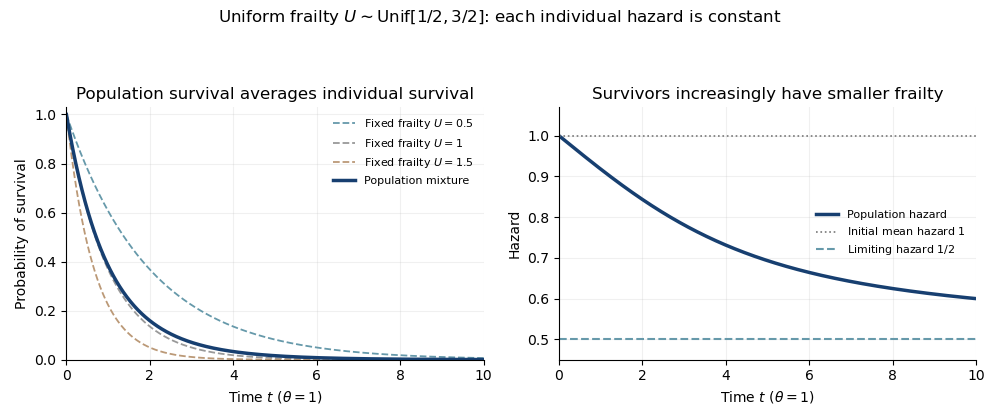
Uniform frailty survival mixture and declining population hazard despite constant individual hazards
. Details. 
The figure takes . The population survivor curve averages conditional exponential curves, while its hazard falls from the initial mean to the minimum individual hazard.
Articles by others on the same topic
There are currently no matching articles.