The normalized Fock vacuum obeys for every momentum and . Taking adjoints gives . Of the four products in the mode expansion of , only has a nonzero vacuum expectation value. The commutator impliesConsequentlyThis unordered Wightman function differs from the time-ordered Feynman propagator when the temporal ordering is reversed.
Write and . By time ordering for a bosonic field,Reverse in the second integral. At fixed spatial momentum considerThe Feynman i-epsilon prescription places the poles at and . For , close in the lower half-plane, clockwise. The positive-energy residue and the orientation give . For , close counterclockwise in the upper half-plane; the negative pole has derivative denominator , and its residue gives . Thus , reproducing the time-ordered mode expression. We obtainThis is a distributional boundary value, not an absolutely convergent Fourier integral. As an independent normalization check, , so ; the numerator is with the question's definition of the propagator.
The Yukawa interaction has one real-scalar leg and an oriented fermion line at each vertex. At lowest connected order, two vertices exchange one scalar, so the diagrams are of order .
For two incoming fermions, there are two pairings of the outgoing fermions: the channel joins to and to , with scalar momentum ; the channel joins to and to , with scalar momentum . Fermion number conservation excludes an annihilation channel for two particles carrying the same charge.
For an incoming fermion and antiparticle, there is a -channel scalar exchange with momentum and an -channel annihilation and recreation diagram with momentum . Arrows on antiparticle lines run opposite to the direction of physical propagation. These are the four tree scattering in Yukawa theory diagrams shown below; all external momenta are labelled.
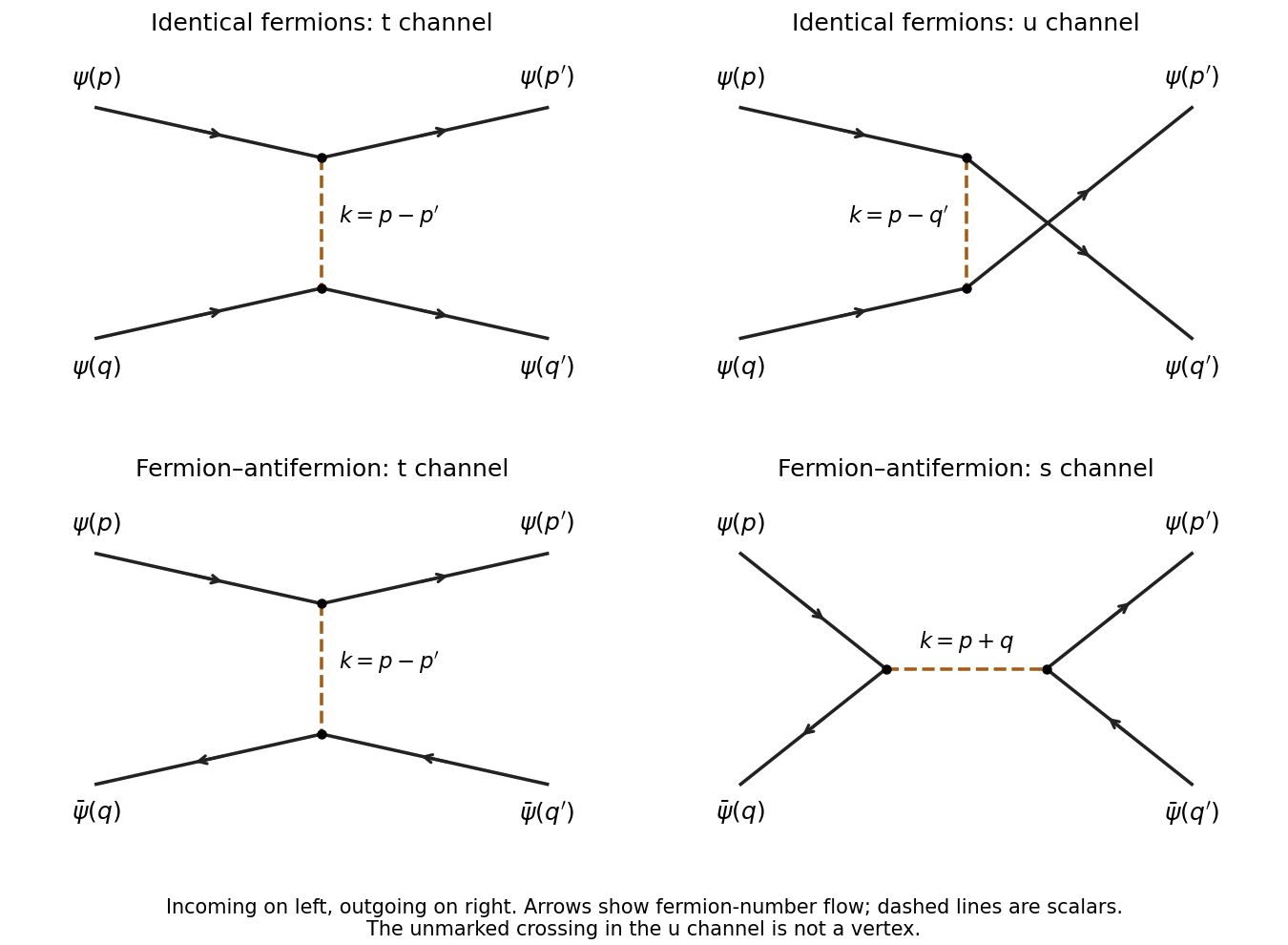
Tree-level scalar-exchange diagrams for fermion–fermion and fermion–antifermion scattering; incoming states on the left
. Details. 
The crossing in the -channel drawing is not a vertex. Dashed internal lines are the real scalar field; solid arrows show fermion-number flow.
Use the Feynman vertex for the scalar Yukawa coupling, the internal scalar propagator , incoming factors and outgoing Dirac adjoints . Define as the coefficient in the connected S-matrix element after removing its overall momentum-conserving Dirac delta function. A direct pairing contributesThe crossed pairing interchanges the identical outgoing fermions and therefore has a relative fermionic sign of minus. With and , the result isIt changes sign under exchange of the two outgoing momenta and spin labels, as required for identical fermions. No fermion spin sum or identical-particle phase-space factor belongs in this amplitude; those enter a relativistic scattering cross-section calculation.
Articles by others on the same topic
There are currently no matching articles.