With an approximately constant Hubble parameter , the scale factor is after a choice of normalization. Integrate and choose the integration constant so that the future endpoint is :Substituting in the FLRW metric gives . This is Conformal time during de Sitter expansion.
For the FLRW metric in conformal time, , and . The equation for a minimally coupled massless scalar field is consequentlyFor a Fourier mode of comoving wavevector , the Laplacian contributes , where . ThusSince , this yieldsThe absence of a curvature-coupling term is material: a conformally coupled scalar field obeys a different mode equation.
Denote the comoving box volume by , keeping it distinct from the inflaton potential . For the Canonically rescaled de Sitter scalar mode , the equation in part (b) becomesDirect differentiation verifies the positive-frequency solutionFor , tends to , the positive-frequency flat-space mode. It therefore selects the incoming Bunch-Davies vacuum. The Bunch-Davies mode normalization in a finite comoving volume is fixed by the Wronskian conditionAfter cosmological horizon exit, , the mode tends to the time-independent value . The complex mode and its Hermitian conjugate together make the real quantum field.
In the incoming Bunch-Davies vacuum, only contributes to the coincident vacuum expectation value. ThusReplacing the box sum by givesThe subhorizon vacuum contribution is the flat-space zero-point term; at fixed comoving it redshifts as . The other term gives frozen scalar power on superhorizon scales. Specifically, the dimensionless cosmological power spectrum per logarithmic interval isIts late-time value is independent of , producing a scale-invariant inflationary power spectrum. Each fixed Fourier mode freezes separately as .
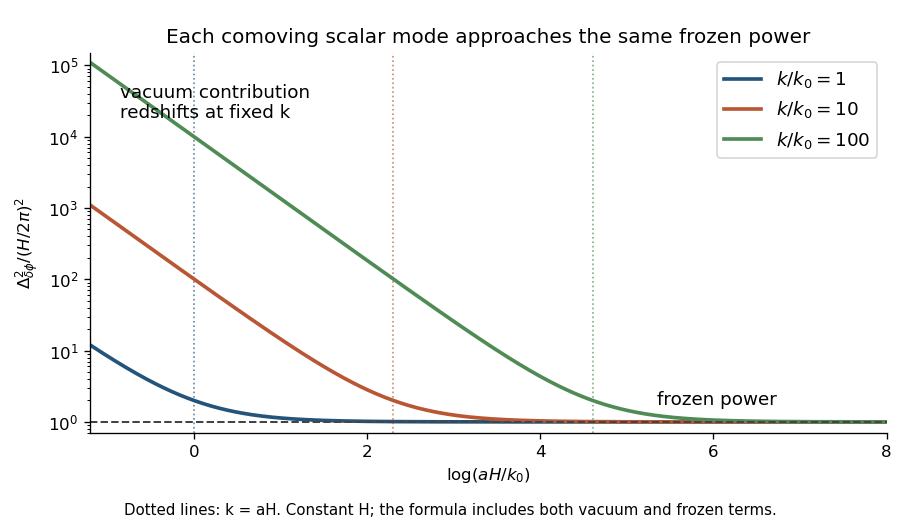

The coincident integral is formal: the vacuum part diverges at large , and an unlimited scale-invariant part diverges at small . The conclusion concerns the power in each finite logarithmic band. A finite inflationary history supplies a largest generated wavelength, as described by the infrared qualification of a scale-invariant covariance; taking the late-time limit inside an unregulated integral would not be justified.
Articles by others on the same topic
There are currently no matching articles.