Let be the Hubble parameter, and normalize the scale factor by . The cosmological continuity equation gives for pressureless matter, whereas the cosmological constant has constant energy density . The spatially flat Friedmann equation therefore becomesThe present Hubble constant is . In terms of the present critical density , the matter cosmological density parameter is . Spatial flatness gives , so
For , set and choose the expanding branch of the Friedmann equation. ThenSeparating variables and choosing cosmic time at the Big Bang givesThus the flat dust-and-vacuum expansion isSetting gives the age of a flat matter-Lambda universe,The two matter-vacuum age endpoint limits follow below.
As , use to obtainAt fixed Hubble constant, the age of a flat matter-Lambda universe diverges logarithmically. The limiting purely vacuum-dominated de Sitter spacetime has an exponential scale factor and no Big Bang at a finite value of cosmic time in this flat slicing.
As , use near zero. ConsequentlyThe flat dust-and-vacuum expansion tends to , the Einstein-de Sitter universe.
A radial light ray in the FLRW metric travels comoving radial distance in units . The total comoving visibility radius is therefore the full available conformal time interval,Insert the Friedmann equation from part (a), then put to getFor the integrand is bounded at zero and decays as at infinity, so the total conformal lifetime of a flat matter-Lambda universe is finite. Equivalently, this distance is the present comoving particle horizon plus the remaining comoving distance to the cosmological event horizon. This describes causal visibility under the assumed ability to see back to the initial singularity.
The degeneracy factor counts internal states with the same energy, including the allowed spin states. The chemical potential measures the free-energy cost of changing the number of particles of species ; in this convention the rest energy remains in the exponential of the nonrelativistic Maxwell--Boltzmann number density.
The chemical potential is fixed by the densities of conserved charges and by chemical equilibrium between reactions. For a reaction , chemical equilibrium requires . Equivalently, when these are the only constraints, is a linear combination of the chemical potentials of the conserved charges carried by . An unconstrained species has zero chemical potential. In particular, the photon chemical potential vanishes in thermal equilibrium when photon-number-changing reactions are effective.
For , chemical equilibrium and the vanishing photon chemical potential imply . Taking the ratio of the three nonrelativistic Maxwell--Boltzmann number densities cancels these chemical potentials:The ground-state hydrogen atom has four combined electron and proton spin states if the small hyperfine splitting is ignored, whereas . Hence . With Hydrogen binding energy and , the Saha ionization equation givesThe approximation in the prefactor neglects relative corrections of order ; the Hydrogen binding energy must be retained in the exponential.
Write for the cosmological baryon density in this hydrogen-only model, and for the hydrogen ionization fraction. By charge neutrality, , so the Saha ionization equation becomesThe baryon-to-photon ratio is , and the equilibrium photon number density is . At an order-one hydrogen ionization fraction, neglecting factors of order one therefore givesReplacing inside the slowly varying logarithm by givesWith , and , this is . Solving the preceding implicit approximation instead gives . Both are reasonable estimates of the recombination temperature at the accuracy requested. The small baryon abundance delays hydrogen recombination: even when , the high-energy tail of the abundant photons can still ionize the much rarer hydrogen atoms.
With an approximately constant Hubble parameter , the scale factor is after a choice of normalization. Integrate and choose the integration constant so that the future endpoint is :Substituting in the FLRW metric gives . This is Conformal time during de Sitter expansion.
For the FLRW metric in conformal time, , and . The equation for a minimally coupled massless scalar field is consequentlyFor a Fourier mode of comoving wavevector , the Laplacian contributes , where . ThusSince , this yieldsThe absence of a curvature-coupling term is material: a conformally coupled scalar field obeys a different mode equation.
Denote the comoving box volume by , keeping it distinct from the inflaton potential . For the Canonically rescaled de Sitter scalar mode , the equation in part (b) becomesDirect differentiation verifies the positive-frequency solutionFor , tends to , the positive-frequency flat-space mode. It therefore selects the incoming Bunch-Davies vacuum. The Bunch-Davies mode normalization in a finite comoving volume is fixed by the Wronskian conditionAfter cosmological horizon exit, , the mode tends to the time-independent value . The complex mode and its Hermitian conjugate together make the real quantum field.
In the incoming Bunch-Davies vacuum, only contributes to the coincident vacuum expectation value. ThusReplacing the box sum by givesThe subhorizon vacuum contribution is the flat-space zero-point term; at fixed comoving it redshifts as . The other term gives frozen scalar power on superhorizon scales. Specifically, the dimensionless cosmological power spectrum per logarithmic interval isIts late-time value is independent of , producing a scale-invariant inflationary power spectrum. Each fixed Fourier mode freezes separately as .
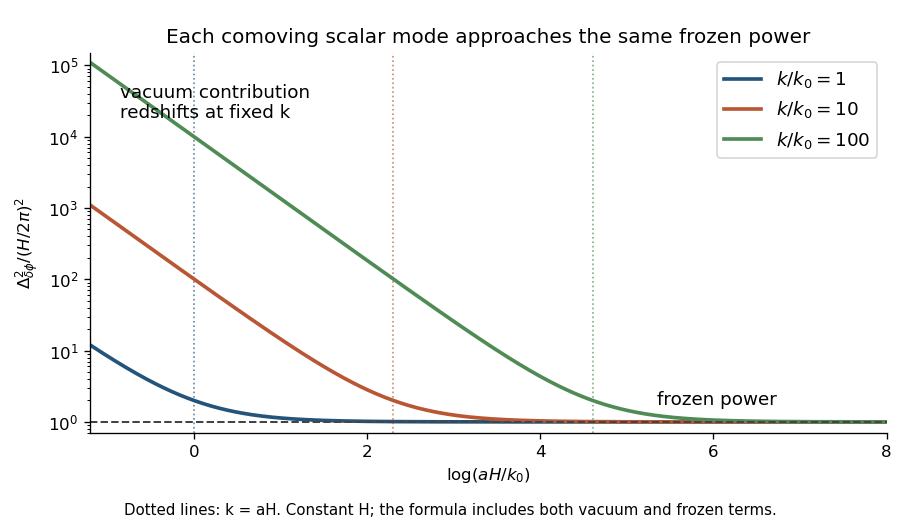

The coincident integral is formal: the vacuum part diverges at large , and an unlimited scale-invariant part diverges at small . The conclusion concerns the power in each finite logarithmic band. A finite inflationary history supplies a largest generated wavelength, as described by the infrared qualification of a scale-invariant covariance; taking the late-time limit inside an unregulated integral would not be justified.
A perturbation of the inflaton shifts its local clock: . Regions with different clock shifts reach the end of inflation at different times and hence undergo different amounts of expansion. The inflaton clock-shift origin of curvature perturbations gives a local expansion difference of magnitude . The sign depends on whether denotes a clock advance or a delay to a fixed end value.
The comoving curvature perturbation has amplitude . For adiabatic evolution, superhorizon conservation of single-field comoving curvature carries this amplitude into the later growing density contrast, with the numerical conversion depending on the epoch and the density slice. Thus the approximate density-amplitude statement in the question follows; it does not identify the density contrast and in every gauge.
The frozen scalar power per is , so the slow-roll curvature power spectrum isConsequently , giving the requested approximate growing-density spectrum. Both and are evaluated separately when each Fourier mode undergoes cosmological horizon exit.
At cosmological horizon exit, is proportional to ; the convention-dependent factor has zero logarithmic derivative. Define the first Hubble slow-roll parameter . ThenThe chain rule gives . In reduced Planck units, the slow-roll equations are and . Therefore the horizon-exit logarithmic derivative in slow roll is
The slow-roll equations turn the slow-roll curvature power spectrum intoThe spectral tilt is the logarithmic derivative of this dimensionless spectrum. Apply the horizon-exit logarithmic derivative in slow roll:With the potential slow-roll parameter above and the second potential slow-roll parameter ,This is the first-order departure of the scalar spectral index from unity, in reduced Planck units.
During radiation domination, the cosmological continuity equation gives . The flat Friedmann equation in conformal time is . Hence is constant, and choosing the Big Bang at yieldsFor the CDM density equation in a matter-radiation universe, neglect while retaining itself. The adiabatic initial conditions give , soThis Euler-Cauchy equation has powers with , namely . Selecting the growing superhorizon adiabatic CDM mode in radiation domination gives
After cosmological horizon entry in radiation domination, the oscillating radiation source averages away. Neglecting both that source and CDM self-gravity in the CDM density equation in a matter-radiation universe givesso . The superhorizon adiabatic CDM mode in radiation domination has amplitude at entry , fixing this scale for the subsequent logarithmic CDM growth after radiation-era horizon entry.
More explicitly, in a sharp-transition approximation with , continuity of and givesThe matching the CDM growing mode at horizon entry therefore yields the late subhorizon scalingHere suppresses order-one coefficients and the nonlogarithmic term, as in the question. A smooth treatment of the radiation forcing through entry changes those coefficients; the factor two is exact only for the sharp matching model just used. This logarithmic growth, rather than growth proportional to , is the Mészáros effect.
During matter domination, . The flat Friedmann equation in conformal time implies , and henceWith radiation neglected, the CDM density equation in a matter-radiation universe reduces toFor this Euler-Cauchy equation, requires . Thus the matter-era growing and decaying density modes are and , respectively, andThere is no explicit in this pressureless equation, so the result holds on all scales within the stated CDM-comoving synchronous gauge description. The amplitude can still depend on through its earlier evolution; the result does not equate density contrasts on different time slicings.
Articles by others on the same topic
There are currently no matching articles.