Let the spatial spacing be , the time step , and . Abbreviate the three new-time coefficients by , , , and the two old-time coefficients by , . These are the coefficients of the compact third-order advection stencil.
For a smooth solution of the advection equation, implies . Substituting the exact solution into the stencil therefore evaluates all five terms on the same characteristic profile, at spatial offsets , , , , and . Its Taylor moments areDirect polynomial expansion givesConsequently the unscaled local truncation error isAt a fixed nonzero Courant number, dividing by the time step gives an consistency defect. ThusWhen , the order is higher because the method simplifies to an exact integer shift: at the two sides have the common factor and the amplification is ; at it is . The signed value gives the shift , and gives the identity. These special cases do not invalidate the third-order statement for the family. Under the stability conditions established next, the usual accumulation of the fourth-order local defect over steps gives third-order convergence for smooth data.
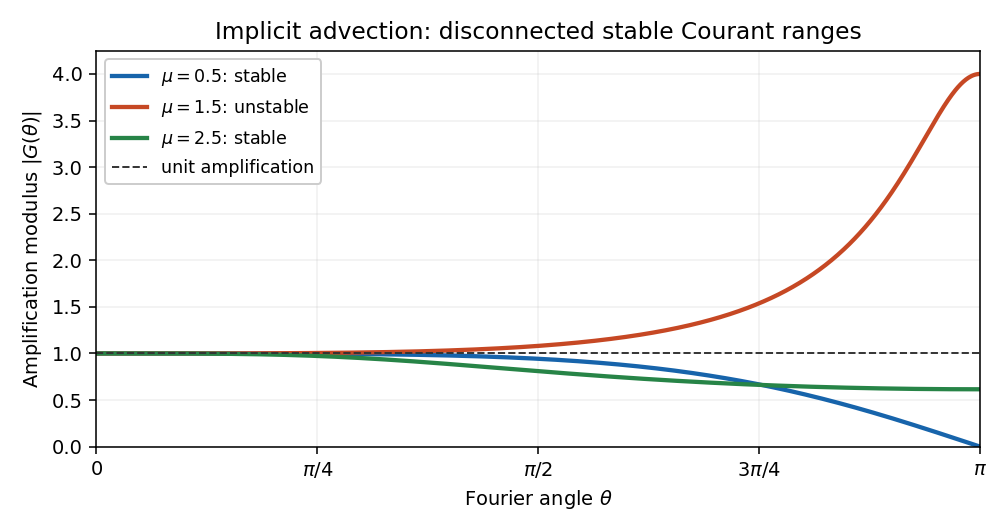
For a Fourier mode , defineThe amplification factor is . To derive its stability condition, use the coefficient abbreviations from the preceding solution and set . The squared moduli areHere , , and . Subtraction and factorization giveThus for every frequency exactly when , provided the implicit denominator does not vanish. For the physically nonnegative Courant number, this givesFor a signed convention the full real range is .
There is no hidden denominator failure in these ranges. If and , the identity forces and ; but . If , then , and could vanish only when its two real coefficients have equal magnitudes. Their sum is three, so equality requires , which is not a root of . Hence is nonzero for every frequency in the allowed ranges. On the compact frequency interval its inverse is bounded for each fixed allowed .
When , choose a small nonzero frequency. The denominator remains close to three, while the boxed identity gives . Its fixed-frequency numerical mode grows geometrically, proving instability in the usual fixed-Courant refinement limit. Conversely, for , the Plancherel theorem converts the mode bound into a discrete L2 norm contraction on the whole-line or periodic grid. The large-Courant branch is possible because the scheme is implicit; stability alone does not promise small error at a large step.

Articles by others on the same topic
There are currently no matching articles.