Put and extend the system by . At the zero equilibrium with zero parameters, the block is the nilpotent matrix , while the eigenvalues are . Since , these are stable. The extended centre manifold is a graph , tangent to the four-dimensional centre space containing the two parameter directions. Its invariance equations areFor the quadratic jets in the ordinary total degree, the coefficient multiplying has no linear part. Hence and . With , comparison gives , , . The second graph is obtained in the same way. Terms involving parameters at quadratic order have zero forcing and vanish. Thus the quadratic centre manifold for a pair of linear filters isSubstitution into the centre equations gives the cubic termsThe last displayed cubic term is absent from the proposed second-order approximation, so its omission needs the weighted scaling rather than an ordinary-degree truncation.
Under the hinted scaling , , , , one has and . The invariance equations at weighted orders two and three give and . In particular no additional parameter-dependent weighted-order-three graph terms appear. Therefore the term and the omitted manifold corrections affect the reduced acceleration only at order , whereas has order and order . After division by , the slow equation isThis proves why the stated approximation retains the leading nonlinear restoring force and its first nonlinear damping correction. The centre manifold theorem removes the exponentially decaying transverse directions, while the retained generic coefficients determine the nearby reduced bifurcations. It is a local asymptotic description, not an exact global reduction. If either relevant coefficient vanishes, higher-order terms may be needed to resolve that degeneracy; the two extreme cases in part (b), with , avoid it.
Set and rescale , . The reflection-symmetric cubic double-zero normal form becomesIt is invariant under . Thus the large- case has and the small- case . At the origin the Jacobian matrix has determinant and trace : it is a saddle for , stable for , and unstable for . In the latter two cases the discriminant distinguishes nodes from foci; its zero is not an equilibrium-creation bifurcation.
The nonzero equilibria satisfy , . At either of them the determinant is and the trace is . Therefore for , a pair of saddles exists when , while for , a pair of attracting equilibria exists when , and a repelling pair when . The repelling or attracting points may be nodes or foci. Their origin collision occurs on the pitchfork bifurcation line , away from . For fixed , the scalar centre equation there beginsFor , the large- case is a subcritical pitchfork and the small- case a supercritical pitchfork. For , the scalar criticality reverses, but there is already an unstable transverse eigenvalue, so the full-plane branches have the stability just listed.
At the origin, , is a Hopf bifurcation with frequency . Averaging the leading weakly nonlinear oscillator gives the amplitude equationConsequentlyThese are respectively a supercritical Hopf bifurcation and a subcritical Hopf bifurcation, with fixed and the cycle sufficiently small. The portraits change from a stable focus to an unstable focus surrounded by a stable cycle in the first case; in the second, a stable focus is surrounded by an unstable cycle before the focus becomes unstable and that cycle disappears.
The small- case has an additional pair of Hopf bifurcations at the nonzero equilibria:Their criticality includes quadratic terms and is not read off from the positive term alone. Set , , and . ThenFor an oscillator , the cubic radial coefficient is . Here it is . Thus both nonzero Hopf bifurcations are supercritical: for small , each newly unstable well equilibrium is surrounded by a stable small cycle with .
To constrain periodic orbits, use either the divergence or the energyFor , the divergence has one strict sign except on a line, and the Bendixson-Dulac criterion excludes every nonconstant periodic orbit. For , the same reasoning excludes every periodic orbit. When the divergence changes sign, this criterion makes no such exclusion; the Hopf cycles above are consistent with that restriction. In the large- case a periodic orbit also requires : if , a positive maximum of would have , or a negative minimum would have negative acceleration, both impossible. For the same extremum argument confines a cycle to , between the two saddle locations. The local bifurcation lines and representative portraits on both sides are summarized below; their global completion requires part (c).
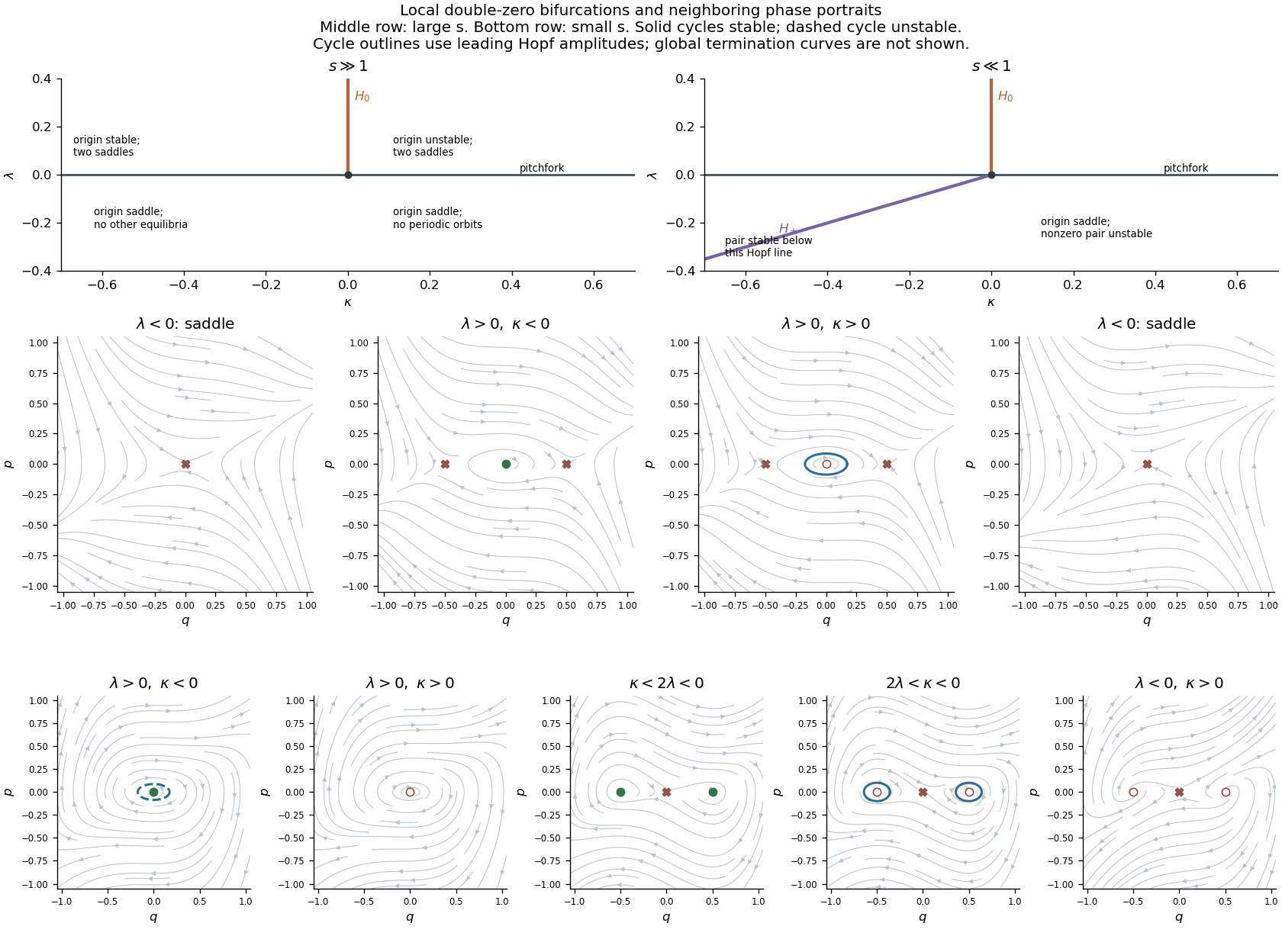
Local bifurcation lines and representative phase portraits for the two signs of the cubic double-zero normal form
. Details. 
Local equilibrium and Hopf bifurcations do not locate the larger cycles' endpoints. In the large- case, the stable origin cycle is confined between two symmetry-related saddles. A natural global completion is a heteroclinic cycle formed by the two separatrix connections between those saddles. The stable periodic orbit expands into that connecting cycle and disappears; the two connections occur together because exchanges them. This is a global transition in the positive-, positive- region where the Bendixson-Dulac criterion permits cycles. Beyond it, the cubic inverted potential allows trajectories to leave the local region; the local reduction does not specify their ultimate fate in the original four-dimensional system.
In the small- case, the two stable cycles born around the nonzero well equilibria can encounter the central saddle simultaneously. Their limiting orbits form a symmetric figure-eight pair of homoclinic orbits. A symmetric homoclinic gluing bifurcation can then replace the two one-well cycles by one larger cycle visiting both wells. There is also an outer unstable cycle associated with the subcritical origin Hopf branch, continued into the double-well region. A saddle-node bifurcation of periodic orbits between the large stable and unstable cycles provides a possible later termination. Thus the global curves needed for the usual completion are a symmetric heteroclinic connection in the large- case, and paired homoclinic gluing together with a fold of cycles in the small- case.
These connections, and any resulting basin changes, are not detected by the equilibrium Jacobians. Their precise parameter curves require a global return-map or separatrix calculation, which is not part of this requested qualitative description. Symmetry forces paired connections where indicated, but the local centre manifold and Hopf calculations alone should not be presented as numerical locations or a proof of the full large-amplitude diagram.
Articles by others on the same topic
There are currently no matching articles.