Put and extend the system by . At the zero equilibrium with zero parameters, the block is the nilpotent matrix , while the eigenvalues are . Since , these are stable. The extended centre manifold is a graph , tangent to the four-dimensional centre space containing the two parameter directions. Its invariance equations areFor the quadratic jets in the ordinary total degree, the coefficient multiplying has no linear part. Hence and . With , comparison gives , , . The second graph is obtained in the same way. Terms involving parameters at quadratic order have zero forcing and vanish. Thus the quadratic centre manifold for a pair of linear filters isSubstitution into the centre equations gives the cubic termsThe last displayed cubic term is absent from the proposed second-order approximation, so its omission needs the weighted scaling rather than an ordinary-degree truncation.
Under the hinted scaling , , , , one has and . The invariance equations at weighted orders two and three give and . In particular no additional parameter-dependent weighted-order-three graph terms appear. Therefore the term and the omitted manifold corrections affect the reduced acceleration only at order , whereas has order and order . After division by , the slow equation isThis proves why the stated approximation retains the leading nonlinear restoring force and its first nonlinear damping correction. The centre manifold theorem removes the exponentially decaying transverse directions, while the retained generic coefficients determine the nearby reduced bifurcations. It is a local asymptotic description, not an exact global reduction. If either relevant coefficient vanishes, higher-order terms may be needed to resolve that degeneracy; the two extreme cases in part (b), with , avoid it.
Set and rescale , . The reflection-symmetric cubic double-zero normal form becomesIt is invariant under . Thus the large- case has and the small- case . At the origin the Jacobian matrix has determinant and trace : it is a saddle for , stable for , and unstable for . In the latter two cases the discriminant distinguishes nodes from foci; its zero is not an equilibrium-creation bifurcation.
The nonzero equilibria satisfy , . At either of them the determinant is and the trace is . Therefore for , a pair of saddles exists when , while for , a pair of attracting equilibria exists when , and a repelling pair when . The repelling or attracting points may be nodes or foci. Their origin collision occurs on the pitchfork bifurcation line , away from . For fixed , the scalar centre equation there beginsFor , the large- case is a subcritical pitchfork and the small- case a supercritical pitchfork. For , the scalar criticality reverses, but there is already an unstable transverse eigenvalue, so the full-plane branches have the stability just listed.
At the origin, , is a Hopf bifurcation with frequency . Averaging the leading weakly nonlinear oscillator gives the amplitude equationConsequentlyThese are respectively a supercritical Hopf bifurcation and a subcritical Hopf bifurcation, with fixed and the cycle sufficiently small. The portraits change from a stable focus to an unstable focus surrounded by a stable cycle in the first case; in the second, a stable focus is surrounded by an unstable cycle before the focus becomes unstable and that cycle disappears.
The small- case has an additional pair of Hopf bifurcations at the nonzero equilibria:Their criticality includes quadratic terms and is not read off from the positive term alone. Set , , and . ThenFor an oscillator , the cubic radial coefficient is . Here it is . Thus both nonzero Hopf bifurcations are supercritical: for small , each newly unstable well equilibrium is surrounded by a stable small cycle with .
To constrain periodic orbits, use either the divergence or the energyFor , the divergence has one strict sign except on a line, and the Bendixson-Dulac criterion excludes every nonconstant periodic orbit. For , the same reasoning excludes every periodic orbit. When the divergence changes sign, this criterion makes no such exclusion; the Hopf cycles above are consistent with that restriction. In the large- case a periodic orbit also requires : if , a positive maximum of would have , or a negative minimum would have negative acceleration, both impossible. For the same extremum argument confines a cycle to , between the two saddle locations. The local bifurcation lines and representative portraits on both sides are summarized below; their global completion requires part (c).
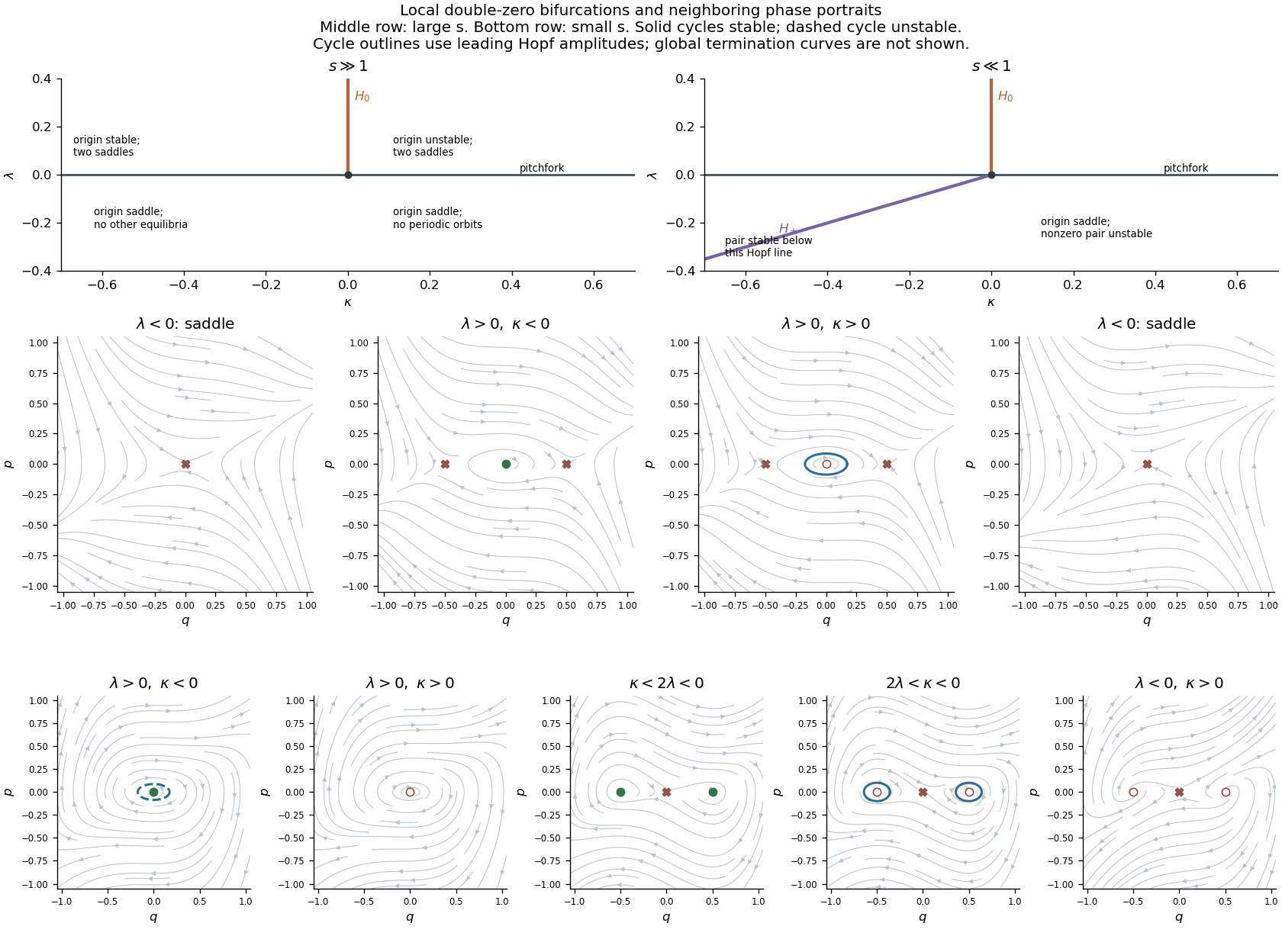
Local bifurcation lines and representative phase portraits for the two signs of the cubic double-zero normal form
. Details. Local equilibrium and Hopf bifurcations do not locate the larger cycles' endpoints. In the large- case, the stable origin cycle is confined between two symmetry-related saddles. A natural global completion is a heteroclinic cycle formed by the two separatrix connections between those saddles. The stable periodic orbit expands into that connecting cycle and disappears; the two connections occur together because exchanges them. This is a global transition in the positive-, positive- region where the Bendixson-Dulac criterion permits cycles. Beyond it, the cubic inverted potential allows trajectories to leave the local region; the local reduction does not specify their ultimate fate in the original four-dimensional system.
In the small- case, the two stable cycles born around the nonzero well equilibria can encounter the central saddle simultaneously. Their limiting orbits form a symmetric figure-eight pair of homoclinic orbits. A symmetric homoclinic gluing bifurcation can then replace the two one-well cycles by one larger cycle visiting both wells. There is also an outer unstable cycle associated with the subcritical origin Hopf branch, continued into the double-well region. A saddle-node bifurcation of periodic orbits between the large stable and unstable cycles provides a possible later termination. Thus the global curves needed for the usual completion are a symmetric heteroclinic connection in the large- case, and paired homoclinic gluing together with a fold of cycles in the small- case.
These connections, and any resulting basin changes, are not detected by the equilibrium Jacobians. Their precise parameter curves require a global return-map or separatrix calculation, which is not part of this requested qualitative description. Symmetry forces paired connections where indicated, but the local centre manifold and Hopf calculations alone should not be presented as numerical locations or a proof of the full large-amplitude diagram.
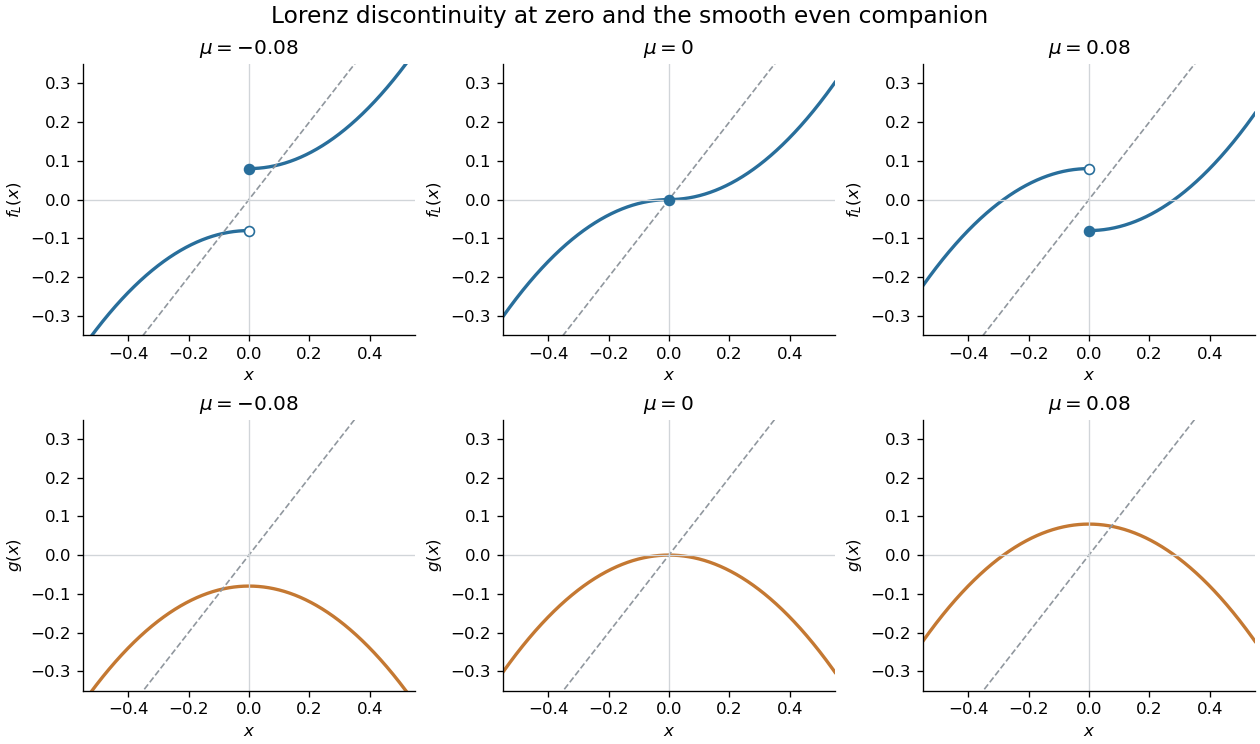
The associated even map is simply . For nonzero , the odd quadratic Lorenz map has the two branches on the positive side and on the negative side. Their limiting values at zero are and , while the prescribed point value is . Thus the branches join continuously only at , where the origin is a fixed point and .
The small fixed point of isFor small negative , and the odd quadratic Lorenz map has two stable fixed points . Their periodic-orbit multiplier is . As these fixed points collide at zero. For small positive , andso a stable symmetric two-cycle is present, with periodic-orbit multiplier . Hence the global transition isThe large fixed points remain unstable near this transition and are not created or destroyed there. The parabola itself is smooth as passes zero; its fixed point crosses the critical point and changes the sign of its periodic-orbit multiplier. The change of orbit type occurs in the sign-lifted discrete dynamical system, whose discontinuity switches orientation.


Write and . Suppose first that for , so no critical hit occurs before the final iterate. Set . The case is the defining identity. If and , evenness of and oddness of away from zero giveInduction proves the sign lift of an even map formulaon noncritical orbit segments. A final zero value is harmless; using oddness at zero in a subsequent step is not.
The PDF's assertion that this holds for every is false with its stated convention. For , choose . Then , sobut the proposed right side for is . This explicit counterexample identifies the missing noncritical qualification. An exact recurrence valid even at critical hits can instead be written with and : start with , and updateThe second rule resets the sign because independently of the previous sign. This proves the intended identity wherever it is valid and accounts for the exceptional critical itineraries without changing the map's definition.
For a period- orbit of that avoids zero, the chain rule gives its multiplier of a periodic orbit of an iteration asThe sign of is positive on the negative half-axis and negative on the positive half-axis, exactly as the parabola sketch shows. ConsequentlyThis product is independent of the chosen starting point because changing only cyclically reorders the factors. If the orbit contains zero, the derivative product is zero and its orientation is undefined. One must then use the actual zero periodic-orbit multiplier, rather than infer a positive or negative orientation from the special assignment . The nonzero-periodic-orbit multiplier cases needed in part (d) avoid this exception automatically.
Assume the cycle has least period and nonzero periodic-orbit multiplier . It then avoids zero. Combining the iterate identity with the periodic-orbit multiplier-sign formula givesThus makes return after iterates, whereas gives . In the latter case oddness on the noncritical orbit impliesTo prove the least periods, note that a cycle cannot contain two distinct points and : evenness would give them the same image, but permutes its distinct cycle points bijectively. Therefore the absolute values in the cycle are distinct. Since , any return under must occur at a multiple of . For the first such return fails because , so is minimal. Hence the period transfer from a quadratic map to its Lorenz sign lift isThere are two symmetry-related cycles in the positive case and one cycle containing both signs in the negative case. Away from zero , so their periodic-orbit multipliers are and , respectively. A stable cycle therefore gives stable lifted cycles in both cases.
The positive fixed point of has periodic-orbit multiplier . At , and the periodic-orbit multiplier crosses . Factoring the second-iterate fixed-point equation givesThe second factor yields a two-cycleIt exists for and has periodic-orbit multiplier . Its stability range is , so undergoes a supercritical period-doubling bifurcation at . At the two-cycle is and its periodic-orbit multiplier is zero, making it superstable.
For positive and , direct composition gives the local second iterateThe one-sided limits at zero are opposite, and agree with zero exactly when in this neighborhood. There is continuous at zero and fixes it. Thus the local return branch has the same discontinuity-closing transition as the map in part (a), with effective parameter crossing zero.
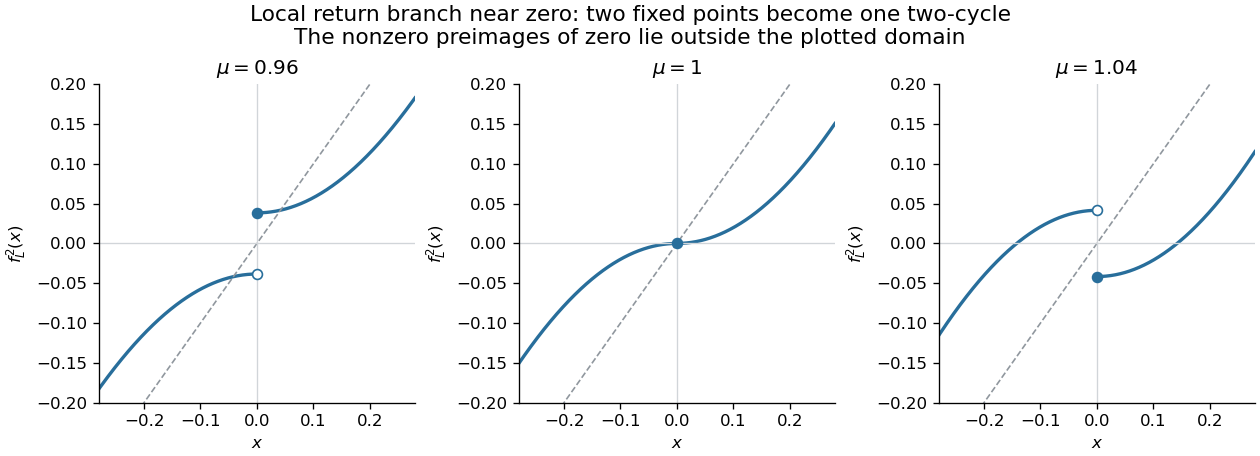
Local second-iterate Lorenz return maps near zero, showing the discontinuity close and reverse at parameter one
. Details. 
For , both are positive and the period transfer from a quadratic map to its Lorenz sign lift gives the two stable cyclesFor , and , so the periodic-orbit multiplier of the cycle is negative and the lifted orbit isIt is one stable four-cycle. Hence the gluing of cycles in an iterated Lorenz map givesEquivalently, changes from two small stable fixed points to a stable small two-cycle . At the critical value itself, the actual convention gives , , : the surviving critical two-cycle is , and is preperiodic. This critical itinerary must be evaluated directly, not with part (b)'s noncritical sign product.
There is also a precise qualification to the printed use of “continuous”. The whole second iterate is not continuous everywhere at : , while and . Jumps persist at the nonzero preimages of the original discontinuity. Therefore the stated global-bifurcation criterion holds for the return map restricted to a neighborhood of zero, as in the sketches; if continuity on all of is demanded literally, the claim about needs that restriction. The orbit creation and destruction above is unaffected.
Let a finite or compact group act linearly on a real space , and let be a smooth equivariant dynamical system: . Assume . The representation is an absolutely irreducible real representation when its complexification is irreducible; equivalently, every real linear operator commuting with is a scalar multiple of the identity. Consequently the linearization at the trivial branch is . A generic steady-state crossing has and , with stable noncritical directions removed by a centre manifold if this is a reduction of a larger system.
The isotropy group of a vector is . For a subgroup , its fixed-point subspace of a group action is . Its normaliser isThe normaliser preserves , and describes its residual symmetry. A steady-state axial subgroup is an actual isotropy subgroup with .
The equivariant branching lemma states that, under the smoothness, equivariance, absolute irreducibility, and transverse scalar-eigenvalue crossing hypotheses above, each conjugacy class of axial isotropy subgroup gives a branch of nonzero equilibria in its fixed-point line through . The generic leading nonlinear coefficient determines which parameter side the branch occupies and whether it is transcritical-like or pitchfork-like; the theorem does not assert that these branches are stable or exhaust every possible branch. The usual nondegeneracy condition excludes a vanishing leading nonlinear coefficient. Conjugate subgroups produce symmetry-related copies of a branch, rather than new isotropy types.
To explain the dynamical role of the fixed-point subspaces of a group action, if is fixed by , then for every . Thus the vector field is tangent to that subspace, and uniqueness makes it flow invariant. On a fixed-point line one solves a scalar equilibrium equation and determines radial stability. Stability in the full space additionally requires all transverse eigenvalues to be stable. Higher-dimensional fixed-point spaces support their own restricted dynamics and may contain symmetry-constrained connecting orbits.
Finally, the normalizer action determines axial branch parity: if contains an element acting as on the fixed line, its scalar vector field must be odd, so a generic cubic term gives a pitchfork bifurcation. If that residual sign reversal is absent, a quadratic term is permitted and can give a transcritical-like branch. This is why fixed-space dimension alone does not determine either the branch type or its full stability.
Use the natural dihedral group generators and , and orient the unfolding parameter so the trivial equilibrium loses stability as increases through zero. Rotation equivariance requires a monomial in to have , while reflection makes its coefficient real. These constraints give the dihedral steady-state normal form. The reflection axes have angles and one-dimensional fixed-point subspaces of a group action; their equilibria are the branches guaranteed by the equivariant branching lemma.
For , a generic quadratic anisotropy dominates:In polar coordinates, and . At a nonzero equilibrium, and . There are three symmetry-related equilibria on each parameter side, on opposite half-axes as the sign of changes. The radial and angular eigenvalues are and , respectively. Hence all three nonzero branches are saddles in the full plane, even though radial stability exchanges at the crossing. The origin is a sink for and a source for . The reflection normaliser has no residual sign reversal in this odd dihedral case, so these are transcritical-like branches, not symmetry-forced pitchforks.
For , both relevant nonlinearities are cubic:There are two conjugacy classes of reflection isotropy: the coordinate axes, with , and the diagonals, with . Generically and . Each class has a pitchfork bifurcation, with four symmetry-related equilibria when its squared radius is positive:These formulas give all generic existence and stability cases. If , both classes emerge for ; the class with consists of stable nodes and the other of saddles. If , both classes exist for ; the class with consists of saddles and the other of sources. If , one class exists on each side and both consist of saddles. Equality is nongeneric and requires higher-order terms. Unlike the odd dihedral cases, the residual normaliser quotient contains a sign reversal, enforcing exact paired pitchfork branches.
For , cubic radial saturation occurs before the first angular anisotropy:For generic , ten equilibria lie on the reflection half-axes whenever , divided into two distinct five-point group orbits. Their radii and eigenvalues areIf , they emerge for : the five with are stable nodes and the other five are saddles. If , they exist for : the five with are saddles and the others are sources. The leading amplitude scaling is pitchfork-like, but the quartic term distinguishes opposite half-axes and generally gives different corrections to their radii; there is no exact sign-reversal symmetry on an individual fixed line. Thus has quadratic saddle branches, has two cubic axial branch types, and has cubic radial branches whose angular stability splits at quartic order.
In a Hopf critical eigenspace, equip the real space with the complex structure defined by the temporal phase action. A subgroup is a complex axial isotropy subgroup when it is the full stabilizer of a nonzero vector andThe isotropy is for the combined spatial and temporal action, so its elements encode spatiotemporal symmetry of a periodic orbit, not necessarily pointwise spatial symmetry. “Complex dimension” here refers to the Hopf complex structure; it need not agree with independently chosen spatial complex coordinates. Any kernel of the combined action belongs to every actual isotropy subgroup.
Let a smooth -equivariant vector field have a trivial equilibrium branch and a critical real eigenspace , where is an absolutely irreducible real representation of the finite group . Assume the critical linearization is semisimple with eigenvalues , , no other imaginary-axis eigenvalues are present, and the real part of the critical eigenvalue crosses zero transversely as the parameter varies. The equivariant Hopf theorem then gives, generically, a branch of small-amplitude periodic solutions for each conjugacy class of complex axial isotropy subgroup of in the critical representation. The restricted Hopf bifurcation on its two-dimensional fixed space must be nondegenerate, with nonzero leading radial cubic coefficient. Each branch has the associated spatiotemporal symmetry of a periodic orbit and period tending to .
The spatial multiplicity means this is not the ordinary simple-eigenvalue Hopf hypothesis: the required critical representation is the whole two-copy isotypic component, and the semisimple pair has the corresponding symmetry multiplicity. The theorem guarantees primary branch existence and symmetry, but neither their stability nor the side of the parameter on which they exist. Those require the nonlinear coefficients and transverse perturbation analysis. A centre manifold and a symmetry-compatible normal form of a dynamical system isolate the critical dynamics and supply those coefficients.
The proposed transformation diagonalizes the time-circle action, but the two resulting coordinates have opposite temporal weights. Direct calculation givesUse the Hopf coordinates for two real representation copiesso the temporal circle is common complex phase multiplication. Writing its phase action as , with , the spatial generators become and . The combined action has kernel .
Three nonconjugate complex axial isotropy subgroups and their fixed complex lines areFor example acts as , forcing ; reflection forces ; and acts as , forcing . Each is the full stabilizer of a generic nonzero point of that line and includes . The rotational spatial projection of distinguishes it from the standing types; the other two use the two nonconjugate reflection-axis classes in .
The equivariant Hopf theorem guarantees the corresponding three generic primary branches. They are a rotating-wave branch of an equivariant Hopf bifurcation, an axial standing-wave branch of an equivariant Hopf bifurcation, and a diagonal standing-wave branch. In the literal coordinates their fixed spaces are , , and , respectively; using a common in both original coordinates would not describe these standing branches correctly.
To interpret them physically, invert the transformation: , . For , the three representatives areThe rotating solution changes spatial direction throughout the cycle. The standing solutions remain on a fixed spatial axis or diagonal while the two real-copy amplitudes oscillate in quadrature. Reflections exchange the two rotating chiralities; rotations generate the other representatives within each standing-wave type.
First there is a necessary coordinate qualification. With the literal action obtained in part (c), the temporal weights are and reflection is conjugation followed by exchange. A linear term with in both equations fails reflection equivariance for , since conjugation changes the sign of . The proposed first-component monomial also has temporal weight , rather than . Thus the displayed equations cannot be proved in those literal coordinates. They are the correct dihedral fourfold Hopf normal form in the common-phase Hopf coordinates .
In these coordinates the temporal circle imposes total phase weight one on every vector-field monomial. There are no quadratic monomials with that weight. A cubic monomial has two unbarred factors and one barred factor. For the first component, rotation by must multiply the monomial by . Inspecting the six phase-compatible monomials leaves preciselyThe excluded three monomials multiply by instead. Reflection swaps the components, so their coefficients must be the same after swapping indices. The linear part is a scalar complex multiple by absolute irreducibility. Orient the Hopf parameter to write it as , and name the cubic coefficients , where are generally complex. This provesThese are cubic amplitude normal forms of a dynamical system, after the usual symmetry-compatible Hopf normalization. Returning to literal coordinates conjugates the second equation: its linear coefficient is , its cubic coefficients are , and the first coupling is . That corrected form respects every printed generator.
On the three complex axial isotropy subgroup fixed spaces, substitute and . The radial equations are , withTherefore the leading component amplitudes areEach expression applies on the parameter side where it is positive, with its denominator nonzero for a nondegenerate branch. The frequencies are , with . The denominators are generically distinct, so coexisting branches generically have different component amplitudes. If the amplitude is instead measured by the original real-space norm, the identity gives squared amplitudes , , and , again generically distinct. Equalities require special coefficient relations, rather than symmetry forcing them.
Articles by others on the same topic
There are currently no matching articles.