For , the first integralhas . The equilibrium points are and . The linearization has eigenvalues at the origin and at . The origin is a center equilibrium: the sufficiently small positive level sets of are closed curves, since its Hessian matrix there is positive-definite. The other equilibrium is a saddle equilibrium.
At the saddle, , and the separatrix satisfiesIts two branches with form a homoclinic orbit through the saddle; its remaining branches extend to . Inside the loop, the closed trajectories run clockwise: above the horizontal axis . The saddle directions have slopes and . Outside the loop there are unbounded trajectories. The left panel shows the closed orbits and all saddle branches.
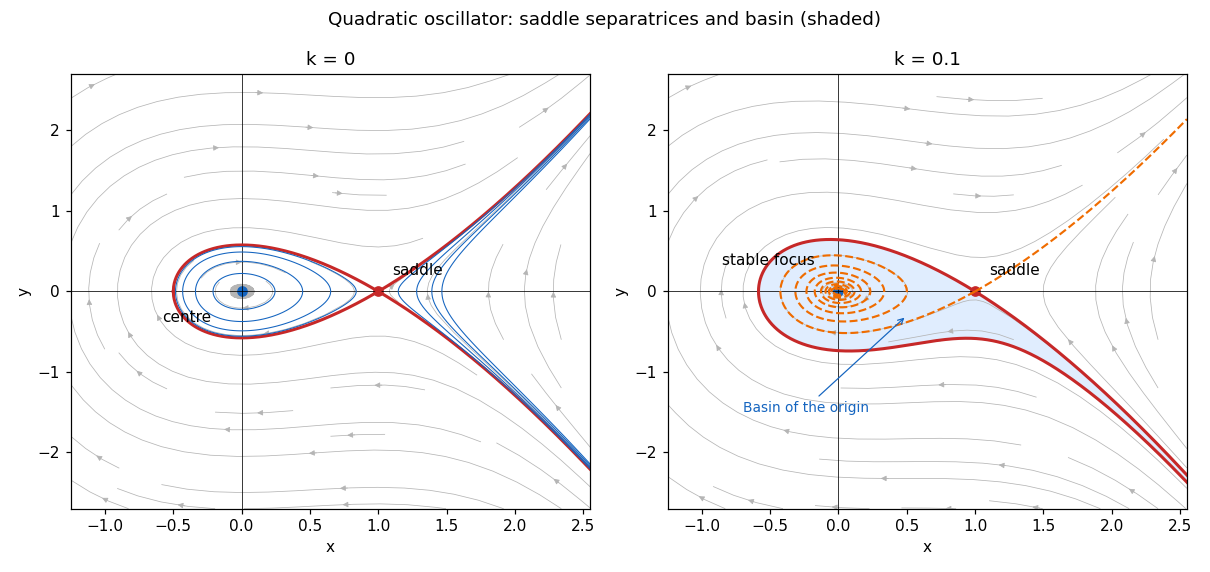
Conservative phase portrait and the attracting basin after adding weak damping
. Details. 
For general , the same energy gives . For the eigenvalues at the origin are , so it is a stable focus. At they are , so it remains a saddle equilibrium. The vector field has constant divergence : there are no periodic orbits, by the planar divergence criterion. Nor can the former homoclinic orbit survive, since strictly decreases along every nonconstant orbit except at isolated crossings of .
The stable manifold of the saddle separates escape to positive from convergence to the origin. Its two branches approach the saddle in forward time with tangent slope . The left unstable branch spirals into the origin, whereas the right unstable branch escapes. The shaded component on the origin's side of the stable manifold in the right panel is the basin of attraction. The boundary itself is excluded: its trajectories converge to the saddle. This boundary is the damped stable manifold, rather than the conservative energy contour. energy decrease prevents bounded recurrent motion, and every bounded orbit off the saddle's stable manifold consequently converges to the origin. The plotted manifold was obtained by integrating backwards from the saddle's stable eigendirection.
Articles by others on the same topic
There are currently no matching articles.