Write . Its fixed points satisfy , retaining only nonnegative right sides. At a simple fixed point,Thus on the outer branches , the positive point is stable and the negative point unstable. On the inner branches , the positive point is unstable and the negative point stable.
For , there are four simple points for , two for , and a saddle-node at each , where the two inner points coalesce. At , there are also bifurcations at . The smooth branches and cross and exchange stability. Locally , where . After a parameter-dependent shift this is a transcritical bifurcation. It is not an ordinary saddle-node: two nearby branches exist on both sides of zero. At zero itself each crossing point is semistable, attracting from the right and repelling from the left.
For , the only possible branch is , existing for . Each point is a saddle-node bifurcation. There are no fixed points for ; outside that interval the positive point is stable and the negative point unstable. At either threshold , so the zero point is semistable. The first row of the diagram displays these branches; solid curves are stable and dashed curves unstable.
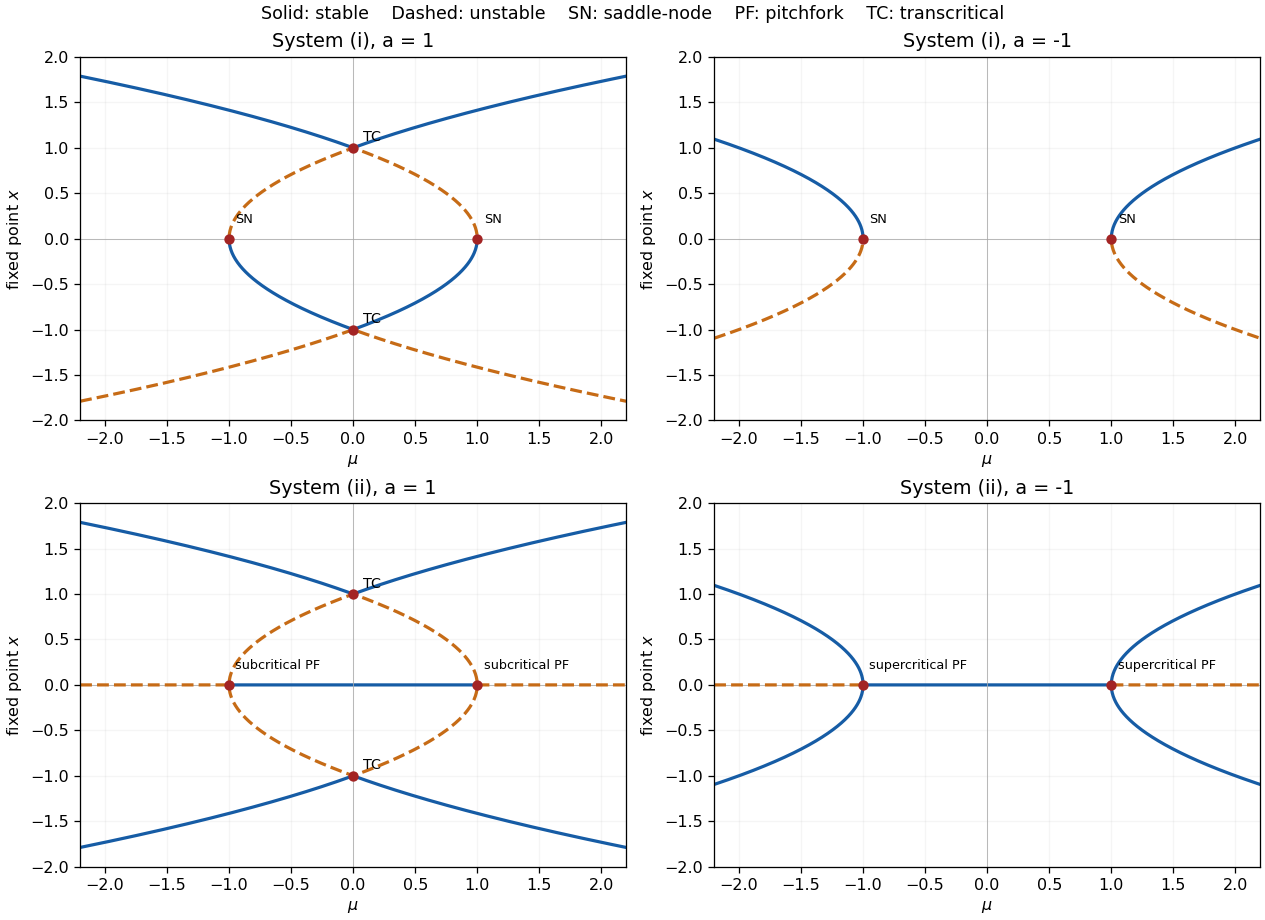
Fixed-point bifurcation diagrams for both scalar systems with positive and negative a; stable branches are solid and unstable branches dashed
. Details. 
Now . The zero point exists for all parameters and has eigenvalue , so it is stable for and unstable for . At every nonzero fixed point,Both outer branches are stable and both inner branches unstable.
For , the nonzero locations are as in part (i). At the local equation is : these are subcritical pitchfork bifurcations, with the two unstable inner branches present on the side where zero is stable. At the bifurcation itself , so zero is unstable. At the inner and outer branches cross and exchange stability in transcritical bifurcations. The positive crossing is semistable, attracting from the right; the negative crossing is semistable, attracting from the left, because the additional factor reverses the local flow there.
For , the outer stable pair exists only for . The points are supercritical pitchfork bifurcations, since the cubic coefficient is negative. Zero loses stability as increases across , and a stable symmetric pair appears. At the threshold zero remains nonlinearly stable, with . There are no further bifurcations. The second row of the preceding figure gives the diagrams. The plots use ; the general locations are obtained from the formulas above.
Articles by others on the same topic
There are currently no matching articles.