For odd positive coprime integers, quadratic reciprocity for the Jacobi symbol isIf the integers are not coprime, both symbols vanish; equivalently the usual signed reciprocity identity still holds. To deduce it from quadratic reciprocity for the Legendre symbol, factor and . Multiplication of the prime reciprocity identities gives the sign exponentModulo two, each bracket is respectively and : for odd , . This proves the composite-denominator law, including repeated prime factors.
Now , and 9 contributes a square factor. Since , reciprocity and reduction of the numerator giveA second reciprocity step gives . Thus the requested Jacobi symbol is .
The Chebyshev alternation theorem says that for a polynomial of degree at most is a best uniform approximation precisely when there are ordered points such thatThe best polynomial is unique. These equally large alternating extrema are the equal-ripple criterion; the zero-error case is interpreted in the evident way.
Set , a monic Chebyshev polynomial. Its norm on is . At the ordered points , its values alternate between the two extreme values .
Approximate by polynomials of degree at most . The error corresponding to is exactly . The Chebyshev alternation theorem therefore makes the unique best approximant. For any monic , the polynomial is an admissible approximant, soEquality holds precisely for . Alternatively, a smaller norm would force to change sign between each consecutive pair of alternating extrema, giving at least zeros to a polynomial of degree at most .
In the upper-half-plane model, with metric , the hyperbolic geodesics are vertical lines and semicircles orthogonal to the real boundary. Two geodesics with disjoint endpoints and no intersection are ultraparallel and have a common perpendicular . To construct it, send one geodesic to the imaginary axis by an isometry. The second then has endpoints after a possible reflection. The semicircle centered at zero with radius is perpendicular to the imaginary axis and to the second circle: its squared radius plus equals , the orthogonality condition for the two circles.
Let the intersection points of with the given geodesics have signed arclength coordinates on . Each hyperbolic reflection preserves and restricts there to : the perpendicular intersection point is fixed and the tangent direction along is reversed. Thus their composition restricts toThe displacement is nonzero since the two perpendicular intersection points differ. Its th iterate translates by , which is never zero for . The composite is a hyperbolic translation of infinite order. The assumption excluding a common endpoint ensures the common perpendicular used here exists.
The supplied congruence is a congruence of squares, since . HenceA nontrivial square root modulo a product of two odd primes may agree with modulo one prime and modulo the other. Taking greatest common divisors separates these factors. The Euclidean algorithm givesFor example the successive remainders for the first computation are ; for the second they are . ThereforeBoth numbers are prime by trial division by primes at most their square roots. More generally, given with , computing often produces a proper factor. The method requires no prior knowledge of which prime gives which sign, and is the basic factor-extraction step in congruence-of-squares algorithms.
An exponential dispersion family has density or mass functionwith support independent of the natural parameter . Usually for a known weight . For the Poisson distribution, identifyThe dispersion is fixed at one. Differentiating the normalizing identity gives ; differentiating again gives . Here both derivatives equal , soThe variance function expresses in terms of the mean . The canonical link function maps the mean to the natural parameter, so the Poisson canonical link is .
By the law of mass action, the net changes in the intermediate concentrations areThe autocatalytic reaction increases by one and decreases by one; its reaction-rate convention is . With the specified common concentration scale and time scale, chooseSubstitution gives the nondimensional Brusselator system. Adding its two steady equations gives , and then the second gives . Its Jacobian matrix there isThe equilibrium is asymptotically stable for and unstable for . At the eigenvalues are , crossing the imaginary axis with nonzero speed .
The nonlinear Hopf bifurcation is nondegenerate. At the threshold, put and . The translated equations areThe Hopf coefficient of the Brusselator in the planar radial normalization is : the cubic contribution is and the quadratic contribution is . Consequently the bifurcation is supercritical, producing small stable oscillations on the unstable-equilibrium side. Their limiting period is
Write . Its fixed points satisfy , retaining only nonnegative right sides. At a simple fixed point,Thus on the outer branches , the positive point is stable and the negative point unstable. On the inner branches , the positive point is unstable and the negative point stable.
For , there are four simple points for , two for , and a saddle-node at each , where the two inner points coalesce. At , there are also bifurcations at . The smooth branches and cross and exchange stability. Locally , where . After a parameter-dependent shift this is a transcritical bifurcation. It is not an ordinary saddle-node: two nearby branches exist on both sides of zero. At zero itself each crossing point is semistable, attracting from the right and repelling from the left.
For , the only possible branch is , existing for . Each point is a saddle-node bifurcation. There are no fixed points for ; outside that interval the positive point is stable and the negative point unstable. At either threshold , so the zero point is semistable. The first row of the diagram displays these branches; solid curves are stable and dashed curves unstable.
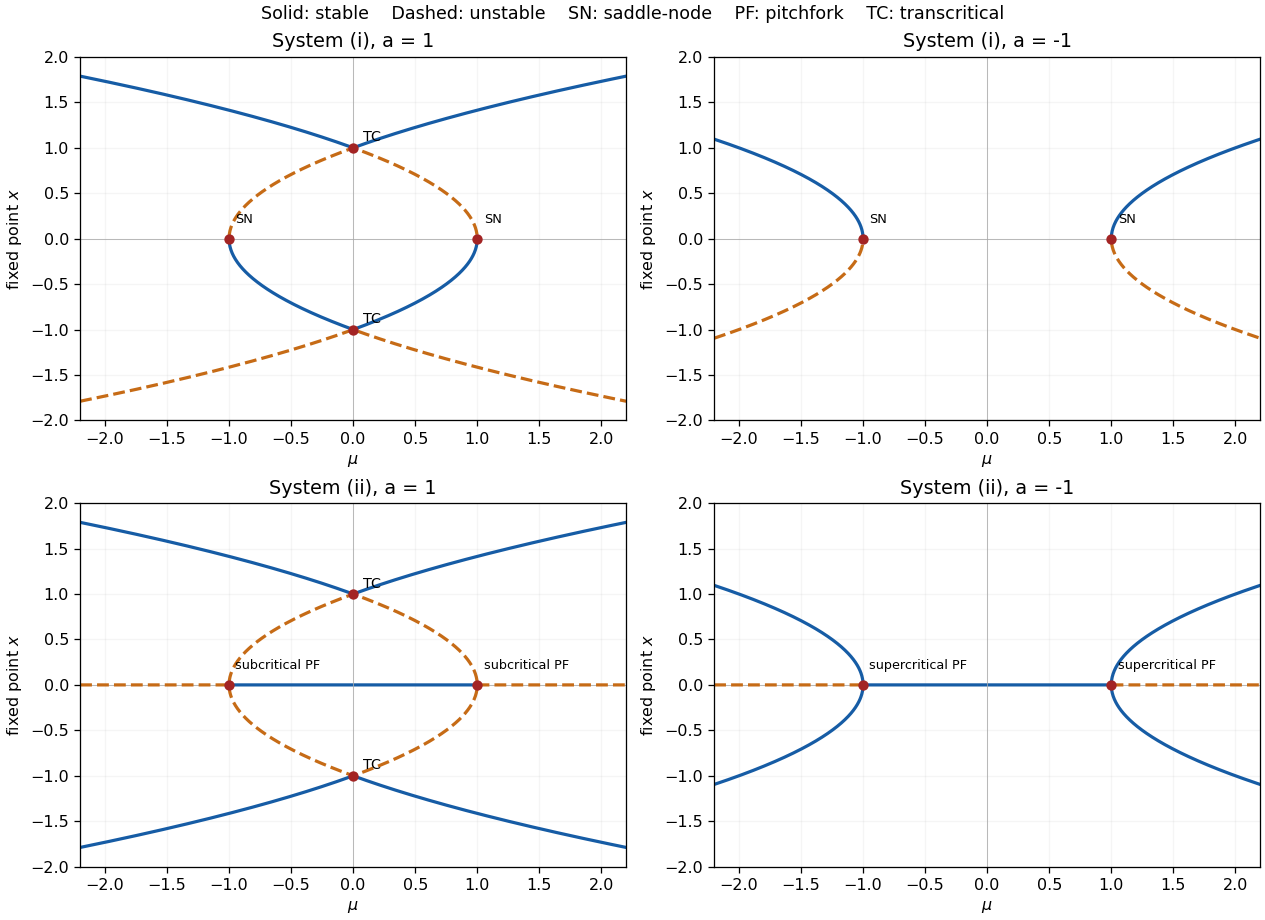
Fixed-point bifurcation diagrams for both scalar systems with positive and negative a; stable branches are solid and unstable branches dashed
. Details. 
Now . The zero point exists for all parameters and has eigenvalue , so it is stable for and unstable for . At every nonzero fixed point,Both outer branches are stable and both inner branches unstable.
For , the nonzero locations are as in part (i). At the local equation is : these are subcritical pitchfork bifurcations, with the two unstable inner branches present on the side where zero is stable. At the bifurcation itself , so zero is unstable. At the inner and outer branches cross and exchange stability in transcritical bifurcations. The positive crossing is semistable, attracting from the right; the negative crossing is semistable, attracting from the left, because the additional factor reverses the local flow there.
For , the outer stable pair exists only for . The points are supercritical pitchfork bifurcations, since the cubic coefficient is negative. Zero loses stability as increases across , and a stable symmetric pair appears. At the threshold zero remains nonlinearly stable, with . There are no further bifurcations. The second row of the preceding figure gives the diagrams. The plots use ; the general locations are obtained from the formulas above.
Use the sign convention in the question: the Hilbert transform kernel is , the negative of another common convention. A contour indentation at the origin givesFor close the contour in the upper half-plane; for close it below. Thus the transform of is for . Since , integration of this multiplier identity, justified first with an Abel regularization, yieldsThe value at zero also follows directly from .
Splitting the exponential into the half-plane where it decays givesTheir singularities at zero are removable. The first function is analytic above the real axis and the second below it; their exponential terms are bounded in those respective half-planes, giving the required decay. Their difference on the real axis is the prescribed jump. Moreover their sum there is , agreeing with the Sokhotski–Plemelj formula and the transform computed above.
For uniqueness in the class with continuous boundary values, subtract two solutions. The zero jump glues their differences into an entire function, tending to zero at infinity. Liouville's theorem makes it zero. Thus these are the unique solutions of the Riemann-Hilbert problem with the stated decay.
For , the Euler-Lagrange equations giveIn components these are , and . A normal mode has and satisfies . For eigenvalue , the first and third rows give and , and the second row then agrees. HenceThe particle positions are recovered by adding the equilibrium offsets to the last two entries. Their displacements are in phase with amplitude ratio .
Substitute in the Fermi-Dirac distribution energy integral. ThenThe integral converges, is positive, and is independent of temperature. Thus , with equal to the displayed constant integral. The given normalization is for the specified degeneracy; further internal degrees of freedom multiply it.
For a relativistic species at zero chemical potential, and , so its entropy density is proportional to . The Bose-Einstein distribution gives the bosonic normalization, while the fermionic thermal integral is of it. Species still in thermal equilibrium have ; freely streaming decoupled species can have another temperature and therefore contribute an extra factor when the total is expressed in units of . This gives the two terms and and their stated effective-degree-of-freedom weights.
After neutrino decoupling, the comoving entropy of the photon-electron-positron plasma is conserved separately from the neutrinos. Before electron-positron annihilation its effective entropy count is ; afterwards it is . Consequentlywhereas stays equal to its pre-annihilation value. HenceThis is the instantaneous-decoupling, negligible residual-electron approximation used in the question. Heating of the still-coupled plasma, not cooling peculiar to neutrinos, creates the temperature difference.
The planar Brouwer fixed-point theorem states that every continuous map from a nonempty compact convex subset of to itself has a fixed point. In particular it applies to a closed disk or a closed triangle. Convexity and compactness are essential hypotheses in this formulation.
Let be the vertices opposite the corresponding sides, and let be their barycentric coordinates. We prove the equivalence by negating each assertion.
Suppose the closed covering sets have empty triple intersection. For put , and define similarly. At least one distance is positive, since cannot belong to all three sets, and at least one is zero, since they cover . Consequentlyis continuous and lies in the boundary: one barycentric coordinate vanishes. On its first coefficient is zero because , so , and likewise for the other sides. This contradicts assertion (1), proving (1) implies (2).
Conversely, suppose such a boundary-valued map exists. Define closed subsets of byThey are closed because is compact and the coordinate functions are continuous. They cover because is boundary-valued; the side-preserving condition gives , , . Their triple intersection is empty because barycentric coordinates sum to one. Thus failure of (1) implies failure of (2), completing the equivalence.
In fact both assertions hold. If the map in (1) existed, let rotate the equilateral triangle through . Brouwer fixed-point theorem applied to gives a fixed point on the boundary. On any side containing , side preservation puts also on , so it is their common vertex. A side-preserving map fixes every vertex because that vertex lies on two sides. Therefore , impossible for a noncentral vertex. This also proves the covering-intersection assertion through the established equivalence.
On the unit circle the two equations reduce to the same conditionsince . Define . At either point it is strictly positive, and at either point it is strictly negative. On each of the four closed quarter-circle arcs, continuity and the intermediate value theorem give a zero in its interior. These four interiors are disjoint, so there are at least four distinct solutions, one in each open quadrant. No solution here lies on an axis because are strictly positive.
The standard name is the Reed-Muller code. For , evaluate all multilinear polynomials over of total degree at most at every point of . These evaluation vectors form , of length . Distinct multilinear polynomials have distinct evaluations: induct on the variables using and the two restrictions . Thus the monomials of degree at most are independent andFor minimum weight, use the same splitting. A nonzero has weight at least by induction, and . If , the two identical halves give the same lower bound by induction on . The endpoint has minimum weight one, and is the repetition code. A product of distinct variables has exactly nonzero evaluations, soHere distance equals minimum nonzero weight because the code is linear.
Every monomial of degree at most in variables has an even number of ones, and parity is additive over . Thus every word of has even weight. If and , their coordinatewise product is an evaluation of degree at most , even after reducing . Its weight is therefore even, so . This proves the asserted inclusion in the dual code. Finallyby binomial symmetry. The dimensions agree with that of the orthogonal complement, proving for .
For a positive-speed travelling wave, the nutrient equation gives . Integrating the bacterial equation once, with zero flux in the uncolonized limit, givesHenceIn the region where , divide the two equations. With ,The condition fixes the integration constant, givingAt the limiting expression is . These formulas are positive between zero and one. For the nutrient reaches zero at a finite rear coordinate, so the strictly positive smooth whole-line ansatz with logarithmic chemotactic sensitivity needs a separate zero-nutrient interpretation there; for it reaches zero only as .
For , the nutrient equation reduces to and integration givesThe factor in the bacterial numerator is required by ; it is absent in the printed expression unless . A translation of sets , which is the version plotted below. The nutrient rises monotonically from zero behind the band to one ahead, while bacteria form a localized pulse with maximum at the nutrient half-height. Its total population is . The band advances into fresh nutrient, consumes it and leaves a depleted region behind; chemotaxis draws bacteria up the nutrient gradient while diffusion spreads them.
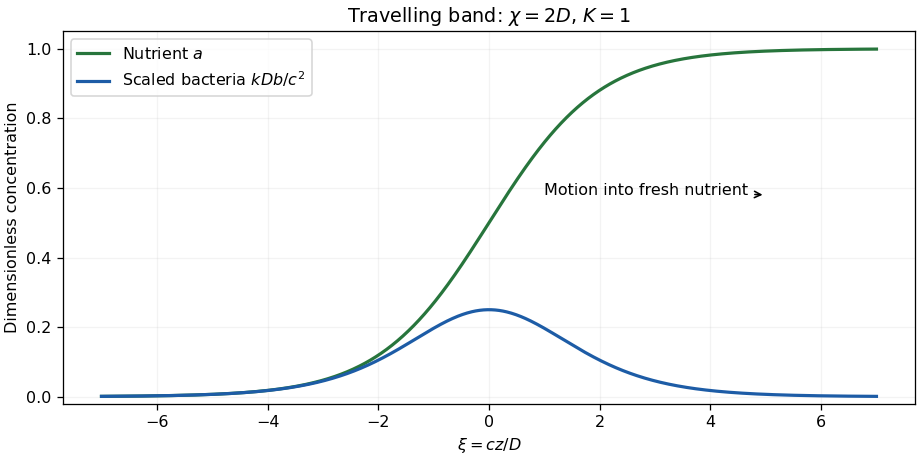
Travelling bacterial pulse and nutrient front for logarithmic chemotaxis with chi equal to twice D, plotted in dimensionless travelling coordinates
. Details. 
Use the half-line transform and let . Integrating the heat equation twice by parts givesHere andwith removable singularities at the apparent denominator zeros. Let , and orient its boundary from infinity on the ray to zero and then out on the ray. Transform inversion and contour deformation giveTo eliminate the unknown boundary derivative, evaluate the transform identity at : . The resulting extra contour integral of vanishes by analyticity and decay in the upper half-plane. This proves that the boxed expression involves only the prescribed data. It is intended for , with boundary and initial values obtained as limits.
Split the real contour at zero and rotate its positive part to angle and its negative part to angle . Rotate the two rays of to these same angles, preserving orientation. The initial-transform pole at is not crossed by either real-contour rotation, while has its pole at , outside the upper half-plane. The apparent poles in are removable.
On the rotated rays, both and . The initial-data factor has Gaussian decay . For the boundary term, retain the integral formwhich is there. Multiplication by gives exponential decay as for every fixed . Thus all integrands are exponentially damped on the deformed contours; the endpoint boundary value at is taken afterwards, rather than claiming uniform exponential decay there.
The angles and are cyclic. Their conjugate momentum components are and , so both are conserved; consequently is constant. With ,Eliminating the cyclic velocities gives the nutation effective potentialapart from the constant axial spin energy. ThusThe endpoint is excluded for these nonzero conserved momenta: the effective potential diverges there. The apparent Euler-angle singularity at is interpreted by its smooth small-tilt limit.
Put . There is no nonzero equilibrium angle because . The upright angle is stable: its linearized equation is . HenceThese are small nutational oscillations of the rapidly spinning top. No downward equilibrium belongs to the momentum level under consideration.
For , the upright angle has and is unstable. There is one nonzero equilibrium in ,Differentiate the right side of the nutation equation at this angle. Since the bracket vanishes there, the derivative is . Therefore it is stable, withThis equilibrium represents steady precession, not a top with all Euler angles stationary. The equality case is excluded by the two cases in the question and requires a nonlinear marginal analysis.
One Hilbert axiomatization of classical propositional logic uses the schemas , and , with modus ponens as its inference rule. Other connectives can be defined from implication and negation. Syntactic entailment means that a finite formal proof derives from the schemas and members of . Consistency means that no formula and its negation are both derivable, equivalently no contradiction is derivable.
Use the standard deduction theorem, closure of derivability under modus ponens, and the maximal-consistency properties: a maximal consistent set contains exactly one of , is closed under derivability, and satisfies exactly when or . These follow from the deduction theorem and the classical schemas; in particular adjoining a missing formula to a maximal set must yield a contradiction. Define iff . Induction on formula construction now provesFor negation use the exactly-one property, and for implication use its displayed membership rule, which is precisely the Boolean truth table. Thus every member of is true under , providing the required valuation.
Add to the group axioms the sentences for every . Their models are precisely the torsion-free groups. This theory is not finitely axiomatizable. If a finite sentence or finite theory were equivalent to it, the compactness theorem would imply that finitely many of these power axioms already entailed the proposed axiomatization. A cyclic group of prime order greater than all the finitely listed exponents satisfies those power axioms but is not torsion-free, a contradiction.
The class of all torsion groups is not first-order axiomatizable at all. If a theory axiomatized it, add a new constant and the sentences for all . Every finite subset has a model: use a cyclic group of sufficiently large prime order, with a generator. Compactness gives a model of all of in which has infinite order, contradicting the claimed torsion property. These conclusions concern the ordinary first-order language of groups.
The Turán graph is the complete -partite graph with part sizes differing by at most one. Turan theorem states that a graph on vertices containing no has at most edges, with equality precisely for that balanced complete multipartite graph.
Here is a symmetrization proof, including equality. Choose a -free graph with the maximum number of edges. Replacing a vertex by a nonadjacent twin of a nonadjacent vertex preserves -freeness: a clique using the replacement would give the same clique using . Thus nonadjacent vertices must have equal degrees, or cloning the higher-degree vertex increases the edge count. In fact their neighborhoods are identical. Otherwise choose adjacent to but not . Cloning to preserves the total number of edges but lowers 's degree by one, leaving 's degree unchanged. The still nonadjacent pair now has unequal degrees, allowing an edge-increasing clone and contradicting maximality.
Nonadjacency is consequently an equivalence relation, and the extremal graph is complete multipartite. It has at most parts because choosing one vertex from each part forms a clique. For , using fewer parts cannot be extremal if a part can be split. Finally its number of edges is , maximized uniquely by balanced sizes: moving a vertex from a part at least two larger than another decreases the sum of squares. This proves the theorem and its equality characterization. The cases with fewer vertices than the forbidden clique are immediate.
For , join a clique on vertices to an independent set on vertices. The resulting complete -partite graph hasIts largest clique has size . Every missing edge joins two vertices of the independent set; adding it produces a with the original -clique. It is therefore maximal -free. For its part sizes are unbalanced, so its edge count is strictly less than that of .
For the construction is a star with edges. Every maximal triangle-free graph on vertices is connected: an edge between distinct components would create no triangle. A connected graph has at least edges, so the minimum is , attained by the star. Literally the requested construction is impossible for , since has zero edges. The nontrivial assertion thus requires the customary hypothesis.
For the first polynomial, put and , so that . The roots are , andTo justify the degree, a rational quadratic factorization would have the form . The vanishing linear coefficient implies either or . The former requires , not rational, while the latter requires , also impossible over . There is no rational root, since its square would have to be , so the polynomial is irreducible. The real field has degree four and does not contain , giving degree eight after adjoining it. The group acts transitively on the four roots while preserving their two opposite pairs, so is contained in the square's dihedral group of order eight; the degree makes it the full group.
For the second polynomial, choose and . Then , and . Its four roots generateIndeed and recover both generators. The real quadratic field cannot contain , so the degree is four. Independent changes of the two square-root signs give all four automorphisms.
If affords an irreducible character , entrywise complex conjugation gives a representation with character . An invariant complex subspace for the conjugate representation conjugates back to one for , so irreducibility is preserved. If representations afford , their tensor product has trace , proving that their product is a character.
With the usual character inner product,The character orthogonality and the first assertion therefore make this equal to one if and zero otherwise. This also counts the invariant vectors in the tensor-product representation.
For a representation space , let and be the characters on and . If the eigenvalues of are , the respective traces are and . Since and , this givesFinite-order matrices over are diagonalizable, so this eigenvalue argument applies to every group element. Equivalently the symmetric and antisymmetric projections on are .
Use the given square-class assignments and , . The character values, in the specified class order, areFor example the fourth entry of is , and that of is . A class of centralizer order has size , so a character norm is the sum of its squared moduli divided by these centralizer orders. ThereforeBoth are genuine characters by their symmetric/exterior-square construction. A character norm is the sum of squares of its irreducible multiplicities, so both characters are irreducible.
Choose a nonzero integral ideal in the inverse of any desired ideal class. For the nonzero element supplied by the norm bound, is integral, belongs to the desired class and satisfiesThere are only finitely many integral ideals of bounded norm: identify with as an additive group, so ideals of norm are among its subgroups of index , of which there are finitely many. Since every ideal class has one of these bounded-norm representatives, the ideal class group is finite.
For the ideal class group of the imaginary quadratic field of discriminant minus eighty-four, write . Here , , and the Minkowski bound for ideal classes is . Thus every class has a representative of norm at most five. The relevant prime ideals areThe first two are ramified: and . Also , as both sides have norm 25 and . The element has norm 30 andThere are no elements of norms 2, 3, 5 or 6, since the element norm is . Hence the classes of , and their product are all nontrivial and distinct. The relation makes the last product equal to the class of . Ideals of norm four are principal, and the two primes above five have the same class of order two. The norm bound therefore gives no further classes. Thus
Suppose . Its positive left side gives . Reduction modulo four shows that is odd and even. Moreover would make the valuation of at 3 equal to one, impossible for a cube. The same argument excludes .
In , factor . Any common prime ideal divisor divides both and , so must lie above 2, 3 or 7. The odd norm excludes 2, and the previous divisibility arguments exclude 3 and 7. The two ideals are therefore coprime. Unique factorization of ideals gives . The class group has exponent two, so implies . Thus , and the only units, , can be absorbed into a cube. It follows thatComparing the coefficient of gives , an impossibility over the integers. Consequently there are no integer solutions: this is the no integer solutions of the Mordell equation with constant minus twenty-one result. The class-group argument is essential: element factorization was not assumed to be unique.
A deck transformation is a homeomorphism satisfying . A connected cover is regular when its deck group acts transitively on each fiber. In the usual connected, locally path-connected covering-space setting, this is equivalent to normality of in .
A two-sheeted cover corresponds to an index-two subgroup, which is normal: its two left and right cosets are the subgroup and its complement. If is abelian, every subgroup is normal. These observations prove both regularity assertions.
For examples over the wedge of two circles, label their generators and use three sheets numbered . A permutation describes the lift of each oriented base edge. For a regular cover take and : the covering graph has an oriented three-cycle of -edges and a -loop at each vertex. Cyclic rotation of the vertices is a transitive deck group . For a nonregular cover take and : the same -cycle is accompanied by a -edge in each direction between 1 and 2, and a -loop at 3. It is connected. A deck permutation must commute with both generators, whose image is all ; their centralizer is trivial. Thus its deck group is not transitive and the cover is nonregular. Each vertex has exactly one entering and one leaving edge of each label, verifying that these graphs really are three-sheeted covers.
Let . The scalar Young inequality follows by maximizing over , obtaining . If both norms are nonzero, apply it to and , and sum over a finite initial segment. Passing to the increasing limit givesZero norms give the trivial case. This proves Hölder's inequality without assuming convergence of the product series in advance.
Apply Hölder's inequality to the finite sum with the second sequence :Divide by the last power if the sum is nonzero. The resulting bound is independent of , so passing to the limit proves both membership in and the Minkowski inequality
Assume is nonempty; without that necessary hypothesis the assertion is false. Put and choose with . Convexity gives , so its distance to is at least . Apply the supplied uniform-convexity inequality to and :Thus the minimizing sequence is Cauchy. Completeness of the Banach space gives ; closedness gives , and continuity of the norm gives . The minimum distance is attained. This is the nearest point in a uniformly convex Banach space property. The same inequality applied to two minimizers shows uniqueness, though existence alone was requested.
An elliptic function for a lattice is a meromorphic function on satisfying for all . Its order is the number of poles, counted with multiplicity, in a fundamental parallelogram, equivalently the degree of its map from the torus to the Riemann sphere. Differentiation preserves the periods. If the distinct poles have orders , the derivative has exactly the same pole locations with orders . ThereforeThe bounds use , valid for a nonconstant elliptic function.
For the Weierstrass elliptic function , has a single pole of order five, so its derivative has order six. For the second example choose not a critical value of and choose away from zero and the two points where . Thenhas a double pole at and three simple poles: the quotient has residue at zero and residue 1 at each of its two other poles. No locations overlap. Hence its order is five and its derivative has order , as required.
The monodromy theorem states that a germ admitting analytic continuation along every path in a simply connected domain extends to a single-valued holomorphic function there. Equivalently continuations along homotopic paths with fixed endpoints agree. For a biholomorphism between the two tori, lift its composition with through the second covering. Simple connectivity, or monodromy applied to local inverse charts, yields a holomorphic lift .
Lift the inverse similarly. The compositions of the lifts differ from the identity by lattice translations; adjusting the lifts shows that is bijective. By the allowed classification, with . For , its two arguments represent the same torus point, so . Thus . Apply the inverse lift to obtain the reverse inclusion. ThereforeThe translation affects the chosen origin, not the period lattice.
In an affine chart, the Zariski tangent space at consists of vectors with for every polynomial vanishing on the variety. Intrinsically it is the dual of . For a finite set of generators in an ambient -space, its dimension is . The condition that this be at least is the vanishing of all -minors, hence is closed. The affine-chart descriptions agree intrinsically; being closed is local on the variety, so the same conclusion holds projectively.
For the two given quadrics the gradient rows areTheir intersection has dimension two: the quadrics have no common factor, so form a codimension-two complete intersection. Its singular points are where the two rows are dependent. If the first row vanishes, one obtains . Otherwise write a dependence with nonzero coefficient of the second row. Its first coordinate forces . The defining equations then imply and , hence . Conversely every point of the resulting line lies on the variety and has dependent rows. ThereforeOn this line at least one of is nonzero, so the Jacobian rank is exactly one. The projective ambient tangent dimension is four, giving at every singular point. Away from the line the rank is two and the tangent dimension is two.
For an arclength-parametrized curve define the Frenet frame by , , and . Differentiating the unit lengths gives diagonal frame-derivative coefficients zero. Also implies , while . Define the torsion of a space curve by . Orthogonality then givesThese are the Frenet formulae. Differentiating also verifies the chosen torsion sign; equivalently .
Articles were limited to the first 100 out of 149 total.
Articles by others on the same topic
There are currently no matching articles.