Put . The two fixed points on the invariant line are and . There are also when . At equality they coalesce with .
The Jacobian matrix isAt its eigenvalues are and , so it is always a saddle equilibrium. At they are and , so it is a saddle equilibrium for and a stable node for , with a zero eigenvalue at .
At the characteristic equation is , givingFor these points are stable spirals; for they are stable nodes. At the double negative eigenvalue has only one independent eigenvector, so these are improper stable nodes. When they are center equilibria, as established in part (iii). Thus the collision at changes both the number and stability of fixed points; it is the bifurcation classified below.
Set and , and include for the extended center manifold. The equations near becomeThe stable direction has eigenvalue and the center directions are . Choose a symmetry-preserving center manifold , even in , containing the equilibrium line . Its invariance equation isWrite . At degree two, , so . At degree three, , so . ConsequentlyWith this is , the supercritical pitchfork bifurcation. For , is attracting; for it becomes a saddle equilibrium and two attracting branches appear, consistent with the exact .
For , the vertical invariant line flows from towards between those points. The two off-axis stable equilibria lie below the horizontal axis, one in each invariant half-plane and . For , these stable equilibria have merged into the stable node , while remains a saddle equilibrium. Filled green points mark attracting equilibria, green rings mark centers, and red crosses mark saddle equilibria. The plotted arrows and nullclines show the corresponding phase portraits; a focus can become a node within the first parameter range without changing the pitchfork classification.
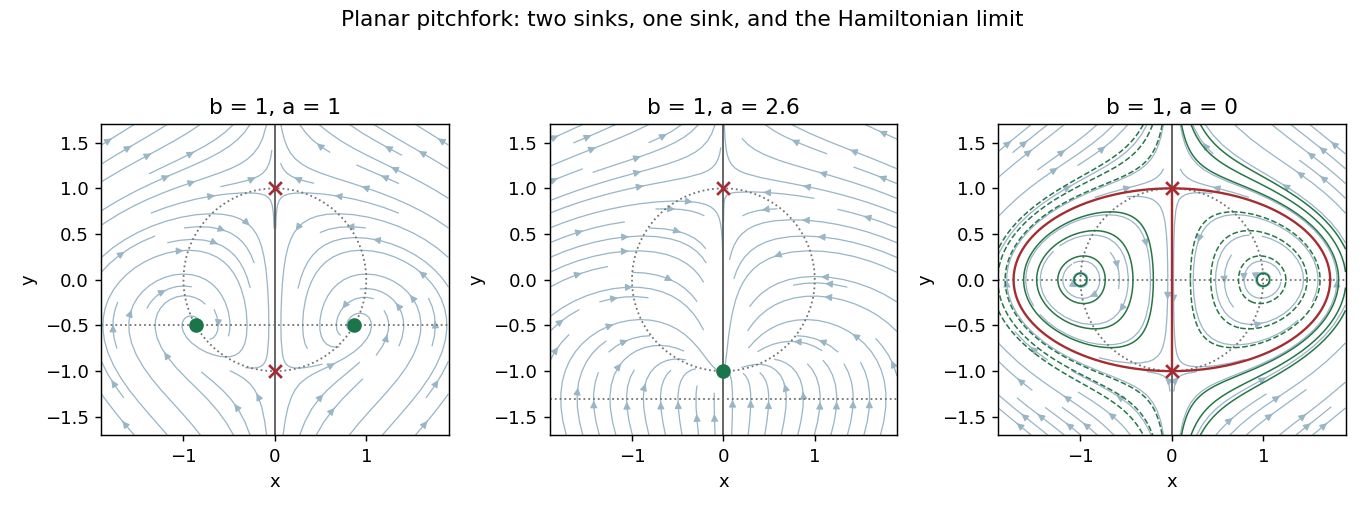
Phase portraits of the planar pitchfork system before collision, after collision, and in its Hamiltonian limit
. Details. 
When , define the Hamiltonian functionThen and , so . At the Hessian of is , a strict nondegenerate minimum; at it is , a strict maximum. Small regular level curves around either point are closed curves, and the vector field is nonzero on them. Motion around each curve therefore returns after a finite period, proving the existence of periodic orbits and classifying both equilibria as center equilibria.
The separatrix level is , consisting of and . The two arcs of this ellipse run from the lower saddle equilibrium to the upper one, while the vertical segment runs from the upper saddle to the lower one. They enclose the two families of periodic orbits, as shown in the last panel of the phase portrait. Outside the loops, regular levels are unbounded.
For the divergence of the original vector field is exactly . If a periodic orbit existed, uniqueness of trajectories would make it a simple closed curve, tangent everywhere to the vector field. The flux across its boundary would be zero, whereas the divergence theorem would give times its positive enclosed area. This contradiction is the Bendixson-Dulac criterion. Hence .
Articles by others on the same topic
There are currently no matching articles.