Number the vertices by . The continuous-time Markov chain moves one step forward cyclically at rate one, as shown in the left diagram.
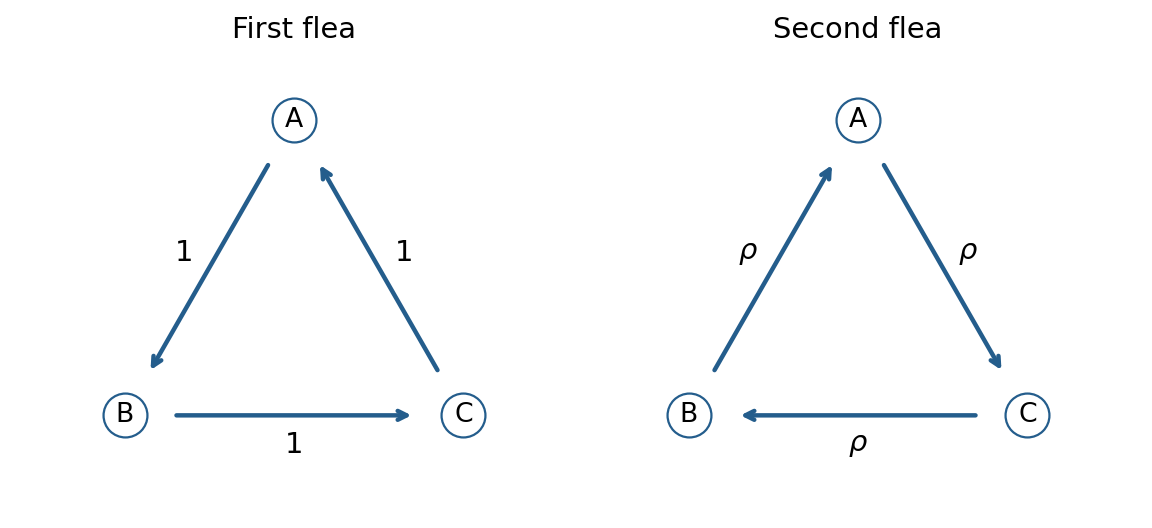

Write for the cyclic shift matrix, so . With , the eigenvalues of are and those of areThe stationary distribution is uniform. A jump count is a rate-one Poisson process, and the displacement is that count modulo three. The roots-of-unity filter and therefore give, for ,These are also the entries of obtained by diagonalizing . In particular,
The second continuous-time Markov chain runs in the reverse direction at rate , as in the right diagram. Its nonzero eigenvalues have real part , and its transition probabilities tend to for each vertex. Independence therefore givesThus the limit exists for every pair of starting vertices and equals .
One can also see the limit directly without spectral multiplication. For fixed starting vertices, modulo three advances with each jump of either flea. Its jump count is the sum of independent Poisson processes with rates and , hence is Poisson with rate (multiply their generating functions). The formula from part (a), with replaced by and the appropriate initial residue, gives and the same limit.
Articles by others on the same topic
There are currently no matching articles.