The axisymmetric magnetic mode spans a one-dimensional real representation of axial rotations, so its signed amplitude is a real variable . An equatorial dipole has two real horizontal components. Rotation through an angle rotates that pair; encoding the components by one complex amplitude gives , and rotation through gives . The velocity mode has the same rotational representation, so write it as . Magnetic reversal acts asThus the two relevant symmetries are axial rotation and magnetic reversal. Reflection symmetry has not been assumed, so complex coupling coefficients are permitted.
The equations for must be linear in the magnetic variables at fixed velocity. Combining this with rotational equivariance, their general local form iswhere is real valued and are complex valued. These functions can be understood through their local Taylor expansions; the symmetry argument does not require a convergent infinite series. Reality of explains its conjugate pairing.
For the velocity equation, a monomial must have the same rotational weight as and be even under magnetic reversal. Its selection rules areA formal sum of all such monomials with complex coefficients is the most general local velocity evolution. At degree one there is ; at degree two there is ; at degree three there are . Expanding the magnetic equations similarly gives the equivariant three-mode dynamo normal formThe are real, and the remaining coefficients are complex. The minus signs on cubic coefficients are a convention, not an assumption about their signs. Terms such as and are forbidden in the magnetic equations by magnetic linearity, even though symmetry alone would allow some of them.
For the normalization of nonzero dynamo coupling coefficients, assume . Make the variable changesThe transformed coefficients are and , of modulus one. ThusThe remaining phase is genuine; the two complex coefficients cannot both generally be made positive real. A zero coupling cannot be normalized to one, so the printed normalization presupposes this generic nonzero-coupling case.
Now impose the specified simplification, in the normalized variables, and write , with and signed real . Put . Separating real and imaginary parts givesConstant moduli require the first three right sides to vanish. Since , the first equation also fixes , so a continuously evolving phase difference must be constant. Hence the last right side must vanish as well. Both phases then advance at one common frequency, giving a relative equilibrium. These four algebraic conditions and the displayed common-frequency equations govern all the requested nonzero constant-modulus solutions, without needing to solve them.
The pure-velocity branch isThis presumes ; the usual saturated branch has . Near it, set , , and define and . Magnetic feedback in the velocity equation is quadratic, so the first magnetic linearization isA branch of the stated relative equilibria has a zero growth rate in this rotating frame. Its determinant therefore gives the magnetic onset on a rotating velocity branch conditionFor , the zero-mode relation is , so a nonzero gives a nonzero when . With a transverse eigenvalue crossing and nondegenerate nonlinear saturation this is the generic magnetic bifurcation surface; magnetic reversal pairs its two signs. Degenerate cases require separate treatment. For example, if and , determinant zero is automatic but the stationary equation forces , so that zero mode does not establish the requested branch with both magnetic amplitudes nonzero.
The six critical Fourier modes are at , with . Reality of the pattern pairs each positive-wavevector coefficient with the conjugate coefficient at the negative wavevector. The leading critical part of the extended centre manifold parametrization is consequentlyThe displayed six-mode expression is its leading-order projection; nonlinear harmonics on the full centre manifold need not vanish identically.
A translation acts by . Each monomial in the equation for must therefore carry wavevector . Since , the allowed quadratic term is . At cubic order the allowed terms are . Rotation through degrees acts, with one choice of orientation, asIts square cyclically permutes the amplitudes, equating the coefficients across the three equations. Its cube conjugates every amplitude; equivariance under this half-turn makes all coefficients real. It does not interchange the two cross-coupling coefficients. A reflection would do that and force , but that symmetry is expressly absent. Thus the chiral hexagonal amplitude equations areat the retained order, with cyclic indices and real coefficients. The missing opening modulus bar in the last cubic term of the printed formula must be supplied; phase equivariance requires .
Write , with all three amplitudes nonzero, and let . Separating real and imaginary parts givesHence the phase locking of a resonant hexagonal triad obeysFor , is phase stable and is phase unstable. Two independent translation coordinates remove two phases; since the wavevectors sum to zero, the remaining phase is exactly . Thus a stable fully active phase-locked pattern can be represented by three positive real amplitudes after choosing the spatial origin. The statement is modulo translations, not a restriction on every representative. Boundary states must also be retained: the zero solution is stable for , and rolls have two zero amplitudes. These are the necessary qualifications to a literal claim that all stable solutions are strictly positive.
In the real nonnegative subspace, a roll isor a cyclic permutation. For hexagons let , which is positive under the assumptions. The equal-amplitude branches solve , givingwith only positive roots retained. The upper branch exists for ; the lower branch is positive for . They meet at a fold.
For a purported rectangle with , subtract its first two equilibrium equations after dividing each by its own amplitude. The quadratic terms agree, and the difference is . Since implies , it forces . A state with exactly two nonzero amplitudes is also impossible because the quadratic term drives the zero third amplitude. Thus there are no nontrivial rectangles.
In fact no other unequal positive equilibria are possible under the straddling cross-couplings. Here is the uniqueness of positive hexagon equilibria with straddling cross-couplings argument. Put , . The equilibrium equations implyConsider , write , , and relabel cyclically so is maximal. If , subtracting equations one and two givesThe left side is positive unless all three are equal, while the right side is nonpositive. If , subtract equations two and three instead:Now the left side is negative unless all are equal and the right side is nonnegative. Both cases force equality. For , reverse the cyclic orientation and exchange . Thus the only nonzero equilibria in this subspace are the stated rolls and hexagons.
At a roll the active radial eigenvalue is . The two inactive amplitudes have real-part linearizationIts determinant is . It therefore has a positive eigenvalue: the rolls are unstable for every , which is stronger than the large- conclusion. In the complex system there is also a neutral translation phase, and the imaginary transverse block has the same determinant.
At a positive hexagon the real-amplitude Jacobian is circulant, with diagonal and off-diagonals , . Its uniform eigenvector has eigenvalueThe other two eigenvectors lie in the zero-sum subspace; using the two nontrivial cube roots of unity givesFor sufficiently large , , and the positive term dominates the quadratic-coupling term . Thus the hexagons are unstable at large , while the uniform radial direction on the upper branch is stable. The two translation phases are neutral and the total phase has eigenvalue , so the amplitude instability is genuine.
More precisely, the upper branch is amplitude stable between its fold and the chiral hexagon Hopf thresholdAt this threshold the conjugate pair crosses with nonzero frequency because , permitting a Hopf bifurcation. The linear calculation locates the crossing; the nonlinear normal form decides the stability and direction of its periodic branch.
The dynamics are bounded in the retained model. For in the positive phase-locked subspace,Since , the negative quadratic-in- term dominates at large amplitude. For large positive , the origin, rolls and hexagons are all unstable, so generic bounded dynamics cannot end at an asymptotically stable steady pattern. The chiral difference favors successive changes in dominant roll orientation, in the spirit of the Küppers–Lortz instability. Oscillatory competition or periodic switching is the natural behavior near the Hopf transition; linear stability alone does not establish a unique global limit cycle. With , coordinate planes are invariant and heteroclinic roll switching is possible. For a missing third mode is regenerated when two others are present, so that exact boundary-plane heteroclinic picture is broken. Finally, sufficiently large is a conclusion of the cubic truncation; far from onset, omitted higher-order terms can change the physical pattern dynamics.
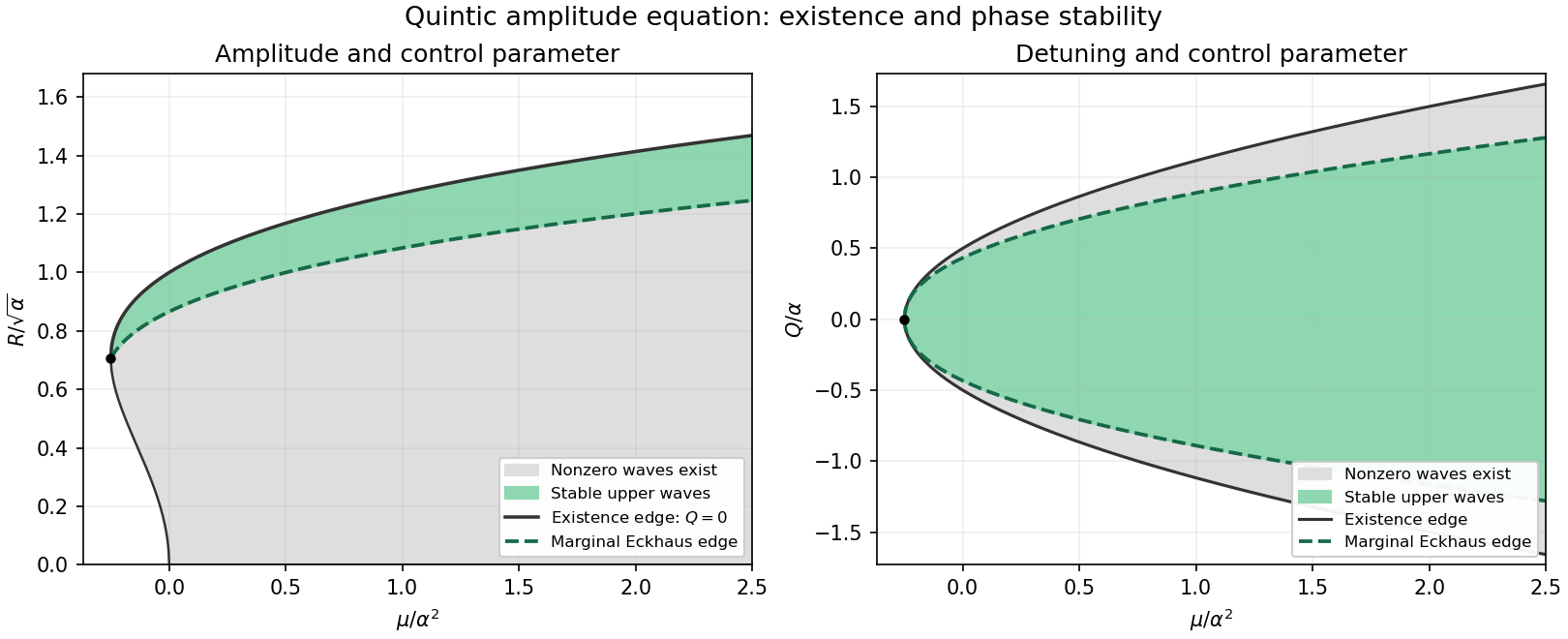
Put . Substituting the plane wave into the quintic real Ginzburg-Landau equation givesso the two nonzero branches areThe upper branch has and exists for . The lower branch is positive when ; at it reaches the zero solution. The two branches meet at the fold , . Thus for a given , nonzero waves exist only if , withThe zero solution exists for every independently of , because its spatial phase has no meaning.
For stability, write with real small . Linearizing and using the steady-wave condition givesDefine . A sideband of wavenumber has matrixand exact growth ratesOn the lower branch , the uniform amplitude perturbation already grows at rate , so that branch is unstable. On the upper branch , the fast amplitude mode decays and the slow phase mode hasThe coefficient of phase diffusion gives the Eckhaus boundary for a subcritical quintic amplitude equation:for robust stability to long wavelengths. At equality, ; the leading diffusion coefficient is marginal, while nonzero sufficiently long-wave linear perturbations still decay at the next spatial order. Indeed when , the matrix trace is negative and its determinant is , proving linear non-growth at every , not just asymptotically small . The neutral phase mode reflects the constant phase symmetry.
At the fold, . If , is positive for small , so the fold wave is unstable. At , the fold is a marginal linear point, but uniform amplitude perturbations have the one-sided nonlinear instability of a saddle-node; it is not a robust stable state. For the trivial state the linear growth rate is , so it is stable for and only linearly marginal at .
The requested regions can be expressed without eliminating . In the plane, nonzero waves exist wherever . The robust stable part isThe left boundary is the zero-detuning wave ; the right boundary is the marginal Eckhaus curve. Both meet at . At fixed , an equivalent description iswith the lower endpoint added if only marginal linear stability is required.
In the plane, eliminate from the marginal condition. It gives , henceThe equality curve is the marginal boundary; the existence boundary is . They touch at but separate for nonzero detuning, leaving an unstable wave band. Equivalently, for fixed the robust stable interval isThe stable amplitude is the upper root throughout this interval. The sketch uses scaled coordinates , so it applies to every fixed positive . Green denotes stable nonzero waves; the marginal curves form its boundaries, while the surrounding gray region contains existing but unstable nonzero waves.

Articles by others on the same topic
There are currently no matching articles.