Substitute into the mixed-derivative equation. Its left side is , so for the dispersion relation, phase velocity and group velocity areThe graph of a function for each velocity is symmetric about , singular at zero, and approaches the horizontal axis as grows. Energy packets travel right while their crests travel left.
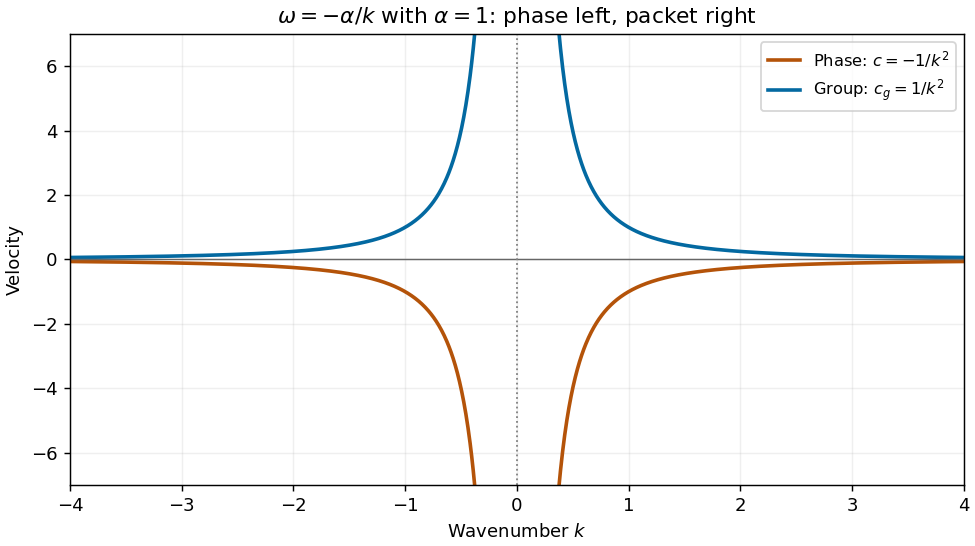

At a distant fixed observer , stationary components obey , so . As time increases their wavelength decreases and their frequency magnitude decreases; the crests pass toward decreasing .
For the given initial spectrum the solution isThe value of a regular spectrum at the single point is irrelevant to this integral; a nonzero spatially constant mode is incompatible with the PDE. For asymptotic calculation assume the usual smooth localized spectrum, with sufficient integrability for the following stationary-phase steps.
At , , the phase has stationary points , . Their values are and their second derivatives are . Expanding quadratically and using the oscillatory Gaussian integral gives the stationary phase leading termFor real data this is twice the real part of the positive-frequency term. If a stationary coefficient vanishes, the formula instead asserts that its contribution has smaller order. At , the phase derivative is , so there is no real stationary point and no corresponding wave packet. For smooth compactly supported spectra away from zero, repeated integration by parts gives decay faster than any power of . More general spectra require endpoint/tail control; absence of stationary points alone does not justify that stronger rate for arbitrary .
Articles by others on the same topic
There are currently no matching articles.