Put . Every positive solution satisfiesAfter reducing , we still have . Here is the continued fraction convergent criterion with its proof. If is reduced and obeys this inequality, it is a strict best approximation of the second kind: for any different with , the assumption would givea contradiction. Choose consecutive continued fraction convergents with . Their determinant is , their errors alternate in sign, and every integer pair is uniquely . For , either , or have opposite signs: positive would make , negative make , and is impossible. Opposite signs make and have the same sign, so . If , reduction gives the th convergent itself. Thus a strict best approximation must be a convergent. The determinant and alternating-error facts follow immediately from the recurrence , and the positive continued-fraction tail formula. Therefore the reduced ratio is a convergent of . Without assuming , the unreduced pair may be a common multiple of the convergent's numerator and denominator; for example for reduces to .
The continued fraction starts , since has integer part . Its next continued fraction convergent is . Direct substitution gives
Take the holomorphic function on a neighborhood of the annulus. Every polynomial has integral zero around the unit circle by the Cauchy integral theorem, while . Uniform convergence on the annulus would imply convergence of these contour integrals, since their difference is bounded by times the uniform error. Thus uniform polynomial approximation on the full annulus need not exist.
Choose the argument in on the slit annulus and letThese compact sets increase to the slit annulus, and each has connected complement: the omitted angular corridor joins the inner disk to the outside of the outer disk. The polynomial Runge theorem says that a function holomorphic near a compact set with connected complement can be approximated uniformly there by polynomials. Choose with . Every compact subset of the slit annulus has positive distance from the removed positive ray, so for all sufficiently large . Hence uniformly on every such compact subset.
If the polynomials converge uniformly on the full annulus to , their limit is continuous and equals on the slit annulus by part (ii). That subset is dense in the full annulus, so everywhere. The Cauchy integral theorem and uniform convergence on the unit circle then give
Let be the open hyperbolic half-plane beyond , opposite the central region . These three half-planes have disjoint closures in the disk, and hyperbolic reflection exchanges and its complementary half-plane. In particular and when . A reduced nonempty reflection word therefore sends an interior point of into the half-plane corresponding to its first letter. It cannot be the identity. This ping-pong lemma argument proves that the reflection group isThe usual reflection tiling makes a fundamental domain for : successive reflection across an offending side reduces a point to , and the disjoint-side configuration yields locally finite tiles. Equivalently this is the disjoint-geodesic case of the reflection fundamental-domain theorem; there are no vertex relations because the sides never meet.
The orientation-preserving subgroup consists of even words. Every pair can be expressed in and : the other nontrivial pairs are their inverses and , . Thus it is exactly . A fundamental set is , with one representative chosen on each paired side; its interior is a fundamental domain. To see there are no relations between , the reflection-word tree has vertices the reduced words and edges joining to . The even subgroup acts freely on this tree; its quotient has two vertices joined by three edges. Choosing the edge as a spanning tree leaves two independent loops, represented by and . Reduced loops in a graph form a free group, soThe quotient is the double of the central three-sided region along its geodesic sides: an orientable pair of pants, topologically a sphere with three points removed. Its three ends are hyperbolic funnels, not cusps, because the sides are ultraparallel and the peripheral transformations have positive translation lengths. The compact convex core has three geodesic boundary circles; the complete quotient itself has no boundary.
A linear code of length over is a linear subspace . A parity-check matrix satisfies . Its minimum distance of a code is the least Hamming distance between distinct codewords, equivalently the least Hamming weight of a nonzero word, because differences remain in the code.
For the usual binary bar product of binary linear codes, take equal-length binary codes with and defineIt is linear, of length and dimension , since the parametrization is injective. If and the word is nonzero, its weight is . If , coordinatewise . The words with of minimum nonzero weight and with of minimum weight achieve the two candidate bounds. ThusFor a word , membership is equivalent to and . Consequently a parity-check matrix of a bar product isThe same distance argument actually needs only equal block lengths and a common field, not nesting. Over a general field replace the second row block by , so it tests . The displayed binary construction uses the conventional nesting.
Assume , the ordinary nonsaturated Gaussian linear model. The log likelihood is, up to a constant,The normal equations and full column rank give the least-squares estimator . Write and , an orthogonal projection of rank . Maximizing in yieldsSince , the residual sum of squares is . Expanding its expectation uses only :This does not use Cochran's theorem. It proves bias and givesIn the saturated case , residuals vanish identically, the likelihood is unbounded as the positive variance tends to zero, and the unbiased residual estimator is unavailable. Thus the usual variance-estimation request requires .
With no chemotaxis, the stationary oxygen equation is . Symmetry and the two prescribed surface values giveBy Fick's first law, the vertical oxygen flux is . Thus each face supplies an inward flux per unit area, and the total influx is , equal to the integrated consumption across the layer. The profile is physically nonnegative only if ; otherwise the constant-consumption approximation must be modified.
For bacteria retained in the fluid, impose zero bacterial flux at the faces. The stationary bacterial equation says that is constant, hence zero. Integrating gives , with fixed by the total bacterial population. Substitution into the oxygen equation provesZero bacterial through-flux is the boundary assumption behind this equilibrium relation.
Use binary expansions ending in zeros at dyadic rationals. The doubling map shifts the expansion left:In ordinary coordinates it is on and on . The branches are continuous; the left limit at is while its value and right limit are . This is its only discontinuity in the half-open interval.
For every , the repeating binary block givesIts least period is : a shorter repeating block would make more than one digit equal to one in a length- period. The orbit avoids the discontinuity, and its multiplier is , so these periodic orbits are repelling and unstable. The same multiplier argument applies to every periodic orbit, with the endpoint fixed point treated one-sidedly.
In the two-branch horseshoe formulation of Glendinning chaos, disjoint subintervals are each mapped onto the same interval by an iterate. Here , and already satisfy . Their inverse branches and realize every binary itinerary. This is a horseshoe for a piecewise continuous map; on the circle the endpoint jump disappears. The symbolic explanation also shows dense periodic points, by repeating any prescribed finite prefix, and topological transitivity, because an iterate maps any sufficiently small dyadic cylinder onto . Finally every neighborhood contains points sharing an arbitrarily long prefix but with different subsequent digits; an appropriate iterate separates their images by a fixed amount, for instance more than . This proves sensitive dependence on initial conditions as well. The binary shift has full two-symbol chaotic dynamics.
For , differentiate the absolutely convergent geometric series to obtainIf , the sum of integrals of absolute values isThus Fubini theorem permits termwise integration, even for complex . The substitution and the definition of the Gamma function giveThe missing terms cancel in the difference of the two Riemann zeta functions.
The quadratic first integrals of the torque-free Euler equations for a torque-free rigid body areDifferentiation and substitution of all three Euler equations make each derivative vanish: the coefficients respectively sum to and . At either endpoint these constants are , , proving .
Eliminating the other squared components gives, with ,Hence and the second Euler equation gives , where increases with . The specified orbit goes from to , so its sign must be negative. The sign in the original PDF's reduced equation is therefore inconsistent with its endpoint conditions. The corrected heteroclinic satisfiesIntegrating by separation gives this family for ; the integration constant is a time translation. The printed positive-sign equation instead has the increasing solutions and cannot meet the stated endpoints. For completeness its other real solutions are and the branches on intervals avoiding their pole. These latter branches are excluded by the conserved-energy constraint . The scalar heteroclinic is unique up to translation. For the full angular-velocity vector there are two sign-related branches: simultaneously reversing and preserves all three Euler equations and both endpoints. Full-vector uniqueness therefore also requires choosing one of those branches.
For a comoving fluid volume, and . The first-law relation gives . Since , the cosmological perfect-fluid continuity equation isFor the Newtonian energy argument, assume negligible pressure, spherical homogeneity, Newtonian gravity and constant enclosed mass. A test particle at physical radius has constant specific energyDivide by and set to obtain the Friedmann equationHomogeneity makes independent of the chosen comoving shell. In the relativistic interpretation it specifies the spatial-curvature sign: positive, zero or negative gives closed spherical, flat or open hyperbolic spatial geometry, with a conventional rescaling allowing . Newtonian mechanics itself derives the energy constant, not the spatial metric. When pressure is appreciable, the general relativistic equations still have the displayed Friedmann form, but the constant-mass Newtonian test-particle derivation cannot be applied without that qualification.
The Miller-Rabin primality test first handles as prime and or even as composite. For odd , write with odd and choose a base . A nontrivial proves compositeness. Otherwise compute : the round passes if or . If neither holds, square successively, at most times, and pass if a value occurs; otherwise declare composite. An occurrence of before exhibits a nontrivial square root of one and is also a failure. For prime , Fermat's theorem and the fact that a field has only the square roots force a pass. The standard strong-liar bound says that an odd composite passes for at most one quarter of the bases; independent random rounds therefore have error probability at most after rounds. Passing is a probable-prime verdict, not a proof of primality. A Fermat pseudoprime is composite and passes ; a strong pseudoprime is composite and passes the stronger round above.
Since is odd, andis a product of two odd integers greater than one. Thus is odd and composite. Also . Fermat's theorem modulo gives , and , so . This number is even; hence . Thereforeproving that is a base-two Fermat pseudoprime.
By the definition of Fermat pseudoprime, is composite as well as odd, and . Put . A proper factorization makes a proper divisor of , so is composite. NowSince , . This is the first passing condition of the Miller-Rabin primality test, with . Thus is a base-two strong pseudoprime. If “pseudoprime” were used to include primes, the compositeness conclusion would fail, for instance gives ; the standard composite definition matters.
For a continuous loop in , choose a continuous argument lift with . Such a lift is constructed by subdividing the interval into pieces whose images lie in an argument chart and matching the arguments at their endpoints. The winding number of a continuous closed path isChanging the initial lift adds one constant multiple of and does not change this integer.
A loop homotopy is a continuous with , and for every . Compactness gives a positive lower bound for and uniform continuity. Partition the interval finely enough that neighboring loops satisfy . Their quotient lies in , and has a single-valued continuous argument with equal endpoint values. Its winding number is zero. Arguments of a product add, so . Applying this at every step provesThis proves homotopy invariance of winding number directly, including continuous curves without differentiability.
The principal argument is continuous and single-valued on . The given loop stays in this slit plane, and its initial and final values have the same principal argument. The definition therefore gives .
Here the target of is the unit circle. The boundary loop extends through the disk, so the radial homotopy contracts it to a constant loop. Thus its winding number is zero. On the boundary put , also circle-valued. Adding argument lifts gives . If never vanished, would avoid , which is the only negative real point of the unit circle. Part (iii) would give , contradicting . Therefore there is a boundary point with . The circle-valued hypothesis is essential; it is not a claim about arbitrary complex-valued .
Introduce dimensionless quantities , , and . Substitution and cancellation of give the stated spatial SIR model withDrop tildes. A travelling wave with obeysAt the leading edge , the infective equation linearizes to . For an invading epidemic the susceptible level must exceed the removal threshold, . A nonoscillatory decaying tail has exponentsIf the discriminant is negative, a nonzero real tail oscillates in sign, violating nonnegative infective density. Thus for a right-moving waveThis is a necessary admissibility condition from the leading-edge calculation, not by itself a global existence proof.
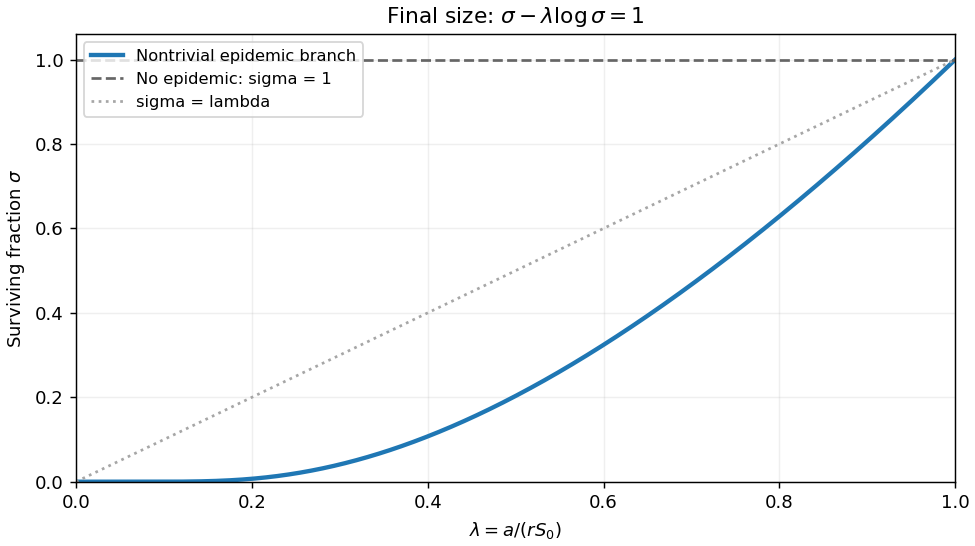
To derive the final size relation for an epidemic, use and integrate the infective ODE across the wave. The tails have , givingThereforeFor a nontrivial epidemic . The function is strictly convex, minimized at . For it has the trivial root and one further root . For , it exceeds one for every , so only the no-epidemic root remains; this also proves the necessity of . On the nontrivial branch,It rises from as to as . The sketch distinguishes this branch from the always-present trivial root.

For parameter-dependent centre manifold theorem, append . At the eigenvalues are : the direction is strongly stable and span the extended centre directions. An extended centre manifold for a parameter is an invariant graph of a function tangent to ; nearby trajectories approach its reduced dynamics along stable fibers. The stable eigenvalue remains separated from zero, so local bifurcation and stability are governed by this reduction. This is the parameter-extension content of the requested stable/centre-manifold discussion.
The centre-manifold invariance equation isReflection symmetry permits an invariant graph of a function with and . At quadratic order the left side vanishes and the right side is , giving . More explicitly its first mixed coefficient is , found by equating the terms. The reduced equation isThus the origin is locally asymptotically stable for , becomes a saddle for , and creates two stable equilibria , . This is a supercritical pitchfork bifurcation. The exact nearby nonzero branches provide a check: the equilibrium equations givewhich are real and nonzero for small positive . The omitted branch is not near the origin. At the leading also attracts, although at an algebraic rather than exponential rate.
For a nonrelativistic particle, . The Gaussian integral yieldsIndeed , which combines with to give the prefactor. For the two species this givesChemical equilibrium imposes . If the two massless bath species have zero chemical potentials, then ; their masses alone do not imply this chemical-potential condition.
Weak reactions such as , with leptons treated as relativistic, interconvert neutrons and protons. Negligible lepton chemical potentials give approximately , since their degeneracies and masses are nearly equal. Equilibrium favors protons increasingly as temperature falls. But the weak reaction rate decreases faster than the expansion rate and eventually falls below it: cosmological weak freeze-out prevents the ratio from following its equilibrium exponential to zero. Free neutrons subsequently decay, reducing the frozen ratio further.
In Big Bang nucleosynthesis, cooling eventually makes deuterium survive photodissociation. Nuclear reactions then build helium through deuterium and the light intermediate nuclei, locking almost all surviving neutrons into stable helium-four. Neglecting binding-energy corrections and taking , each helium nucleus uses two neutrons and two protons, so andFor example gives a helium mass fraction , with the remaining baryons predominantly hydrogen.
The cumulative hierarchy is defined by transfinite recursion:The rank of a set is , equivalently the least such that . The standard hierarchy properties give , so every ordinal occurs as a set rank; the ordinal itself is another example of rank .
Let be transitive of rank , and fix . The supremum formula gives an element of whose rank is at least . Choose such an element of least possible rank. If , the same supremum formula gives with rank at least . Transitivity gives , and membership strictly decreases rank, contradicting the choice of . Thus contains an element of every rank below .
A nonempty finite set has rank the maximum of finitely many successor ordinals, hence a successor ordinal; the empty set has rank zero. Conversely, for any , the singleton has rank . ThusA finite transitive set of rank contains, by the proved property, distinct elements of every rank . Finiteness therefore forces . Every finite ordinal is itself a finite transitive set of that rank. Consequently
Take a uniformly random ordering of the vertices and select each vertex that precedes every neighbor. The selected set is independent: if two adjacent vertices were both selected, each would have to precede the other. Among the vertices consisting of and its neighbors, each is equally likely to come first, so the selection probability is . Linearity of expectation gives expected size . At least one ordering attains at least this average; its integer size is therefore at least the ceiling. This proves the Caro-Wei bound
Write . The Cauchy-Schwarz inequality givesThe proved Caro-Wei bound therefore gives an independent set of at least vertices.
No. The disjoint union of copies of the complete graph has exactly the prescribed number of edges and has independence number : an independent set can choose at most one vertex from each component, and choosing one from every component attains .
Choose the radicals with positive imaginary part. The roots of unity areThe first comes from . For the second, obeys , so ; solving gives the displayed expression. The Kummer extension towers areEach step is quadratic and the base contains the second roots of unity. The second tower really has degrees : its intermediate field is real, while the added radical is nonreal, and belongs to the cyclotomic field.
Let . Its Galois group embeds into , by sending an automorphism to the exponent in its action on . It is therefore finite abelian, of order dividing . The finite case of the Fundamental theorem of finitely generated abelian groups supplies a subgroup chain whose successive quotients are cyclic of prime order . Every such , since for (and for the possible prime is , whose roots of unity already lie in every characteristic-zero field). Thus every intermediate base contains , because contains all roots of unity of orders smaller than .
Each cyclic degree- step is a Kummer extension. Here is the relevant criterion explicitly. For a generator and a primitive th root , the operator is not identically zero, by linear independence of distinct field automorphisms. Choose its nonzero value ; then , so and . Since the degree is prime, is obtained by adjoining an th radical. Applying this to the subgroup chain proves is a succession of Kummer extensions.
Finally use strong induction on , for arbitrary characteristic-zero base fields. Successively adjoining the roots is contained in a Kummer tower by the induction hypothesis, applied over each current base. The just-proved assertion then adjoins by further Kummer steps. Hence any cyclotomic extension is contained in a Kummer tower. In the given cyclotomic-and-Kummer tower for a soluble extension, replace every cyclotomic step by such a tower; enlarge subsequent steps by compositum with the new intermediate fields. Base change preserves radical adjunction and the requisite roots of unity, possibly making a step trivial. Thus every finite soluble extension is contained in a succession of Kummer extensions.
We use the standard facts that finite complex representations are completely reducible, irreducible characters are orthonormal, the regular character is , and the number of irreducible characters equals the number of conjugacy classes. We also use Schur's lemma, Sylow's theorem and the nontrivial center of a nontrivial finite -group.
For an irreducible character of degree , a conjugacy-class sum acts as the scalar by Schur's lemma and taking traces. This scalar is an algebraic integer: class sums form an integral basis of the center of the integral group algebra, their multiplication has integer structure constants, and multiplication by satisfies its monic integer characteristic polynomial. That same polynomial annihilates its image in any irreducible representation. Character values are also algebraic integers, since they are sums of roots of unity. Character orthogonality now givesThis is a rational algebraic integer, hence an integer. Therefore divides .
The Burnside's pa qb theorem states that every finite group of order is soluble. We prove its character-theoretic ingredient. If a class has size coprime to , integers with givean algebraic integer. Every algebraic conjugate of this number is the average of roots of unity and has modulus at most one. If it is nonzero, its algebraic norm is a nonzero integer of absolute value at least one; since every factor has modulus at most one, all must have modulus one. In particular . Equality in the triangle inequality for the unit-modulus eigenvalues implies that is scalar. Thus if , either or is scalar.
Suppose a group of order were nonabelian simple, with both primes present. Choose a nonidentity in the center of a Sylow -subgroup. Its centralizer contains that Sylow subgroup, so its class size is a power of . Every nontrivial irreducible representation is faithful by simplicity. If it sent to a scalar, faithfulness would make central in the group, impossible in a nonabelian simple group. The ingredient above therefore gives for every nontrivial character with degree coprime to . Evaluating the regular character at givesThe right side is an algebraic integer, but is not, a contradiction. A group of prime-power order cannot be nonabelian simple either, by its nontrivial center. Induct on the order: every nonsimple group has a proper nontrivial normal subgroup, and that subgroup and the quotient have smaller orders with at most these two prime divisors. By induction both are soluble; their derived-series extensions make the original group soluble. Simple abelian groups have prime order and start the induction. This proves Burnside's theorem.
For the final divisibility, let be odd and let be its number of conjugacy classes. All irreducible degrees are odd by the divisibility just proved. We use the standard Frobenius-Schur indicator theorem: is zero precisely for an irreducible character not equal to its conjugate, and is otherwise. Squaring is a bijection on an odd-order group: for each , its unique square root is , since every element order divides . For every nontrivial irreducible character, orthogonality to the trivial character consequently gives . The nontrivial characters therefore occur in distinct conjugate pairs of equal odd degree. Since an odd square is one modulo eight,is a sum of pairs , each divisible by sixteen; the trivial character contributes zero. Hence
Cover the circle by two open arcs whose intersection has two components, and take their products with . Both members of this cover retract onto , while their intersection retracts onto . The Mayer–Vietoris sequence has the mapafter consistent identifications of the two overlap components. Its kernel and cokernel are each . Exactness therefore suppliesThis splits because the last group is free abelian: lift a basis and extend linearly. With , the result isStarting from a point and iterating this decomposition, Pascal's identity yields
The real Stone-Weierstrass theorem states that if is compact Hausdorff and is a subalgebra containing the constants and separating points, then is uniformly dense in . Let be its uniform closure, still an algebra over a field. If and , scale the permitted polynomial approximation of absolute value on to . Applying these polynomials to proves . Thereforebelong to : it is a lattice.
Fix and . For every , point separation and an affine adjustment give with and ; if , a constant suffices. For fixed , the open sets where cover . Select finitely many and take their maximum . Then everywhere and . By continuity, on some neighborhood of . Choose finitely many covering and take the minimum of the corresponding . The result satisfies everywhere. Since is closed and arbitrary, . Thus , proving the theorem.
A meromorphic function on the Riemann sphere is rational: it has finitely many poles; subtract their principal parts, including a polynomial for a possible pole at infinity, and the remaining entire function is bounded at infinity, hence constant by Liouville theorem. A rational map of degree has preimages of a regular value, counted with multiplicity. An analytic isomorphism is bijective, so , giving preciselyConversely these Möbius transformations have a Möbius inverse and extend holomorphically at their pole and infinity, so are analytic isomorphisms.
For a nonconstant analytic map between compact connected Riemann surfaces, the Riemann-Hurwitz formula isHere are genera, is the degree (the sum of local multiplicities over any fiber), and is the local degree in coordinates where the map has the form . Only finitely many terms are nonzero; these are the ramification points.
For a degree-two sphere map the formula gives total ramification two. Each local degree is at most two, so there are exactly two distinct ramification points, each of local degree two. Their branch values are distinct, because one fiber cannot have multiplicity four. Choose sending to the two ramification points, and sending their values to . Then has its only zero at zero, of order two, and its only pole at infinity, of order two; it is with . Rescale by . Therefore , as required.
At a smooth point of an irreducible curve, the local ring is a discrete valuation ring. A local parameter is an element generating its maximal ideal; its order at is one. Embed the projective target as a closed subvariety of . Write the rational map generically as with , and let be the smallest finite valuation of the nonzero coordinates at . Multiplying by makes every coordinate regular at and at least one a unit. These functions are regular on some common neighborhood of and have no common zero after shrinking, so define a morphism to . The defining homogeneous equations of the target vanish generically and hence identically on this neighborhood. Thus the rational map extends to the projective target at .
For a nonprojective target, from rationally to cannot extend at zero: a regular extension would give there, impossible. In dimension two the morphism on cannot extend to zero, because its constant values along the two punctured coordinate axes are different. This shows why both projectivity of the target and smooth one-dimensional source were used.
Work geometrically over an algebraic closure; the degree and ramification do not change under this base extension. The coordinate squaring map lands in because its defining equation pulls back to that of . Above a generic target point with all coordinates nonzero there are square-root choices, identified in pairs by simultaneous sign change. HenceThe effective sign-change group is . At a point with all coordinates nonzero its stabilizer is trivial, and the squaring map is locally étale, since characteristic is not two. Thus there. If one coordinate is zero, a sign change of that coordinate fixes the point, giving stabilizer order two. More explicitly, if , use as a local parameter; the curve equation has nonzero derivative in the other coordinate, so this is valid, and the corresponding target parameter is . ThereforeTwo coordinates cannot vanish on either curve. For each vanishing coordinate, the other-coordinate ratio solves , giving eight distinct points; there are 24 ramification points. As a check, the smooth plane-curve genera are and , and Riemann-Hurwitz formula gives .
The Theorema Egregium states that Gaussian curvature is determined by the first fundamental form, and therefore preserved by local isometries. For a local surface parametrization , write , choose a unit normal , and set . Decomposing the second derivatives into tangent and normal parts givesCommute the third partial derivatives of and take tangent components. The terms involving derivatives of are normal; the tangent terms give the Gauss equationwhere is computed from derivatives and products of the displayed Christoffel symbols, using . For example the tangent term from differentiating is , which produces exactly the difference of the two products on the right. ConsequentlyThe last expression depends only on and its derivatives. Pulling back under a local isometry therefore preserves , proving the theorem.
The shape operator is the self-adjoint tangent map , using a locally chosen unit normal. Its eigenvalues are the principal curvatures, and their eigenvectors give the principal directions. At an umbilical point they coincide, so and every tangent direction is principal. Reversing the normal changes both curvature signs but does not change the principal directions or umbilicity.
At , each of the given ambient rotations fixes , rotates its tangent plane and preserves the local surface. Naturality of the shape operator under that rotation makes commute with every planar rotation. A symmetric real two-by-two operator commuting with all rotations is scalar, so every point of is an umbilical point. The trace-free part of the shape operator is continuous. Density therefore makes it zero everywhere on .
Locally write . The Codazzi equation gives for tangent fields ; choosing independent fields proves . Thus the surface is locally a plane if , or has constant spherical centersince its differential is . A change of normal reverses both and , leaving this center unchanged, so these local descriptions patch across the connected surface. In the flat case the whole surface lies in one plane, where a regular surface without boundary is open; a nonempty such set cannot also be compact and closed. Hence the flat case is excluded. In the other case lies on one sphere of radius . Its inclusion in that sphere is locally open, since both have dimension two, and its compactness makes the image closed. Connectedness of the sphere forces the image to be the entire sphere. Therefore is a sphere.
For , symmetry gives andbecause the tail integrand is . The strong law of large numbers for independent identically distributed integrable variables therefore gives almost surely and hence in distribution. At , is an equally likely sign, which is included in this argument.
For , has the standard Cauchy distribution. Its characteristic function isFor , close a contour in the upper half-plane; the pole at has residue and the semicircle integral vanishes. For , symmetry gives the same value with , and gives one. Independence now yields . Thus is exactly standard Cauchy for every . Consequently
For , the variance is finite and equals , using the integral notation in the question. The central limit theorem for independent identically distributed variables with finite variance givesIn particular gives variance one at . The invoked implications from almost-sure to distributional convergence and the characteristic-function uniqueness theorem are the standard probability results used above.
Assume the first-fork choices are independent Bernoulli routings, as in Poisson thinning. Put . Cars assigned to A form a Poisson process of rate , also an ordinary renewal process with independent exponential holding times of rate . The stream to the second fork is an independent Poisson process of rate .
B receives its odd-numbered arrivals. Its initial delay is exponential of rate , followed by independent Erlang distributions of shape two and rate between successive B arrivals. Thus B is a delayed renewal process, not Poisson. C receives the even-numbered arrivals: its first and all subsequent holding times are independent Erlang, so C is an ordinary renewal process, not Poisson. Their holding-time density and survivor are and . Both have asymptotic rate ; equality of these mean rates with A does not make the processes Poisson.
For a renewal holding time with mean , the equilibrium residual-life distribution has survivor . For C, and also the common long-run B/C renewal structure, and the Erlang survivor giveFor A the exponential law is already its own equilibrium delay.
Let count second-fork arrivals. Its independent increment over is Poisson, andobtained by evaluating . If is even, the next second-fork arrival goes to B, so no B arrival requires zero new arrivals. If it is odd, the next goes to C, so up to one new arrival is allowed. Reverse these alternatives for C. ThereforeAt these reduce to the distinct initial-delay survivors; as , both non-Poisson probabilities approach the equilibrium-delay survivor from part (b).
In the normal form of a Bayesian decision problem, choose a measurable decision rule before seeing the data to minimize the prior Bayes risk . In the extensive form, after observing , choose an action minimizing posterior expected loss. Conditional expectation makes these equivalent, subject to the usual measurable selection conditions. If is the posterior distribution and is the best no-data loss, thenThe inequality follows by ignoring the data.
For a measurable region , posterior or prior expected loss is . It is minimized by including exactly the locations where the integrand is negative; including equality points is harmless. Thus the highest density region is a Bayes act andFor , if the answer is zero. Otherwise put . The optimal interval is , andFor the specified prior and , the prior density is everywhere below , so . Completing the square gives . Its peak is , so a positive-measure region has posterior density strictly above and its optimal expected loss is strictly negative. That loss is independent of its mean, hence independent of . Therefore . Explicitly, with , .
A control policy specifies each control as a nonanticipating measurable function of the observed history, possibly with additional randomization. It may depend on time and the entire past; a stationary Markov policy uses only the current state. We use the standard admissibility assumptions allowing measurable choices and concatenation of continuation policies.
The dynamic programming operator is monotone: implies . Nonnegative costs give , so induction gives . Thus increases pointwise to an extended nonnegative limit . Backward induction identifies with the infimum of expected costs for the first periods: condition on the first control and next state, then optimize the continuation. Every infinite-horizon policy has at least that finite-horizon cost, so
For the Bellman equation, any infinite-horizon policy, conditional on its first action and next state, has continuation cost at least . Its total cost is therefore at least ; infimizing gives . For the reverse inequality at a state with finite , choose a first action within of its infimum and concatenate continuation policies whose costs are within of at each next state . This produces a policy of cost at most . Such continuations are needed only at states of finite value, which have probability one under an action with finite continuation expectation. Let . If , the first inequality already gives . Therefore
Let , and use the permitted selector . Under the stationary policy , repeated conditional expectation givesIf is infinite the desired comparison is immediate; otherwise these nonnegative quantities have finite expectations and the displayed recursion is legitimate. Drop the terminal term and apply monotone convergence theorem as . The policy's infinite-horizon cost is at most , soThus the value is the least nonnegative Bellman fixed point. The argument works also for because costs and the dropped terminal term are nonnegative; it makes no unwarranted contraction or finite-value assumption.
A state-price density is a strictly positive random variable withOn the stock-state space this means a positive integrable function satisfying and . Equivalently is an equivalent probability measure with . Such measures exist because , for example exponential tilts of the uniform law with mean tuned to .
By the fundamental theorem of asset pricing, any arbitrage-free claim price is represented by such a density in the enlarged market. For payout ,with strictness because equivalence preserves the stock's nondegenerate distribution. Also almost surely, so . Hence .
When , nonnegative wealth for all stock states requires . At wealth is . The tangent inequality for the strictly concave square root gives, for ,Uniform integration gives and , so the expected linear term vanishes exactly when . Strict concavity makes equality possible only for . Thus the unique optimal holding is , including this boundary optimum without assuming an interior maximizer.
The marginal utility price density isIt is integrable and satisfies both pricing constraints: and . Therefore
Use with inverse factor . The Fourier transform of the Schrödinger equation gives , hence . To invert the multiplier, first damp it by . The Gaussian integral in each coordinate givesLet , with the branch continuous from positive real damping. The fundamental solution of a linear differential operator isFor Schwartz initial data this convolution and Fourier derivation are justified directly; the multiplier tends to one as and has modulus one, giving the initial data and a unitary extension to . The kernel itself is interpreted through the displayed Abel regularization.
Articles were limited to the first 100 out of 125 total.
Articles by others on the same topic
There are currently no matching articles.