For a curve with fixed , its tangent is proportional to . The Vaidya metric has , so the curve is a null curve. Moreover, the Christoffel symbols with two lower indices vanish:because is constant and every other is zero. Thus the covariant derivative along this tangent gives . The geodesic equation is satisfied with as an affine parameter; choosing future orientation gives the tangent and an affine parameter increasing as . These are the ingoing radial null geodesics.
Use the future-directed null vector , whose dual is . The stress-energy tensor has the null dust formFor every future-directed timelike vector , . The energy current appearing in the dominant energy condition isIf , this is a future-directed null vector, or zero; also . If , the current is past-directed and that energy density is negative. Therefore, given the already stipulated positivity and smoothness of , the necessary and sufficient additional condition is
An event horizon is a null hypersurface. For its spherical defining function , the inverse radial metric tensor has , and . The normal's null condition isIt follows that the event horizon follows the outgoing radial null geodesics of the Vaidya metric:This ordinary differential equation also describes other outgoing null hypersurfaces; the global event horizon is selected by its future boundary condition, not by this local equation alone.
In the final Schwarzschild spacetime, an outgoing ray with escapes to future null infinity, whereas one with cannot do so and ends at the Schwarzschild singularity. Their boundary is the outgoing null geodesic . Since the final region continues indefinitely, the boundary of the causal past of future null infinity there is exactly that Schwarzschild event horizon. Equivalently, integrating the outgoing equation backward from this final boundary selects the complete event horizon. ThusThe original Penrose diagram below shows the right-hand exterior and black-hole interior appropriate to ingoing coordinates. The green band is the ingoing accretion interval; the dashed blue curve is the spherical apparent horizon . Outgoing null geodesics escaping to future null infinity lie to the right of the red event horizon; those to its left terminate on the future spacelike singularity. In the final stationary region the two horizons coincide. The red event horizon already lies outside before the ingoing matter arrives, because its position is fixed by the future escape criterion.
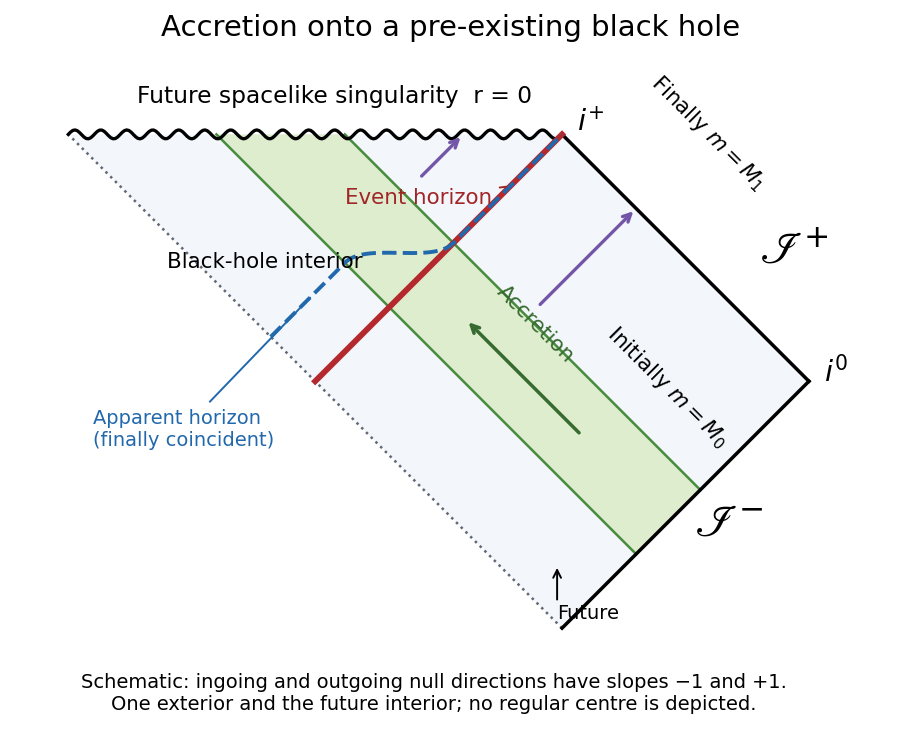

Let and retain only terms first order in and . The outgoing event horizon equation expands toHere is the initial Schwarzschild surface gravity. The integrating factor gives . Future stationarity imposes for and removes the growing homogeneous solution. Integrating from to infinity yields the teleological response of a Vaidya event horizon:The integral is finite because is bounded. Integrating by parts also givesFor , this reduces to . For , the first form becomesConsequently as . The positive constant shows that this event horizon is already expanding in the initially vacuum region. For monotone accretion, , so it lies outside the instantaneous apparent horizon to first order. All displayed radius corrections are understood up to .
The stress-energy tensor is already first order, so its energy flux can be evaluated on the unperturbed Schwarzschild event horizon , with the infinity-normalized Killing vector field . On this background , and henceThe conserved stress-energy current from a Killing vector is . Its radial component is negative, so the positive inward energy flux is . Using the directed null-surface measure givesThe initial and final event horizon areas are and . Thus . With Schwarzschild surface gravity , the Physical-process first law of black-hole mechanics follows:The flux is Killing energy, including gravitational redshift, rather than the energy measured by a sequence of static observers arbitrarily close to the event horizon.
Articles by others on the same topic
There are currently no matching articles.