For a stationary component, the stationary internal-wave WKB solution has local vertical wavenumber and vertical-velocity amplitudewith the upward branch . The WKB approximation requires and sufficient smoothness, with a useful additional criterion. The background changes little over a vertical wavelength; this excludes a turning level of a stationary internal wave.
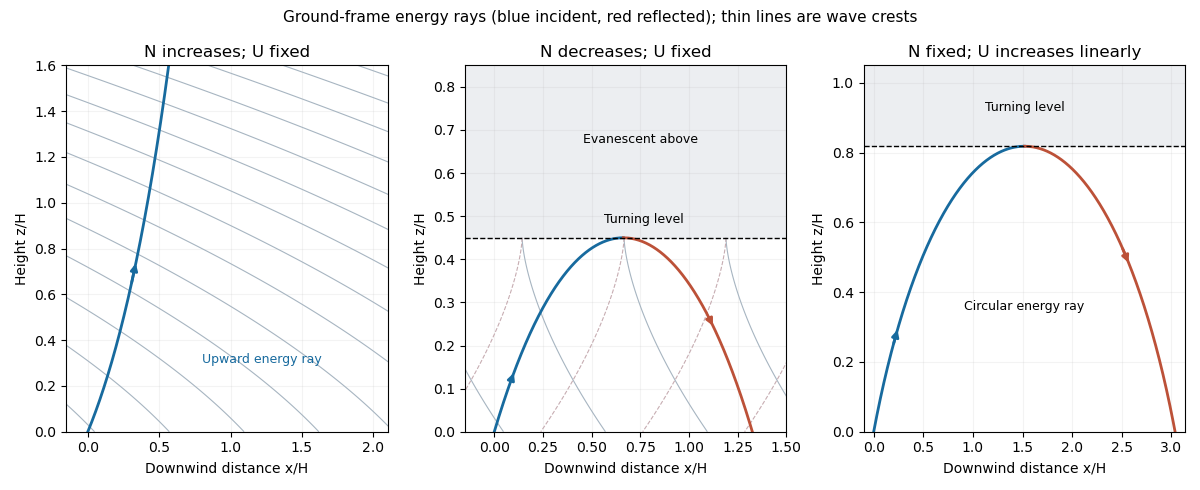
For increasing , the vertical wavenumber increases. The crest slope tends toward zero, and successive crests get closer vertically. The laboratory energy ray obeys , so it becomes more nearly vertical as it rises. There is no upper turning level in this ideal increasing-stratification profile.
For decreasing , the vertical wavenumber decreases to zero atThis assumes propagation at the bottom, . The crests become more nearly vertical and the incident energy ray becomes horizontal at . Above it the wave is evanescent, and the incident wave is reflected downward. The divergent WKB amplitude at is an approximation failure, resolved by an Airy function transition, rather than an infinite physical wave amplitude. The decreasing formula for is only a positive-frequency background below ; the relevant turning height lies below that level.

Articles by others on the same topic
There are currently no matching articles.