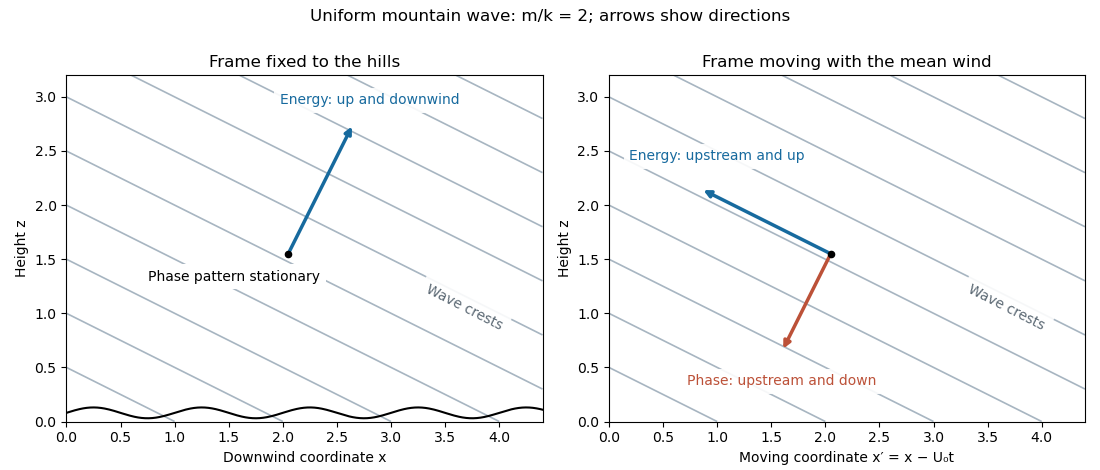
Take , , and represent the stationary topographic internal gravity wave by phase . Its laboratory angular frequency is zero, and its intrinsic frequency is . The internal gravity wave dispersion relation givesThe radiation condition selects , since this makes the vertical group velocity upward. The lower kinematic boundary condition is , so a corresponding linear wave field iswhere is the vertical fluid displacement. The constant-phase lines of an internal gravity wave slope down to the right, with .
Let . In the frame fixed to the hills the phase pattern is stationary: its phase velocity is zero, while the group velocity isEnergy travels up and downwind, with ray slope . In coordinates moving with the wind, the phase is . ThusThe intrinsic phase velocity is upstream and downward; the intrinsic group velocity is upstream and upward, perpendicular to the wave vector. Adding to the group velocity recovers the laboratory energy ray.
Vertically propagating waves require , equivalently . At equality the vertical group velocity vanishes; above the mountain-wave cutoff the bounded response is an evanescent wave. The linearization requires small terrain slope and small wave-induced displacement gradients , often summarized by . The model also neglects rotation, viscosity and compressibility; its scales must permit those approximations.
For a stationary component, the stationary internal-wave WKB solution has local vertical wavenumber and vertical-velocity amplitudewith the upward branch . The WKB approximation requires and sufficient smoothness, with a useful additional criterion. The background changes little over a vertical wavelength; this excludes a turning level of a stationary internal wave.
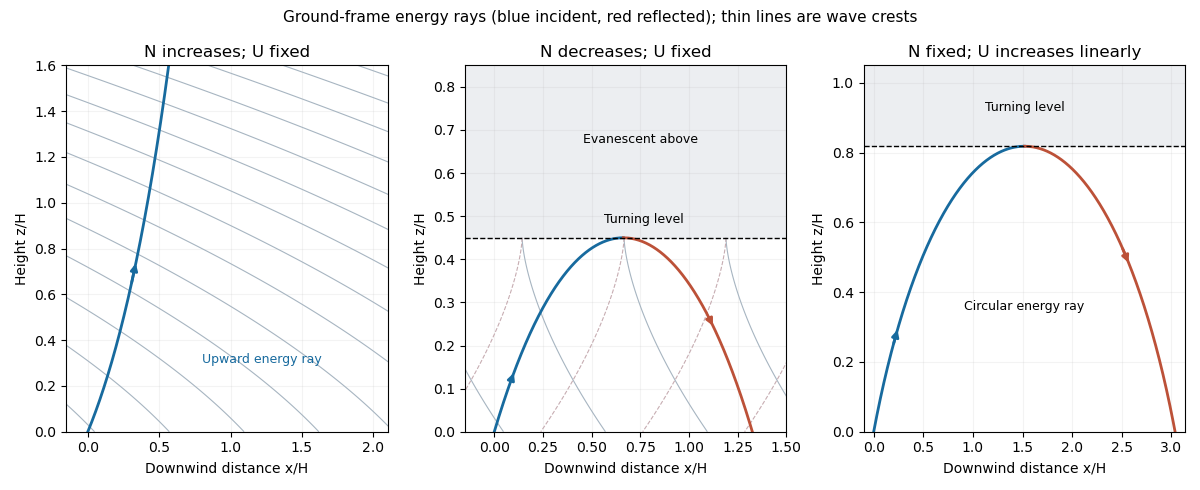
For increasing , the vertical wavenumber increases. The crest slope tends toward zero, and successive crests get closer vertically. The laboratory energy ray obeys , so it becomes more nearly vertical as it rises. There is no upper turning level in this ideal increasing-stratification profile.
For decreasing , the vertical wavenumber decreases to zero atThis assumes propagation at the bottom, . The crests become more nearly vertical and the incident energy ray becomes horizontal at . Above it the wave is evanescent, and the incident wave is reflected downward. The divergent WKB amplitude at is an approximation failure, resolved by an Airy function transition, rather than an infinite physical wave amplitude. The decreasing formula for is only a positive-frequency background below ; the relevant turning height lies below that level.


Let be pressure divided by the reference density and the buoyancy perturbation. The linear, inviscid Boussinesq equations about areFor a stationary Fourier component , incompressibility gives . The horizontal momentum equation then gives , while buoyancy conservation gives . Substitute these into the vertical momentum equation to obtain the stationary Taylor–Goldstein equation:Hence its local WKB approximation isFor negligible, an outgoing upward wave has . In particular for . In an upper evanescent region choose the branch with in so the solution decays upward. These choices express the radiation condition; a reflected wave has the opposite real branch and downward group velocity.
There are two different limiting levels. A critical layer in a shear flow occurs at , where the intrinsic frequency vanishes, , and upward propagation slows while the vertical wavelength contracts. Dissipation or nonlinear effects can absorb the wave and transfer its momentum to the mean flow. For a stable, slowly varying critical layer with Richardson number , the usual causal inviscid continuation suppresses transmission; it is not the same as reflection at . When the Richardson number is small, a general absorption-only conclusion needs extra stability assumptions.
Reflection instead occurs at the turning level of a stationary internal wave , beyond which . It is sometimes called a critical reflection height, but the wind there is nonzero. Assuming , the specified profiles giveThe decreasing-wind profile never encounters before its zero-wind layer. Both profiles have ; a well-separated WKB description requires , and a turning-layer transition is still required for the increasing profile.
The internal-wave ray tracing equations preserve the horizontal wavenumber and laboratory frequency. For the increasing wind, the upward branch satisfiesThe group-velocity ratio therefore givesIntegrating from yieldsThis is the ascending branch of the circular mountain-wave ray in linear shear:It reaches at , where the energy direction is horizontal. After reflection, and the ray continues downwind and downward along the other branchreturning to at . The last panel of the figure in part (b) shows this path. These are WKB energy rays, with the short neighborhood of the turning height supplied by its transition solution.
Articles by others on the same topic
There are currently no matching articles.