Treat the channel as prismatic, with horizontal bottom datum , uniform cross-sectional velocity, and surface height . The area and depth-integrated hydrostatic pressure force divided by density areThe prismatic-channel shallow water equations areSince , they becomeTheir two characteristic speeds are . Using gives the Riemann invariantsThe factor replaces the familiar for a rectangular channel. It comes from the depth-dependent width, not from a different gravitational acceleration.
For dilute sediment volume concentration , define . Neglecting particle volume in the fluid-volume balance,This applies the Boussinesq approximation to the bulk mixture, requiring , and uses a deep ambient layer . A gravity-current front condition closes the unresolved nose. Write it as , with a prescribed order-one front coefficient . If the chosen Froude number is instead , then .
Use a parabolic-channel sediment-current box model for one side of the dam: initially its length is , depth , and uniform concentration . Its conserved fluid volume isFor vertical settling onto the channel sides, the projected deposition width is . Thus the total particle deposition flux is andThe geometric factor follows from ; using a rectangular deposition formula would give a different result.
Eliminate time and use :The runout length of a gravity current is the limit where suspended concentration vanishes:The model approaches this length asymptotically in time. It assumes negligible entrainment, erosion and water loss, and does not resolve the initial release or nose. If the initially disturbed region supplies both sides, apply the formula to each side using its share of the initial volume and length.
For the early release, approximate the intact left half by water at rest at depth , and the right half by a dry bed. Put . The parabolic-channel dry-bed dam break is a centered rarefaction wave of the family, with the other Riemann invariant fixed at . Inside the fan, , soHenceThe left edge moves into the reservoir at and the dry front advances at . At the failed dam and . There is initially no finite-depth hydraulic bore into the dry bed: the depth falls continuously to zero.
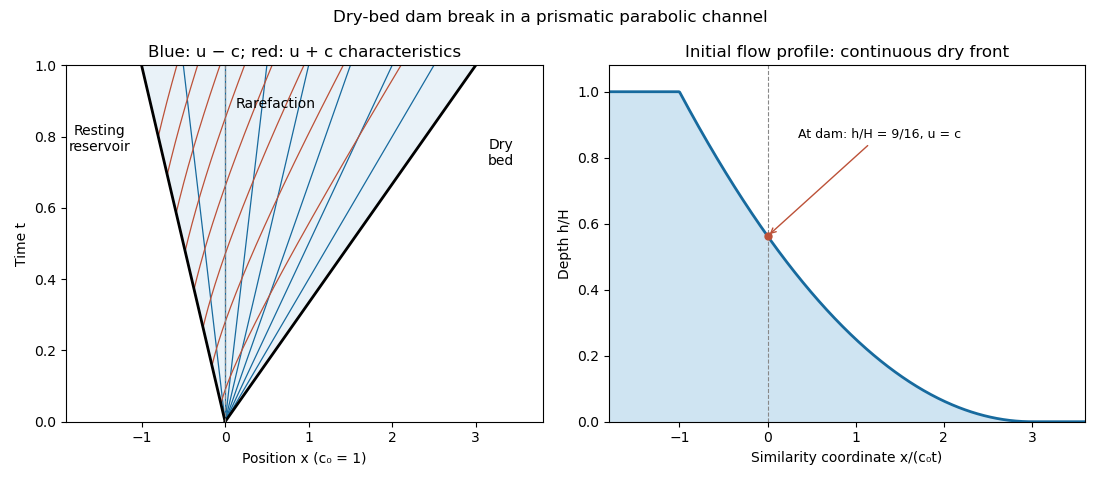
Characteristics and depth profile of the initial dry-bed dam break in a parabolic channel
. Details. 
On the – diagram, the characteristic curves inside the fan are straight rays from the origin. The curves obey , so they have form . The solution describes the period before the finite lake ends and their reflected signals matter. Immediately after failure, near the dam and very near the thin nose, strong vertical acceleration can invalidate the shallow-water approximation. The outer fan becomes appropriate when the horizontal flow scale is large compared with its depth.
Let states and be just left and right of a hydraulic bore moving at speed , and let . Integrating the conservative prismatic-channel shallow water equations across it gives the Rankine-Hugoniot conditionEquivalently the discharge in the shock frame is common on the two sides,Thus, for unequal positive depths,Momentum is conserved through the bore in this ideal model, but mechanical energy is dissipated; an energy-conservation jump must not be imposed as well.
For a stationary bore with rightward flow, , , and the momentum jump must still hold. A compressive hydraulic jump has andThe characteristic curves approach the stationary bore from both sides: upstream flow is supercritical flow, while downstream flow is subcritical flow using the local wave speed . The family travels downstream on both sides. These characteristic directions accompany, rather than replace, the two stationary conservation jumps.
Articles by others on the same topic
There are currently no matching articles.