Combine the real variables into . The linear system of ordinary differential equations becomes , hence for arbitrary real . Taking real and imaginary parts givesThe two independent constants cover every real initial condition. In the phase plane, the distance from the origin grows as and the polar angle changes at rate . For the trajectories are outward logarithmic spirals; for they are outward straight rays.
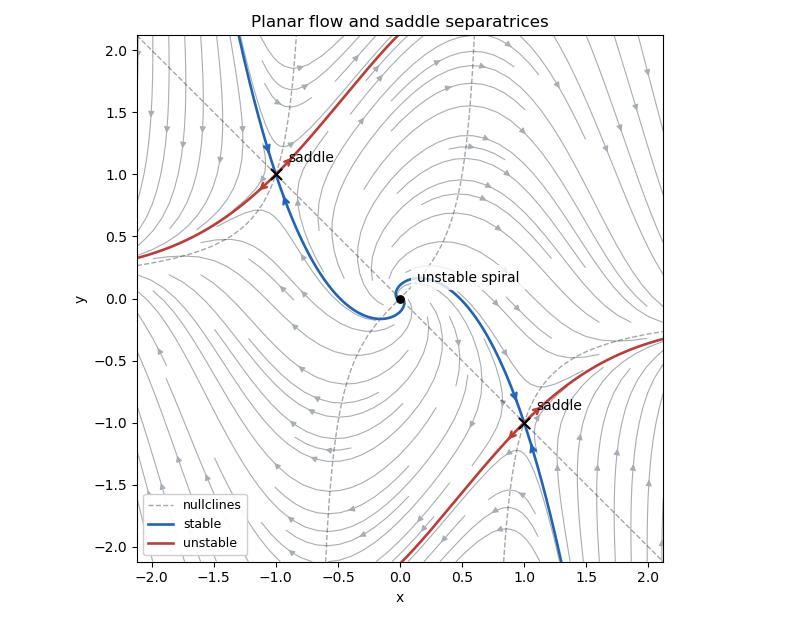
At a fixed point, the first equation gives . Substitution into the second gives , so the equilibrium points are . The Jacobian matrix isAt the origin its eigenvalues are , so the origin is an unstable spiral. The local rotation is clockwise: on the positive -axis the velocity points downward. At either nonzero equilibrium point,Thus both nonzero equilibria are saddles, with eigenvalues . The stable manifold is tangent to , and the unstable manifold to , at each saddle equilibrium. Since all these equilibrium points are hyperbolic, linear stability of a planar equilibrium gives their actual local types.
For the phase portrait, the nullclines are and , the latter defined away from . The horizontal direction has the sign of ; the vertical direction has the sign of . The system is invariant under , so trajectories occur in centrally symmetric pairs. The arrows below show these directions; the highlighted stable manifolds enter the saddle equilibria, whereas the highlighted unstable manifolds leave them.

Articles by others on the same topic
There are currently no matching articles.