In the spherical-collapse model, a bound overdense region initially expands with the background, but its additional Newtonian gravity slows that expansion. Its outer shell reaches a maximum turnaround radius, where its radial velocity is zero, and then falls inward. A perfectly spherical pressureless solution formally collapses to zero radius. In a realistic collisionless system, deviations from that idealization, shell crossing and violent relaxation convert coherent infall into random motions, producing a roughly stationary bound object.
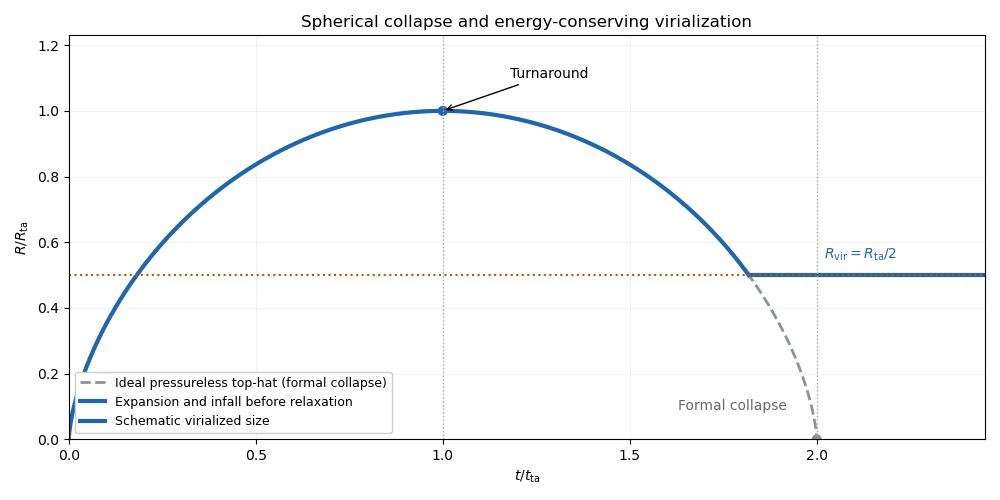

Let the Newtonian gravitational potential energy of the homologous sphere be , where for a uniform sphere. At spherical-collapse turnaround, the kinetic energy of the bulk motion vanishes, so . For the settled object, the virial theorem gives and hence . If energy and mass are conserved and the structure coefficient is unchanged,This is the virial radius from turnaround energy. It assumes negligible external pressure, mass loss and energy exchange. If the final structure coefficient differs, instead. Half the turnaround radius is an idealized equilibrium size, not the radius at which each collisionless particle stops moving. The plotted settling time is schematic; the usual collapse-time convention is .
Use the Einstein-de Sitter universe relations and . Write and . Since ,The dimensionless first integral with zero velocity at is . On the expanding branch this givesEvaluating the integral gives the inverse-trigonometric expression in the source. Alternatively, differentiate it: , so differentiation of the first integral gives exactly the required equation of motion. At , the integral equals . Thus fixes . The collapsing branch is , not the same increasing inverse function.
For the early-time density contrast, expand the integral directly:The leading coefficient in the printed small-radius approximation needs correction to . The printed coefficient is inconsistent with both the exact integral and approach to the homogeneous background. Indeed, the nonlinear density contrast satisfiesHence . In the Einstein-de Sitter universe the growing linear cosmological density perturbation is proportional to , so its extrapolation isThe formal collapse occurs at , giving the linear spherical-collapse thresholdThe actual nonlinear density contrast diverges at collapse; the finite number is the extrapolated linear amplitude. Equivalently, the full spherical-collapse model has and , with turnaround at and formal collapse at . Combining the half-radius estimate with the background-density decrease up to gives .
Articles by others on the same topic
There are currently no matching articles.